
Neo-Banking and Cross-Border Money Transfer Investment | Weinvesta
SEO Title: Neo-Banking and Cross-Border Money Transfer Investment | Weinvesta
Slug: neo-banking-cross-border-money-transfer-investment
Meta Description: Explore Weinvesta’s Neo-Banking and Cross-Border Money Transfer Platform, including its phased launch, revenue model, investment plans, compliance framework and risks.
Excerpt: Discover how Weinvesta plans to build a global digital banking and remittance ecosystem serving freelancers, businesses, travellers and cross-border payment users.
Neo-Banking and Cross-Border Money Transfer: Building a Global Digital Payments Ecosystem
International payments often involve high fees, settlement delays, fragmented currency services and complicated banking procedures. These challenges affect freelancers, travellers, international businesses, non-resident customers and families sending money across borders.
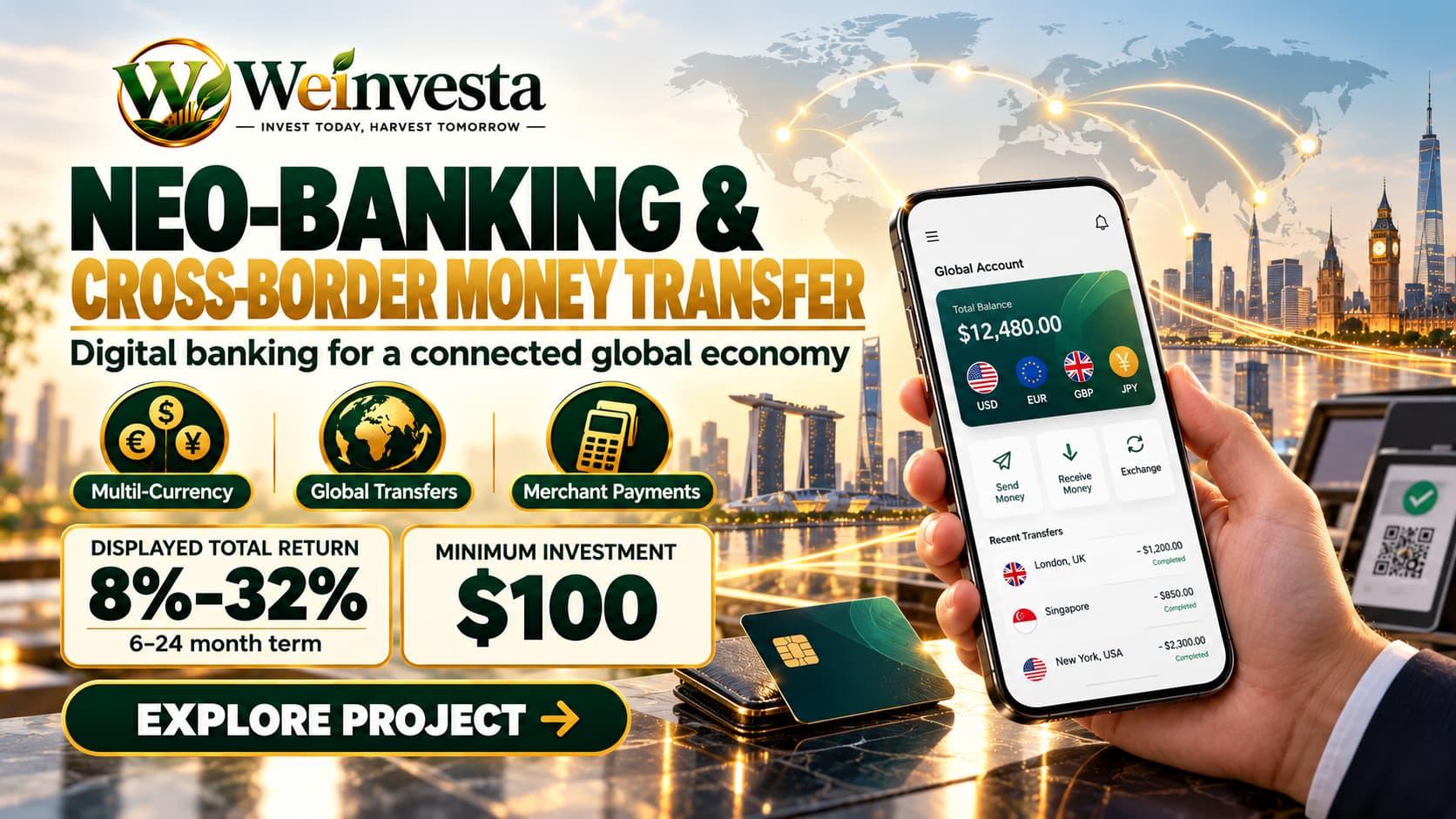
Weinvesta’s Neo-Banking & Cross-Border Money Transfer Platform is designed as a digital financial ecosystem supporting multi-currency accounts, international remittances, merchant payments and cross-border business settlements.
The project plans to combine mobile-first banking technology with licensed financial partners, KYC and AML controls, card services, digital wallets and global payment infrastructure.
Explore the Neo-Banking and Cross-Border Money Transfer Project
Project Overview
Category: Fintech & Payments
Market: Global Digital Services
Status: Active
Target amount: $361,058.43
Project-description target return: 20% total profit
Displayed plan range: 8%–32%
Available terms: 6, 12 or 24 months
Payout schedule: At maturity
Displayed investment range: $100–$1,000,000
Estimated total project requirement: $10.50M–$14.50M
The live project summary and the selectable plan cards present different return figures. Review the current project page, attached documents and applicable plan before making a decision.
What Is a Neo-Banking Platform?
A neo-bank generally delivers financial services through mobile applications and digital infrastructure instead of relying primarily on physical branches.
Depending on licences, regulated partners and available services, a digital banking platform may provide:
Multi-currency accounts
Domestic and international transfers
Digital wallets
Virtual or physical payment cards
Merchant payment gateways
Freelancer and contractor payouts
Foreign-currency exchange
Business settlement tools
Transaction monitoring and support
The availability of each service depends on licensing, partner-bank relationships, local regulations and customer eligibility.
Who Could Use the Platform?
The planned ecosystem is positioned to serve:
Non-resident customers
International freelancers
Remote workers and contractors
Travellers and medical tourists
Importers and exporters
Online merchants
Small and medium-sized businesses
Families sending international remittances
Cross-border trade participants
The platform aims to reduce friction between payment initiation, currency conversion, settlement and withdrawal.
Two-Phase Development Strategy
Phase 1: Launch Through a Licensed Partner
The first phase plans to use a licensed Banking-as-a-Service or parent-licence provider.
Planned Phase 1 components include:
Mobile banking application
Customer onboarding
Identity verification
KYC and AML systems
Card issuing
Digital wallets
Remittance connections
Merchant payments
Compliance monitoring
Customer-support centre
Transaction and fraud monitoring
Using a licensed partner may support faster market entry, but the platform would remain dependent on the partner’s licence, infrastructure and risk policies.
Phase 2: Independent Licensing and Expansion
After achieving customer traction and compliance maturity, the project plans to pursue its own applicable banking, payment or electronic-money licensing.
Phase 2 may include:
Regulatory capital
Independent treasury systems
Expanded multi-currency infrastructure
Additional business-payment tools
Broader card and merchant services
Controlled microfinance products
More direct management of compliance and liquidity
Independent licensing is not automatic and remains subject to regulatory approval.
How Cross-Border Transfers Could Work
A typical transaction may follow these steps:
A customer creates an account.
Identity and compliance checks are completed.
The customer funds a wallet or linked account.
The platform displays the applicable exchange rate and fee.
Funds are converted or routed through an authorised payment corridor.
The receiving customer, merchant or business receives the settlement.
The transaction is monitored and recorded for compliance purposes.
Processing time, fees and availability may vary by currency, country, payment partner and regulatory requirements.
Potential Revenue Sources
Remittance Fees
The platform may charge a transaction fee for eligible domestic or international transfers.
Foreign-Exchange Spread
Revenue may be generated from the difference between currency acquisition and customer conversion rates.
Card Interchange
The platform may receive a portion of interchange revenue when eligible customers use issued cards.
Merchant Settlement
Businesses may pay fees for accepting payments, currency conversion and receiving settlements.
Wallet Services
Revenue may arise from selected wallet transactions, account features or business services.
ATM and Card Fees
Eligible withdrawals, replacements or specialised card services may carry fees.
Freelancer and Business Payouts
The platform may provide payout infrastructure for marketplaces, employers and international businesses.
Compliant Credit Products
Subject to licensing, credit assessment and consumer-protection requirements, revenue may be generated from approved financing products.
Emergency Micro-Loan Feature
The project description states that eligible active investors may be considered for emergency micro-loans of up to 80% of invested principal while capital remains locked.
This should not be interpreted as an automatic entitlement or guaranteed credit facility. Approval would remain subject to:
Product availability
Credit assessment
Identity verification
AML and sanctions checks
Applicable lending regulations
Affordability assessment
Platform and partner policies
Interest, fees and repayment terms
Borrowing against an investment could create additional repayment obligations while the underlying capital remains illiquid.
Displayed Investment Options
Term Displayed total profit Investment range Payout 6 months 8% $100–$1,000,000 At maturity 12 months 16% $100–$1,000,000 At maturity 24 months 32% $100–$1,000,000 At maturity
The plan cards currently show an investment range starting at $100. A separate project-description paragraph states a $1,000 minimum. Confirm the applicable minimum on the live page or with the Weinvesta team before participating.
Displayed returns are project targets and do not guarantee future results.
Compare Weinvesta Investment Plans
Principal Risks
Regulatory and Licensing Risk
Approvals may be delayed, restricted or refused by relevant authorities.
Partner Dependency
Phase 1 depends on licensed banking, card, payment and compliance partners. A partner may change its terms or terminate the relationship.
AML, KYC and Sanctions Risk
Weak customer verification or transaction monitoring could lead to financial loss, restrictions or enforcement action.
Cybersecurity Risk
The platform may face phishing, malware, account takeover, ransomware and infrastructure attacks.
Fraud and Chargebacks
Unauthorised payments, identity fraud and merchant disputes may increase operating losses.
Data-Privacy Risk
A breach involving identity, transaction or financial information could result in claims, regulatory penalties and reputational damage.
Liquidity and Treasury Risk
The platform must manage customer flows, currency conversion and settlement obligations carefully.
Foreign-Exchange Risk
Exchange-rate movements may affect transaction margins and treasury positions.
Consumer-Protection Risk
Fees, lending products and customer communications must meet applicable consumer-protection standards.
Technology and Service Risk
Software defects, outages and third-party infrastructure failures may interrupt payment services.
Read the Weinvesta Risk Disclosure, Terms and Conditions and project documents before participating.
How to Explore the Project
Open the Neo-Banking project page.
Review the business model and two-phase rollout.
Examine licensing and partner dependencies.
Compare the 6-, 12- and 24-month options.
Confirm the applicable minimum investment.
Read the Weinvesta Whitepaper.
Learn how Weinvesta works.
Review the risks and consider independent financial, legal and tax advice.
Use the investment button linked to the selected plan only after reviewing its current terms.
Frequently Asked Questions
What is the project designed to build?
A mobile-first digital banking and remittance platform supporting multi-currency accounts, cross-border transfers, cards, wallets and merchant payments.
Is Weinvesta already an independently licensed bank?
The project description presents a phased model. Phase 1 plans to use a licensed partner, while Phase 2 proposes seeking independent licensing after reaching sufficient compliance maturity and customer traction.
What investment plans are displayed?
The live plan cards display 8% for six months, 16% for 12 months and 32% for 24 months.
When are payouts scheduled?
The displayed options state that payouts are scheduled at maturity.
Is the micro-loan feature guaranteed?
No. Any financing would be subject to product availability, eligibility, credit checks, compliance controls and applicable laws.
Are investment returns guaranteed?
No. Actual outcomes may be affected by licensing, regulation, cybersecurity, fraud, liquidity, foreign-exchange movements, partner relationships, operating performance and other risks.
Explore the Neo-Banking Project
The project aims to combine mobile financial technology, regulated partnerships and cross-border payment infrastructure to serve individuals and businesses participating in the global digital economy.
💳 View the Project and Investment Options

Ready to Grow Your Wealth?
Put your capital behind real-world projects with real assets behind them.