
Scrap Metal Recycling Investment Project | Weinvesta
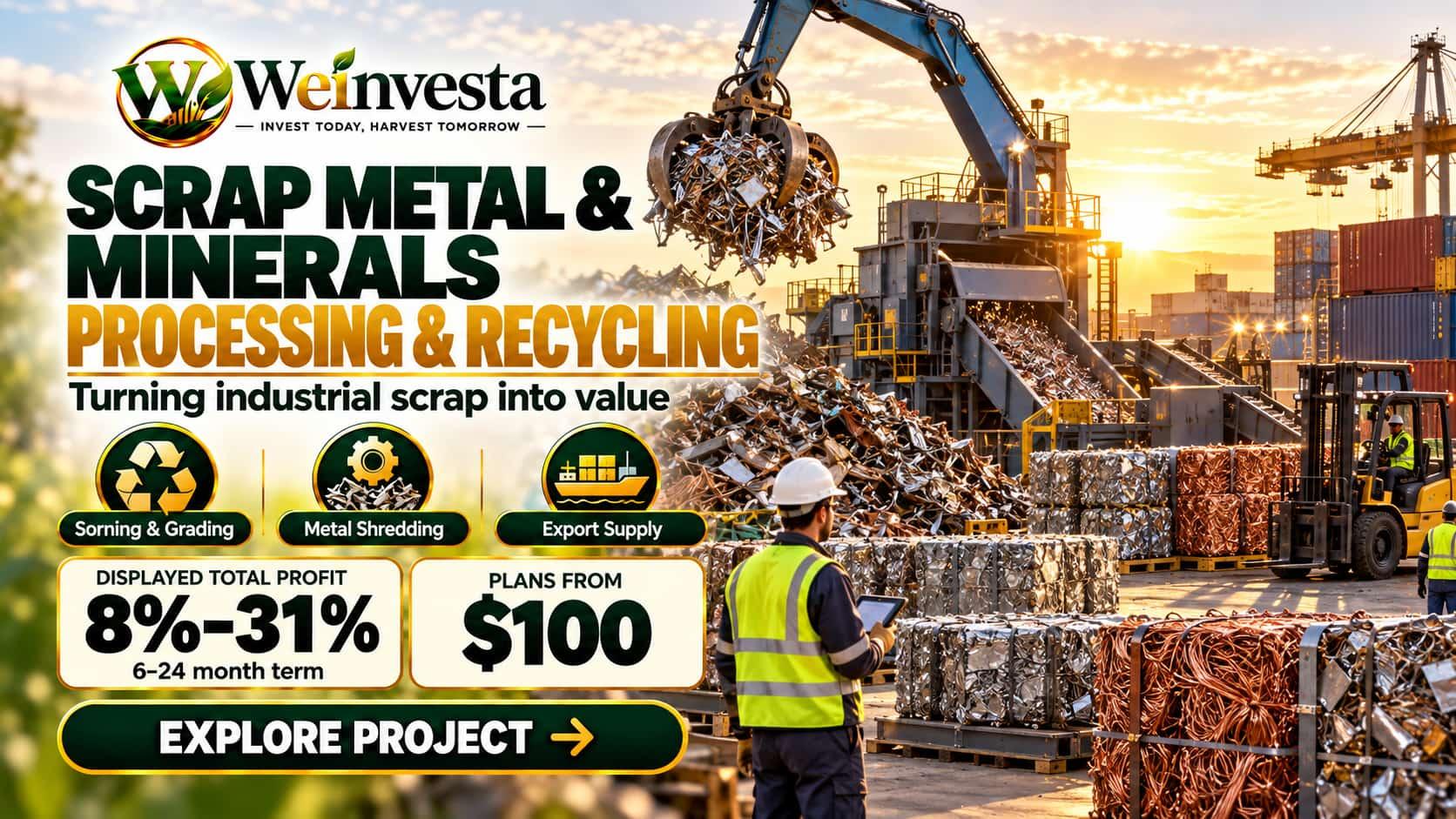
Scrap Metal & Minerals Processing: Building Value Through Industrial Recycling
Scrap metal is not simply discarded material. When properly collected, sorted and processed, it can become an important industrial resource for steel mills, manufacturers, construction companies and international buyers.
Weinvesta’s Scrap Metal & Minerals Processing & Recycling Project proposes an industrial facility specializing in the recovery, sorting, shredding and preparation of ferrous and non-ferrous metals for manufacturing and export markets.
The planned markets include the United Arab Emirates, Turkey, India, Vietnam and Georgia.
Explore the Scrap Metal & Minerals Processing Project
Project overview
Category: Heavy Industry & Metals
Status: Active
Target amount: $149,403.49
Raised so far: $0.00
Funding progress: 0%
Maximum return shown in the supplied plan information: 31%
Terms included in the supplied information: 6, 12 or 24 months
Displayed investment range in the supplied cards: $100–$1,000,000
Payout schedule: At maturity
Maximum lock period: 24 months
Estimated full project requirement: $5 million–$6 million
Funding progress, plan availability and applicable terms may change. Review the live project page and final agreement before making a decision.
What is the Scrap Metal & Minerals Processing Project?
The project proposes an industrial recycling operation that purchases fragmented supplies of scrap metal and processes them into standardized, export-ready materials.
The planned operating model includes:
Purchasing ferrous and non-ferrous scrap
Transporting materials to a controlled recycling yard
Inspecting and weighing incoming loads
Separating metals by type and quality
Removing unsuitable or contaminated materials
Shredding light scrap
Recovering higher-value non-ferrous metals
Preparing standardized product grades
Loading processed materials into containers
Exporting shipments to repeat industrial buyers
The objective is to improve the consistency, traceability and resale value of locally collected scrap.
Ferrous and non-ferrous metals
Ferrous metals
Ferrous scrap contains iron and may include:
Steel structures
Construction scrap
Industrial equipment
Vehicle components
Machinery parts
Metal sheets and beams
Manufacturing offcuts
Processed ferrous material may be supplied to steel mills and re-rolling facilities.
Non-ferrous metals
Non-ferrous materials may include:
Aluminium
Copper
Brass
Stainless steel
Zinc
Lead
Selected industrial alloys
These materials can carry different market values and require accurate sorting to prevent contamination and buyer rejection.
Proposed facility and equipment
The business plan proposes establishing an industrial recycling yard with:
Warehouse and material-storage space
Recycling and sorting areas
Truck fleet
Grabber crane
Weighing and inspection systems
Manual and mechanical sorting equipment
Medium-sized metal shredder
Container-loading equipment
Safety and environmental-control systems
Working capital for the first 5,000 tonnes
The medium-sized shredder is intended to reduce the initial capital burden while increasing the resale value of light scrap.
Planned operating cycle
The project’s commercial model is based on purchasing, processing and exporting material through recurring shipment cycles.
The first shipment may require approximately 60 days because buyers may need to inspect and approve the quality specification.
Following initial approval, the project targets:
Shipment cycles of approximately 30–40 days
Processing volume of up to 5,000 tonnes per month
Repeat relationships with export buyers
Standardized product quality
Faster inventory turnover
Recurring containerized shipments
These are operational targets, not guaranteed outcomes. Actual performance may be affected by material availability, buyer approval, equipment capacity, working capital and shipping conditions.
How the project may generate revenue
Buy-sell margin
The business may generate income from the difference between the cost of purchasing unprocessed scrap and the sale price of processed material.
Quality improvement
Sorting and grading can improve buyer confidence and allow materials to be sold according to recognized commercial specifications.
Shredding and preparation
Shredding light scrap may increase density, reduce transportation inefficiency and improve resale value.
Non-ferrous recovery
Recovering aluminium, copper and other non-ferrous materials from mixed scrap may create higher-value revenue streams.
Volume turnover
Commercial performance depends not only on profit per tonne but also on how efficiently inventory is processed and sold.
Export contracts
Repeat buyers and containerized export contracts may help create recurring shipment cycles, subject to quality approval and international trade conditions.
Connection with steel manufacturing
Processed ferrous scrap can become an input for steel production and re-rolling operations.
This creates a potential relationship between the scrap-processing facility and the Steel Manufacturing & Re-Rolling Mills Project.
Possible benefits of this integration include:
More consistent raw-material supply
Better material traceability
Reduced dependence on third-party scrap traders
Improved control over scrap quality
Potentially shorter supply chains
Additional demand for processed ferrous material
Explore other opportunities in the Heavy Industry and Metals category.
Commercial strategy
The project’s proposed commercial strategy focuses on five principal areas.
Reliable procurement
The business must establish a network of scrap collectors, demolition contractors, manufacturers, workshops and commercial suppliers.
Accurate sorting
Careful separation is required to maintain product quality and reduce rejection risk.
Repeat export buyers
Long-term relationships with verified buyers may support recurring shipments and more predictable sales cycles.
Efficient working-capital turnover
Cash may remain tied up while scrap is purchased, processed, stored, shipped and approved by buyers. Efficient inventory turnover is therefore essential.
Logistics coordination
The project must coordinate trucks, yard operations, containers, ports, customs documentation and shipping schedules.
The Transport, Cold-Chain and Maritime Logistics Project provides additional context on Weinvesta’s broader logistics strategy.
Investment options included in the supplied information
Six-month option
Total profit shown: 8%
Lock period: 6 months
Investment range shown: $100–$1,000,000
Instant bonus: 0%
Payout: At maturity
Twelve-month option
Total profit shown: 16%
Lock period: 12 months
Investment range shown: $100–$1,000,000
Instant bonus: 0%
Payout: At maturity
Twenty-four-month option
Total profit shown: 31%
Lock period: 24 months
Investment range shown: $100–$1,000,000
Instant bonus: 0%
Payout: At maturity
Review the current project and available investment option
These figures are based on the supplied plan information and do not guarantee future results.
Important information about the published figures
Different sections of the website and supplied project information currently show different terms:
The supplied cards list 8%, 16% and 31% options for 6, 12 and 24 months.
The general projects listing describes the project as offering a return of up to 31%.
The current dedicated project page displays a 19% plan with a 24-month lock.
The longer project description also mentions a $1,000 minimum investment and a 19% target total profit.
The supplied investment cards show a range beginning at $100.
Because these figures are not fully aligned, investors should not rely on an isolated percentage or promotional summary.
Before proceeding:
Open the live project page.
Confirm which plan is currently selectable.
Review the investment amount, return, lock period and payout terms.
Read the applicable agreement.
Ask the Weinvesta support team to clarify any discrepancy.
The final selected plan and signed agreement should be treated as the controlling information.
Principal project risks
Commodity-price volatility
Scrap-metal prices may change due to industrial demand, global steel prices, construction activity, energy costs and international trade conditions.
Buyer rejection
A buyer may reject or discount a shipment if the material does not meet the agreed specification.
Contamination
Mixed metals, prohibited material, oil, moisture, dirt or other contaminants can reduce value and create safety or compliance issues.
Working-capital pressure
Funds may remain locked in purchased inventory while materials are processed, shipped and approved.
Machinery breakdown
Shredders, cranes, trucks and sorting equipment may require repairs that interrupt production.
Theft and inventory loss
Scrap yards may be exposed to material theft, inaccurate weighing or inventory discrepancies.
Environmental compliance
Licences may be required for waste handling, emissions, noise, drainage, storage and industrial operations.
Export-documentation delays
Incorrect customs documents, certificates or shipping records may delay containers or create additional costs.
Container availability
A shortage of suitable containers or port capacity may delay shipment cycles.
Yard-safety incidents
Heavy machinery, sharp materials, fires and moving vehicles create occupational safety risks.
Foreign-exchange movement
Purchases and international sales may occur in different currencies, exposing the business to exchange-rate fluctuations.
Supplier and buyer concentration
Dependence on a limited number of scrap suppliers or export buyers may weaken negotiating power.
Review the complete Risk Disclosure, Terms and Conditions and project documents before participating.
Sustainability and circular-economy value
Metal recycling can reduce the need to discard reusable industrial material and return recovered metals to manufacturing supply chains.
The project’s potential circular-economy contributions include:
Recovering materials from industrial waste
Extending the useful life of metal resources
Supplying recycled inputs to manufacturing
Reducing uncontrolled scrap disposal
Supporting standardized waste collection
Improving material traceability
Connecting recycling with steel production
Environmental benefits depend on responsible waste handling, pollution controls, worker safety and regulatory compliance.
How to explore the project
Review the current status and funding information.
Confirm which investment plan is currently available.
Study the business plan, prospectus and risk documents.
Read the Weinvesta Whitepaper.
Compare the available investment plans.
Evaluate the term against your objectives and risk tolerance.
Create an account and complete the required verification.
Use the investment button associated with the verified plan.
Monitor available updates through your account.
New users can read How Weinvesta Works.
Related projects and resources
Readers researching industrial recycling and manufacturing may also explore:
Frequently asked questions
What materials will the project process?
The planned facility will process ferrous and non-ferrous scrap, including steel, aluminium, copper and other commercially recoverable metals.
Which countries are included?
The United Arab Emirates, Turkey, India, Vietnam and Georgia.
What is the project’s target amount?
The displayed funding target is $149,403.49.
What return is currently displayed?
The current dedicated project page displays 19% for 24 months, while other supplied and portfolio information shows options up to 31%. Confirm the applicable live plan before investing.
What is the investment minimum?
The dedicated project description mentions $1,000, while supplied plan cards begin at $100. Confirm the minimum shown on the selected live plan and final agreement.
When are payouts scheduled?
The available plan information states that payouts occur at maturity.
What is the planned monthly processing volume?
The business plan targets up to 5,000 tonnes per month after the initial buyer-approval cycle. This is an operational target, not a guaranteed result.
Are returns guaranteed?
No. Results may be affected by commodity prices, buyer approval, material quality, operating costs, export logistics, equipment performance and other risks.
Explore industrial recycling
The Scrap Metal & Minerals Processing & Recycling Project aims to transform fragmented scrap supplies into standardized materials for manufacturing and export markets.
Its commercial performance will depend on disciplined purchasing, accurate sorting, reliable equipment, efficient working-capital turnover and repeat buyer relationships.
♻️ Explore the project and verify the current investment option

Ready to Grow Your Wealth?
Put your capital behind real-world projects with real assets behind them.