
Steel Manufacturing & Re-Rolling Mill Investment | Weinvesta
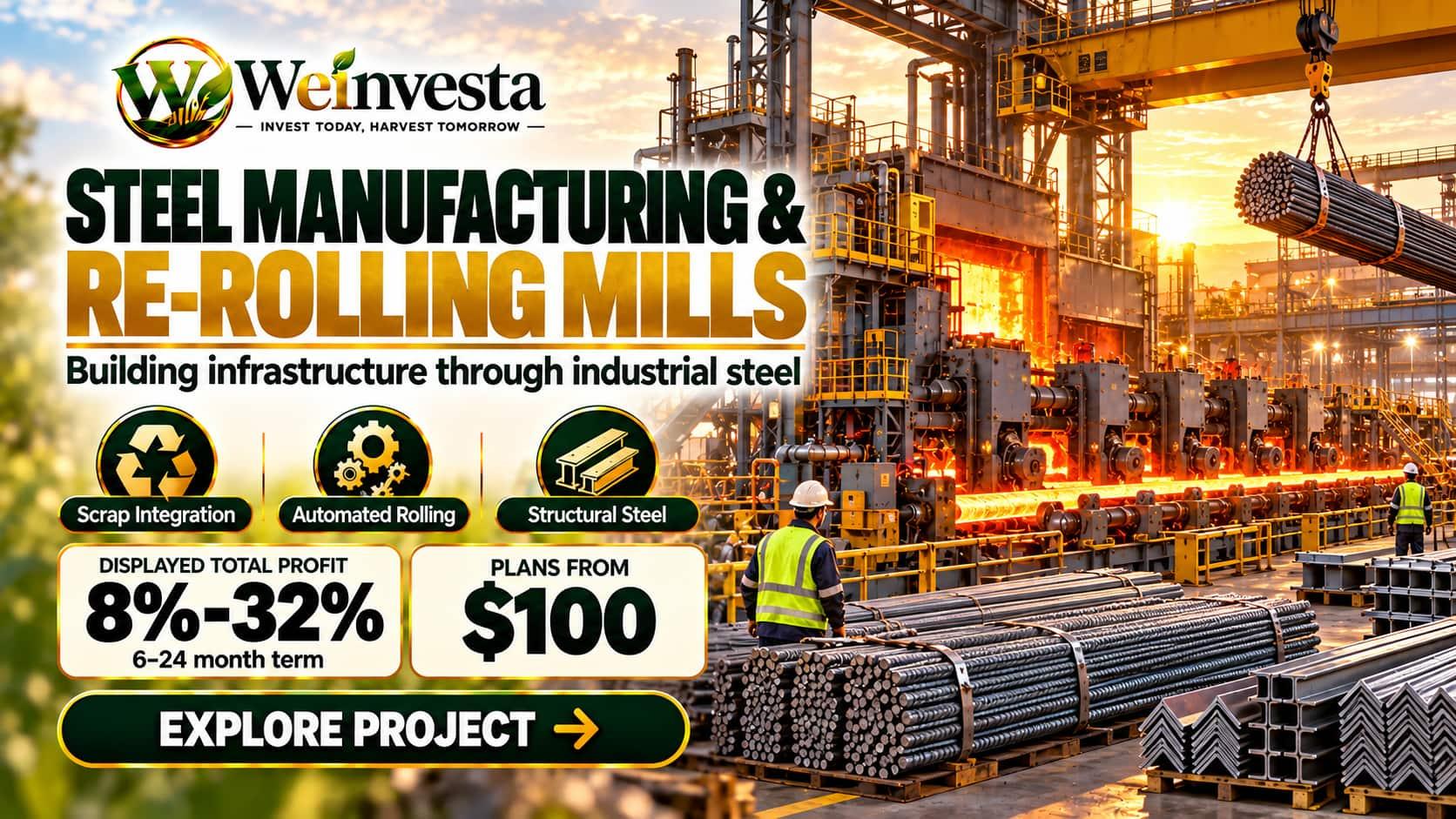
Steel Manufacturing & Re-Rolling Mills: Supporting Infrastructure Through Industrial Steel Production
Steel is one of the most important materials used in modern infrastructure. Residential buildings, commercial developments, factories, bridges, transport networks, and energy projects all depend on reliable supplies of structural steel.
The Steel Manufacturing & Re-Rolling Mills Project presented by Weinvesta plans to establish a high-capacity industrial facility capable of converting scrap metal and steel billets into rebar, angle bars, and other structural steel sections.
The project belongs to the Heavy Industry & Metals sector, with planned activities connected to India, the UAE, Saudi Arabia, Turkey, and Vietnam.
Explore the Steel Manufacturing & Re-Rolling Mills Project
Project Overview
Sector: Heavy Industry & Metals
Status: Active
Target amount: $498,011.62
Displayed total-profit range: 8%–32%
Available terms: 6, 12, or 24 months
Displayed investment range: $100–$1,000,000
Payout schedule: On maturity
Maximum displayed term: 24 months
Project locations: India, UAE, Saudi Arabia, Turkey, and Vietnam
Principal products: Rebar, angle bars, and structural steel sections
Funding progress, availability, terms, and figures may change. Always review the live project page before making a decision.
What Is a Steel Re-Rolling Mill?
A steel re-rolling mill converts billets, scrap-derived steel, or semi-finished steel into standardized construction products. These products can include reinforcement bars, angle bars, flat bars, channels, and other industrial sections.
A typical production process may include:
Sourcing or preparing scrap metal and steel billets.
Melting and refining scrap where furnace operations are included.
Heating billets in a reheating furnace.
Passing heated material through rolling stands.
Forming the steel into the required dimensions.
Cutting and transferring products to a cooling bed.
Conducting mechanical and chemical quality tests.
Bundling, storing, and dispatching finished products.
The project plans to begin with rebar and basic structural sections before considering expansion into higher-margin steel products.
Why Steel Demand Matters
Steel demand is closely connected to construction, infrastructure, industrialization, and urban development. Rebar and structural sections are required for:
Residential and commercial construction
Roads, bridges, and transport infrastructure
Industrial buildings and warehouses
Energy and utility projects
Real-estate development
Public infrastructure
Manufacturing facilities
The project intends to serve contractors, developers, infrastructure projects, wholesalers, and steel distributors.
Backward Integration with Scrap Recycling
One of the project’s principal strategic features is its proposed connection with scrap-metal processing.
The related Scrap Metal & Minerals Processing & Recycling Project is designed to collect, sort, shred, and prepare ferrous and non-ferrous materials.
This relationship may help the steel operation:
Access a more organized scrap supply
Improve raw-material traceability
Reduce dependence on fragmented suppliers
Maintain greater control over material quality
Recover value from recyclable industrial metals
Support a circular industrial production model
However, integration does not eliminate scrap-price, quality, supply, or operational risks.
Planned Business Model
The business plan includes developing or securing:
Scrap-melting or billet-procurement capacity
Reheating furnaces
Automated rolling-mill equipment
Cutting and sizing systems
Cooling beds
Product-testing facilities
Bundling and storage systems
Loading and dispatch infrastructure
Environmental and emissions-control systems
The project plans to enter the market with widely used products such as construction rebar and basic steel sections. Production may later expand according to market demand, technical capability, and available capital.
Commercial Strategy
The planned commercial strategy focuses on supplying:
Construction contractors
Property developers
Infrastructure projects
Industrial manufacturers
Steel wholesalers
Building-material distributors
Government or institutional projects, where eligible
Commercial performance will depend on production efficiency, steel prices, raw-material costs, energy expenses, quality certification, customer relationships, and market demand.
Displayed Investment Options
6-Month Option
Displayed total profit: 8%
Lock period: 6 months
Investment range: $100–$1,000,000
Payout: On maturity
12-Month Option
Displayed total profit: 16%
Lock period: 12 months
Investment range: $100–$1,000,000
Payout: On maturity
24-Month Option
Displayed total profit: 32%
Lock period: 24 months
Investment range: $100–$1,000,000
Payout: On maturity
The source project description separately refers to a 20% target total profit for its underlying business plan. This is different from the displayed plan cards showing 8%, 16%, and 32%. Review the live project page and applicable agreement to confirm which figures and conditions apply before investing.
View the Project and Related Investment Options
Key Project Risks
Energy Costs
Steel manufacturing and re-rolling consume substantial electricity and thermal energy. Higher energy prices may reduce operating margins.
Raw-Material Price Volatility
The prices of scrap metal and billets can fluctuate because of supply, trade conditions, commodity markets, and demand.
Machinery Breakdown
Furnaces, rolling stands, cutting systems, and cooling equipment require regular maintenance. Equipment failure may interrupt production.
Environmental Compliance
Steel operations may require permits and controls relating to emissions, wastewater, noise, heat, dust, and solid waste.
Workplace Safety
High temperatures, molten material, heavy machinery, and moving steel create significant industrial safety risks.
Construction-Market Slowdown
Demand for rebar and structural sections may decline if infrastructure or real-estate activity slows.
Working-Capital Requirements
The business may require substantial capital to purchase raw materials, maintain inventory, pay energy costs, and extend commercial credit.
Regulatory Approvals
Construction standards, environmental permits, factory licensing, labor rules, and product-quality certification may affect operations.
Read Weinvesta’s Risk Disclosure, Terms and Conditions, and available project documents before participating.
How to Explore the Project
Review the project description and available documents.
Compare the 6-, 12-, and 24-month options.
Examine the risk disclosure and applicable terms.
Select the option compatible with your objectives and risk tolerance.
Create a Weinvesta account and complete any required verification.
Use the investment button displayed under the relevant project option.
New users can also read How Weinvesta Works, compare Investment Plans, and review the Weinvesta Whitepaper.
Frequently Asked Questions
What will the project manufacture?
The project plans to manufacture construction rebar, angle bars, and other structural steel sections.
Which countries are associated with the project?
India, the UAE, Saudi Arabia, Turkey, and Vietnam.
What returns are displayed?
The project page displays 8% for 6 months, 16% for 12 months, and 32% for 24 months.
When are payouts scheduled?
According to the displayed options, payouts are scheduled at maturity.
How much can be allocated?
The displayed plans range from $100 to $1,000,000. Availability and eligibility should be verified on the live project page.
Are returns guaranteed?
No. Results may be affected by steel prices, raw-material costs, energy expenses, demand, equipment performance, regulation, safety incidents, and other risks.
Explore the Steel Manufacturing Project
By connecting scrap recovery, industrial processing, steel production, and construction demand, the project aims to establish an integrated heavy-industry value chain.
🏭 Explore the Project and Investment Options

Ready to Grow Your Wealth?
Put your capital behind real-world projects with real assets behind them.