
Organic Banana Fiber & Musa Silk Project: Turning Agricultural Waste into Sustainable Materials
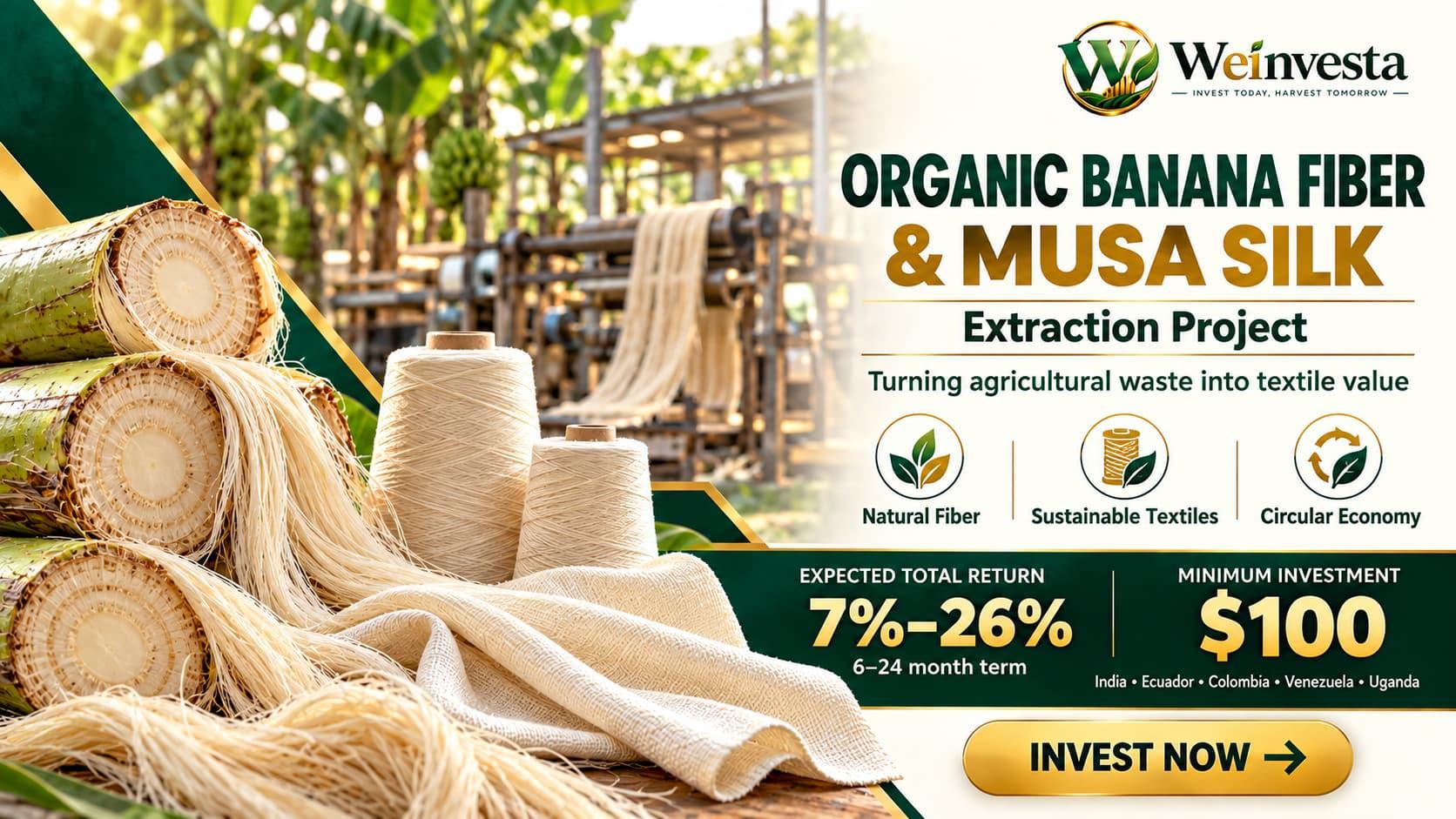
Organic Banana Fiber & Musa Silk Project: Turning Agricultural Waste into Sustainable Materials
Banana farming produces large quantities of pseudostems after the fruit has been harvested. These stems are often left in fields or discarded as agricultural waste, despite containing strong natural fibers that can be used in textiles, paper, packaging, handicrafts, and other sustainable products.
The Organic Banana Fiber & Musa Silk Extraction Project from Weinvesta aims to collect discarded banana pseudostems and transform them into high-tensile banana fiber, refined Musa silk, and biodegradable plant-based materials.
The project belongs to the Recycling & Circular Economy sector, with planned operations across India, Ecuador, Colombia, Venezuela, and Uganda.
Project Overview
Project: Organic Banana Fiber & Musa Silk Extraction Project
Category: Recycling & Circular Economy
Status: Active
Target Amount: $50,000
Displayed Return Range: 7%–26%
Available Terms: 6, 12, or 24 months
Payout Schedule: On maturity
Displayed Investment Range: $100–$1,000,000
Planned Countries: India, Ecuador, Colombia, Venezuela, and Uganda
Target Markets: Sustainable fashion, textiles, handicrafts, paper, packaging, and international buyers
Funding progress and investment conditions may change. Always review the live project page before making a financial decision.
What Are Banana Fiber and Musa Silk?
Banana fiber is a natural plant-based material extracted from the fibrous layers of banana pseudostems. After the fruit has been harvested, the remaining stem can be collected and processed instead of being discarded.
The characteristics of the final product depend on the extraction and refinement process. Potential products include:
Raw banana fiber
Washed and dried fiber
Semi-processed natural fiber
Refined textile-grade fiber
Blended yarn inputs
Banana silk or Musa silk
Eco-paper raw materials
Biodegradable packaging materials
Handicraft and decorative products
The term Musa silk generally refers to fine and often lustrous fibers extracted from plants within the Musa genus, which includes bananas. These fibers may be used in sustainable fashion, luxury textiles, handicrafts, and specialty products.
Turning Agricultural Waste into Economic Value
The project follows a circular-economy model. Instead of treating banana pseudostems as waste, it aims to collect and convert them into commercially usable materials.
The planned production process includes:
Collecting pseudostems from banana farms.
Transporting the raw material to the processing facility.
Cutting and preparing the stems.
Extracting fiber using decorticator machines.
Washing and removing plant residue.
Drying the fibers under controlled conditions.
Degumming and refining the material.
Sorting fibers by length and quality.
Baling and packing the finished fiber.
Supplying domestic and export buyers.
This model could help reduce agricultural waste while creating a new source of plant-based raw materials for manufacturers.
Business Plan and Proposed Equipment
The project’s business plan involves installing the infrastructure required to collect, process, grade, and package banana fiber.
Proposed facilities and equipment include:
Fiber-extraction decorticator machines
Pseudostem cutting and preparation equipment
Washing and cleaning units
Drying facilities
Degumming systems
Fiber grading and sorting equipment
Baling presses
Weighing and packaging units
Raw-material and finished-product storage
Collection trucks or agricultural gondolas
The project plans to begin with raw and semi-processed fiber sales before gradually moving into higher-value products such as refined fiber, blended yarn inputs, Musa silk, and eco-packaging materials.
Potential Revenue Streams
The project may develop several revenue streams rather than depending on a single product.
Raw Banana Fiber
Extracted, washed, and dried fiber can be supplied to paper manufacturers, textile processors, handicraft producers, and other industrial buyers.
Refined Fiber
Cleaned, graded, and refined fibers may command a higher value than raw fiber, particularly when they meet textile-grade requirements.
Musa Silk
Fine and lustrous banana fibers may be used in sustainable apparel, decorative textiles, luxury crafts, and specialty fabric production.
Blended Yarn Inputs
Banana fiber may be blended with cotton, jute, hemp, or other natural fibers to produce yarns and fabrics with different characteristics.
Eco-Paper and Packaging
Shorter fibers or grades unsuitable for textiles may be used in paper, molded packaging, biodegradable wrapping, and other eco-friendly products.
Export Sales
The commercial strategy also targets international buyers in sustainable fashion, natural textiles, paper, packaging, and handicrafts.
Target Markets
The project’s commercial strategy focuses on multiple sectors:
Sustainable fashion brands
Natural textile manufacturers
Yarn and fabric producers
Handicraft businesses
Eco-paper manufacturers
Biodegradable packaging companies
Plant-based raw-material distributors
International importers and exporters
Serving multiple industries may reduce dependence on a single customer group. However, diversification does not remove risks relating to demand, pricing, certification, or competition.
Displayed Investment Options
The project page currently presents three term-based options.
6-Month Option
Displayed Total Profit: 7%
Lock Period: 6 months
Instant Bonus: 0%
Payout: On maturity
Displayed Investment Range: $100–$1,000,000
12-Month Option
Displayed Total Profit: 13%
Lock Period: 12 months
Instant Bonus: 0%
Payout: On maturity
Displayed Investment Range: $100–$1,000,000
24-Month Option
Displayed Total Profit: 26%
Lock Period: 24 months
Instant Bonus: 0%
Payout: On maturity
Displayed Investment Range: $100–$1,000,000
These figures represent the plans displayed on the project page when this article was prepared. Investors should review the current documents and terms before participating.
Displayed or projected returns should not be interpreted as guarantees of future performance.
You can compare additional opportunities on the Weinvesta Investment Plans page.
Why Is This a Circular-Economy Project?
A circular economy seeks to keep materials in productive use for as long as possible rather than discarding them after a single purpose has been completed.
This project applies that principle by:
Collecting banana farming residues
Converting discarded stems into commercial fiber
Reducing agricultural waste
Supporting biodegradable materials
Creating plant-based alternatives for selected products
Adding a potential revenue source to banana farming
Using different fiber grades across multiple industries
Explore other related opportunities through the Recycling & Circular Economy Projects page.
Factors That May Support the Project
Low-Cost Raw Material
Banana pseudostems are agricultural byproducts rather than crops cultivated specifically for fiber production. This may reduce raw-material acquisition costs when collection is managed efficiently.
Multiple Applications
Banana fiber can potentially be used in textiles, paper, packaging, handicrafts, composite materials, and other sustainable products.
Agricultural Waste Recovery
The project seeks to create commercial value from material that farmers may otherwise leave in fields or dispose of.
Value-Addition Potential
Operations may begin with raw fiber and progress toward refined fibers, blended yarn inputs, Musa silk, and finished materials with higher commercial value.
ESG and Sustainability Alignment
Waste recovery, resource efficiency, biodegradable materials, and plant-based production can support environmental and circular-economy objectives.
These factors may create opportunities, but they do not guarantee commercial success.
Key Project Risks
Prospective investors should review the operational and commercial risks carefully.
Inconsistent Raw-Material Supply
The availability of banana pseudostems may vary according to harvest seasons, regional production, supply agreements, and transportation distances.
Fiber-Quality Variation
Fiber strength, color, length, and texture may differ depending on the banana variety, plant age, storage conditions, extraction timing, and processing quality.
Drying Constraints
Heavy rainfall and high humidity may slow the drying process or affect the color, moisture level, strength, and overall quality of the fibers.
Buyer-Qualification Delays
International manufacturers may require samples, laboratory testing, production audits, or certifications before accepting commercial volumes.
Machinery Maintenance
Decorticator machines and other processing equipment require regular cleaning and maintenance. Equipment failure could delay production and increase costs.
Labor Intensity
Collection, loading, transportation, washing, drying, grading, and packing may require substantial manual labor.
Export Certification
Depending on the destination market, the project may need quality, sustainability, origin, processing, or product-compliance certifications.
Transportation Costs
Fresh banana pseudostems contain significant moisture and can be heavy and bulky before processing. Transporting them over long distances could increase operating costs.
Competition From Other Fibers
Banana fiber competes with cotton, jute, hemp, bamboo, pineapple fiber, synthetic textiles, and other natural materials.
Before participating, review the Weinvesta Risk Disclosure, Terms and Conditions, and all project-specific documents.
Documents to Review Before Investing
Investors should review the following materials before selecting a plan:
Weinvesta Whitepaper
Sector-by-Sector Projects Profile
Project Business Plan
Proposed use of funds
Investment Prospectus
Lock-period conditions
Maturity and payout terms
Raw-material sourcing plan
Quality-control and drying procedures
Required export certifications
Project-specific Risk Disclosure
These documents can provide more information about the business model, operating costs, intended customers, project timeline, revenue sources, management responsibilities, and risk controls.
How to Participate
The general process for exploring this opportunity is:
Complete the required identity and KYC verification.
Open the Organic Banana Fiber & Musa Silk Project.
Review the business plan, use of funds, terms, and risks.
Compare the displayed 6-, 12-, and 24-month options.
Select an option that matches your financial goals and risk tolerance.
Complete funding through a supported payment method.
Monitor available project information and updates through your account.
Read the How Weinvesta Works guide for more information about registration, project selection, funding, and online tracking.
Frequently Asked Questions
What is the project’s main raw material?
The principal raw material is the banana pseudostem that remains after the fruit has been harvested.
What products does the project plan to produce?
Planned products include raw and semi-processed banana fiber, refined fiber, Musa silk, blended-yarn inputs, eco-paper materials, and biodegradable packaging inputs.
Where is the project planned?
The project page identifies India, Ecuador, Colombia, Venezuela, and Uganda.
What returns are displayed?
The current plan cards display total profit figures of 7% for 6 months, 13% for 12 months, and 26% for 24 months.
What is the displayed minimum investment?
The current plan cards show an investment range beginning at $100. However, the project description contains a different minimum, so investors should verify the final live terms before participating.
When are payouts scheduled?
The displayed options indicate that payouts are scheduled on maturity.
Can investors withdraw before maturity?
Capital may remain locked for the selected term, and early withdrawal may not be available. Review the applicable withdrawal and maturity conditions before funding.
Are the displayed returns guaranteed?
Displayed or projected returns should not be treated as guaranteed outcomes. Actual performance may be affected by raw-material availability, fiber quality, weather, labor and transportation costs, buyer demand, certifications, machinery, and other risks.
Explore the Organic Banana Fiber & Musa Silk Project
The project presents a circular-economy model for converting banana farming residues into plant-based materials for textiles, handicrafts, paper, and sustainable packaging.
By collecting discarded pseudostems and extracting valuable natural fibers, the project aims to create economic value from agricultural material that would otherwise be treated as waste.
🌿 View the Organic Banana Fiber & Musa Silk Project
More From the Blog
Ready to Grow Your Wealth?
Put your capital behind real-world projects with real assets behind them.