
Rice Bran Oil Production Project: Turning Agricultural Byproducts into Edible Oil
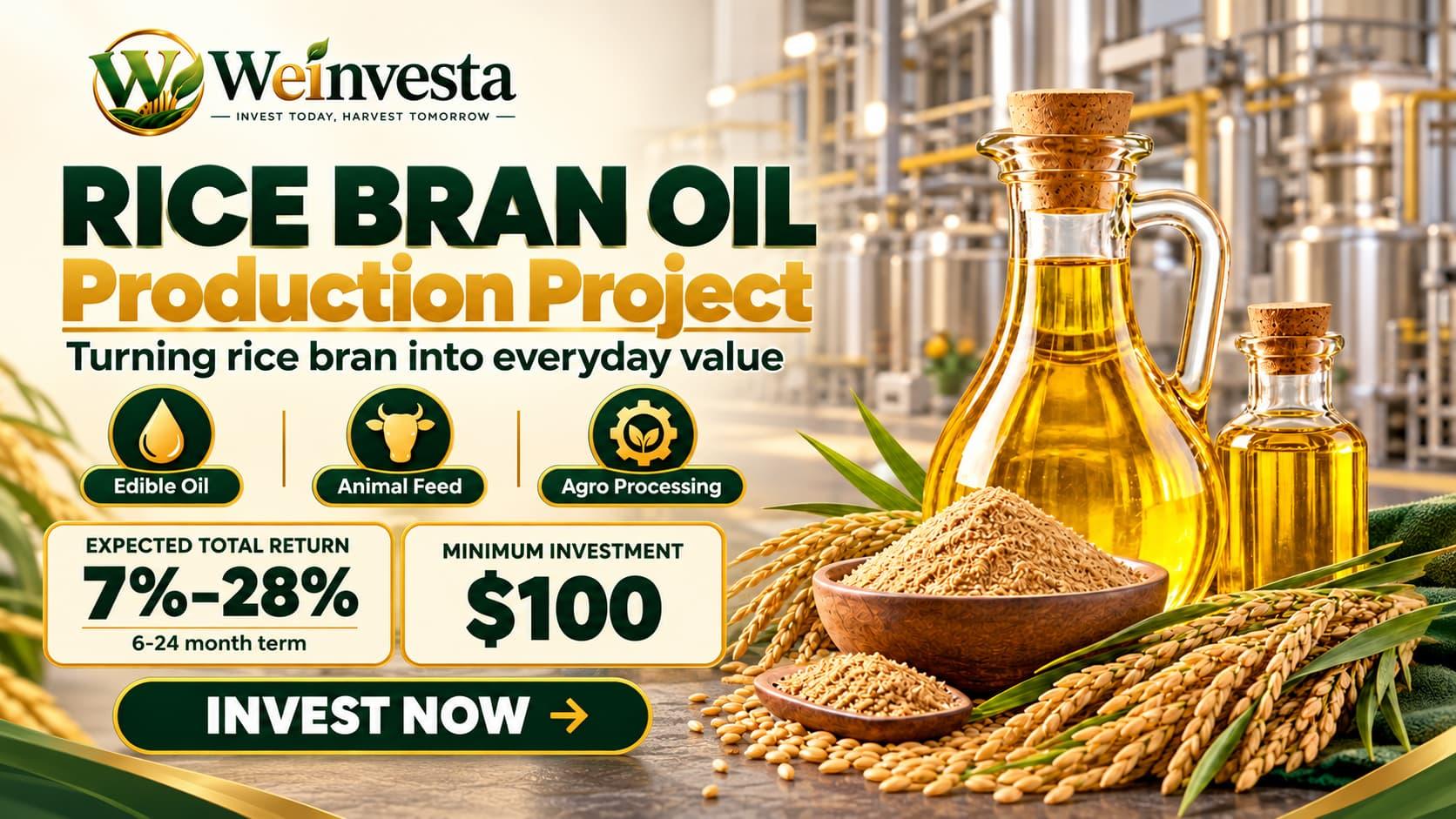
Rice Bran Oil Production Project: Turning Agricultural Byproducts into Edible Oil
Rice bran is produced as a byproduct when paddy is processed into rice. Although it is often treated as a low-value agricultural byproduct, fresh rice bran can be stabilized, extracted, filtered, and refined to produce edible cooking oil and protein-rich material for animal-feed markets.
The Weinvesta Rice Bran Oil Production Project proposes the development of a mid-sized commercial extraction and refining facility. The project is designed to convert fresh rice bran into refined cooking oil, branded edible-oil products, and De-Oiled Rice Bran, commonly known as DORB.
The project belongs to the Agro Processing sector, with planned operations across Brazil, Venezuela, Paraguay, and India.
Project Overview
Project: Rice Bran Oil Production Project
Category: Agro Processing
Status: Active
Target Amount: $54,781.28
Displayed Return Range: 7%–28%
Available Terms: 6, 12, or 24 months
Payout Schedule: On maturity
Displayed Investment Range: $100–$1,000,000
Planned Countries: Brazil, Venezuela, Paraguay, and India
Primary Products: Refined rice bran oil and De-Oiled Rice Bran
Target Markets: Edible oil, animal feed, retail distribution, and exports
Funding progress and investment terms may change. Before making a decision, review the live project page and related investment options.
What Is Rice Bran Oil?
Rice bran oil is an edible oil extracted from the outer brown layer of the rice grain. This bran layer is separated from the grain during the rice-milling process.
Fresh rice bran can deteriorate rapidly after milling. It must therefore be collected and stabilized within a suitable period to preserve its quality and potential oil yield.
Once stabilized, the bran can pass through extraction, filtration, refining, quality testing, and packaging to become a market-ready cooking oil.
The production process generates two principal commercial products:
Refined Rice Bran Oil: Edible oil prepared for consumer and commercial food markets
De-Oiled Rice Bran—DORB: The protein- and fiber-containing material remaining after oil extraction, which can be used in animal-feed production
Producing two marketable products from one raw material gives the project the potential to develop a dual-revenue business model.
Converting an Agricultural Byproduct into Economic Value
Rice bran is generated during the production of white rice. Without proper stabilization and processing, it can lose quality quickly.
The planned production process includes:
Collecting fresh rice bran from auto rice mills.
Inspecting the bran for moisture and quality.
Stabilizing the material to reduce deterioration.
Storing stabilized bran under controlled conditions.
Extracting crude oil from the bran.
Filtering unwanted material from the extracted oil.
Refining the oil to prepare it for consumption.
Conducting laboratory and quality-control testing.
Filling and packaging the refined product.
Processing and supplying DORB to animal-feed buyers.
This model connects rice cultivation, automated milling, edible-oil production, and animal-feed markets within one agricultural value chain.
Integration With Auto Rice Mills
One of the project’s key features is its planned integration with internal and regional auto rice mills.
Freshness is important because rice bran can deteriorate soon after milling. A coordinated sourcing system may help deliver the material to the extraction facility more quickly.
Potential benefits of this integration include:
More consistent access to fresh bran
Reduced delays between milling and stabilization
Improved feedstock traceability
Better control over moisture and storage
Lower risk of raw-material deterioration
More efficient transportation planning
Additional value from rice-milling byproducts
Learn more about the connected processing infrastructure through the High-Capacity Auto Rice Mill Project.
Project Business Plan
The business plan proposes building a mid-sized rice bran oil extraction and refining facility.
Planned infrastructure may include:
Rice bran receiving systems
Bran stabilization equipment
Raw-material storage
Oil extraction machinery
Filtration systems
Refining equipment
Oil-storage tanks
Utilities and power systems
Quality-control laboratory
Bottling and packaging line
DORB handling and storage
Finished-product warehouse
Distribution facilities
The project plans to begin by supplying domestic edible-oil buyers and animal-feed businesses. After establishing production quality and market demand, it may expand into branded retail packaging and export markets.
Potential Revenue Streams
Refined Rice Bran Oil
Refined oil may be supplied to retailers, supermarkets, food distributors, restaurants, institutional buyers, and food manufacturers.
Branded Cooking Oil
Developing a branded consumer product may create additional value compared with selling oil only in bulk.
De-Oiled Rice Bran
DORB may be sold to livestock, poultry, aquaculture, and commercial animal-feed businesses.
Bulk Commercial Supply
The project may supply larger volumes to wholesalers, institutional buyers, food manufacturers, and other industrial customers.
Export Sales
Subject to quality standards, certifications, approvals, and market demand, refined oil and DORB may also be supplied to international buyers.
What Is DORB and Why Is It Important?
De-Oiled Rice Bran is the material left after oil has been extracted from rice bran. Depending on its composition and quality, it may contain protein, fiber, and other nutrients suitable for feed applications.
DORB may be used in:
Cattle-feed formulations
Poultry-feed production
Aquaculture feed
Commercial feed mills
Integrated livestock operations
Selling DORB may provide the project with a secondary revenue stream while reducing waste from the oil-extraction process.
Explore Weinvesta’s wider agriculture, livestock, and food-production ecosystem through the all-projects page.
Displayed Investment Options
The project page currently presents three term-based options.
6-Month Investment Option
Displayed Total Profit: 7%
Lock Period: 6 months
Instant Bonus: 0%
Payout: On maturity
Displayed Investment Range: $100–$1,000,000
➡️ View the related 6-month investment option
12-Month Investment Option
Displayed Total Profit: 14%
Lock Period: 12 months
Instant Bonus: 0%
Payout: On maturity
Displayed Investment Range: $100–$1,000,000
➡️ View the related 12-month investment option
24-Month Investment Option
Displayed Total Profit: 28%
Lock Period: 24 months
Instant Bonus: 0%
Payout: On maturity
Displayed Investment Range: $100–$1,000,000
➡️ View the related 24-month investment option
These figures reflect the options displayed on the project page when this article was prepared. Review the live project information, applicable plan, payout terms, and supporting documents before participating.
Displayed or projected returns do not guarantee future performance.
Commercial Strategy
The project’s commercial strategy is based on developing production and market access in stages.
Initial Stage
Establish a fresh-bran sourcing network
Begin extraction and refining operations
Secure domestic edible-oil customers
Supply DORB to animal-feed buyers
Evaluate production costs and operating margins
Growth Stage
Increase refining capacity
Introduce retail packaging
Develop a consumer brand
Build supermarket and distributor relationships
Strengthen quality-control and certification systems
Expansion Stage
Identify suitable export markets
Supply bulk oil to industrial customers
Develop regional and international DORB distribution
Reinvest operating profits into additional refining capacity
The timing and success of each stage will depend on funding, equipment installation, regulatory approvals, feedstock availability, production performance, and market demand.
Creating a Circular Agricultural Value Chain
The project seeks to create additional value from a byproduct of rice processing.
A wider circular value chain may include:
Producing paddy on agricultural land
Processing paddy through an auto rice mill
Collecting fresh rice bran from milling
Extracting and refining edible oil
Supplying DORB to animal-feed operations
Using rice husk for biomass or industrial fuel
Converting livestock waste into bio-fertilizer
This integrated approach may help reuse agricultural byproducts across different economic activities.
Compare related opportunities through the Agro Processing Projects page.
Factors That May Support the Project
Access to an Agricultural Byproduct
Rice bran is generated during rice milling rather than being cultivated as a separate crop. Integration with auto rice mills may support more efficient sourcing.
Two Principal Products
Producing refined oil and DORB from the same raw material may create multiple potential revenue streams.
Edible-Oil Demand
Cooking oil is an important everyday food product. However, actual market performance will depend on local prices, imports, competition, consumer preferences, and distribution.
Animal-Feed Market
Demand from livestock, poultry, and aquaculture businesses may create a potential market for DORB.
Value Addition
Converting a relatively low-value byproduct into refined and packaged products may create additional economic value.
These factors may support the project’s potential, but they do not ensure commercial success.
Key Project Risks
Bran Freshness Deterioration
Fresh rice bran may deteriorate rapidly. Delays in collection or stabilization could reduce oil quality and extraction yield.
Lower Oil Yield
Oil recovery may be lower than expected because of bran quality, rice variety, moisture, storage conditions, or extraction efficiency.
Electricity and Energy Costs
Extraction, filtration, refining, and packaging require energy. Higher electricity or fuel costs may affect operating margins.
Food-Safety Compliance
Edible-oil production requires effective hygiene, contamination controls, laboratory testing, labelling, and regulatory compliance.
Refinery Quality Issues
Poor process control could affect the oil’s color, smell, taste, stability, safety, and shelf life.
Edible-Oil Price Competition
Rice bran oil may compete with palm, soybean, sunflower, mustard, and other cooking oils in domestic markets.
Packaging-Cost Inflation
Increases in the cost of bottles, caps, labels, cartons, and transportation materials may affect branded-product margins.
Regulatory Approval
Factory operations, food production, packaging, labelling, and exports may require licences, inspections, and regulatory approvals.
Equipment Downtime
Failures involving extraction or refining equipment may interrupt production and increase maintenance costs.
Feedstock Seasonality
Rice production and milling activity may vary by season, which could affect the availability of fresh bran.
Before participating, review the Weinvesta Risk Disclosure, Terms and Conditions, and project-specific documents.
Documents to Review
Before selecting an investment option, review:
Weinvesta Whitepaper
Sector-by-Sector Projects Profile
Project Business Plan
Investment Prospectus
Proposed use of funds
Feedstock-sourcing plan
Production-capacity assumptions
Food-safety and quality-control plan
Applicable licences and approvals
Lock-period conditions
Maturity and payout structure
Project-specific Risk Disclosure
These documents can provide more information about the project’s costs, business model, intended revenue sources, target markets, management responsibilities, and risk controls.
How to Invest in the Related Project Option
Open the Rice Bran Oil Production Project.
Review the project overview, business plan, risks, and documents.
Compare the displayed 6-, 12-, and 24-month options.
Select the option that aligns with your objectives and risk tolerance.
Create a Weinvesta account and complete KYC if required.
Use the investment button displayed under the selected project option.
Complete funding through a supported payment method.
Monitor available project information and updates through your account.
🚀 View the Related Investment Options and Invest Now
Read the How Weinvesta Works guide for more information about registration, project selection, funding, and online tracking.
Frequently Asked Questions
What is the project’s principal raw material?
Fresh rice bran produced during the processing of paddy in auto rice mills is the project’s principal raw material.
What products will the project produce?
The primary planned products are refined rice bran cooking oil and De-Oiled Rice Bran for animal-feed markets.
Where is the project planned?
The project page identifies Brazil, Venezuela, Paraguay, and India as its planned regions.
What returns are displayed?
The current plan cards display total-profit figures of 7% for 6 months, 14% for 12 months, and 28% for 24 months.
What is the displayed minimum investment?
The term cards display an investment range beginning at $100. However, the project description contains a different minimum amount. Verify the live and final terms before funding.
When are payouts scheduled?
The current options display payouts as “On Maturity,” meaning after completion of the selected term.
Where does the Invest Now button lead?
Every “Invest Now” link in this article leads directly to the Rice Bran Oil Production Project, where the related 6-, 12-, and 24-month options are displayed.
Are the displayed returns guaranteed?
Displayed or projected returns should not be treated as guaranteed outcomes. Actual performance may be affected by feedstock quality, extraction yield, energy costs, edible-oil prices, food-safety compliance, packaging expenses, equipment performance, and other risks.
Explore the Rice Bran Oil Production Project
The Rice Bran Oil Production Project presents an integrated agro-processing model for converting a rice-milling byproduct into edible oil and animal-feed material.
By connecting auto rice mills, fresh-bran sourcing, oil refining, branded packaging, and DORB distribution, the project aims to create economic value across multiple stages of the agricultural value chain.
🚀 View the Related Investment Options and Invest Now
🌾 Explore Agro Processing Projects
More From the Blog
Ready to Grow Your Wealth?
Put your capital behind real-world projects with real assets behind them.