
High-Capacity Auto Rice Mill Project: Investing in Modern Rice Processing
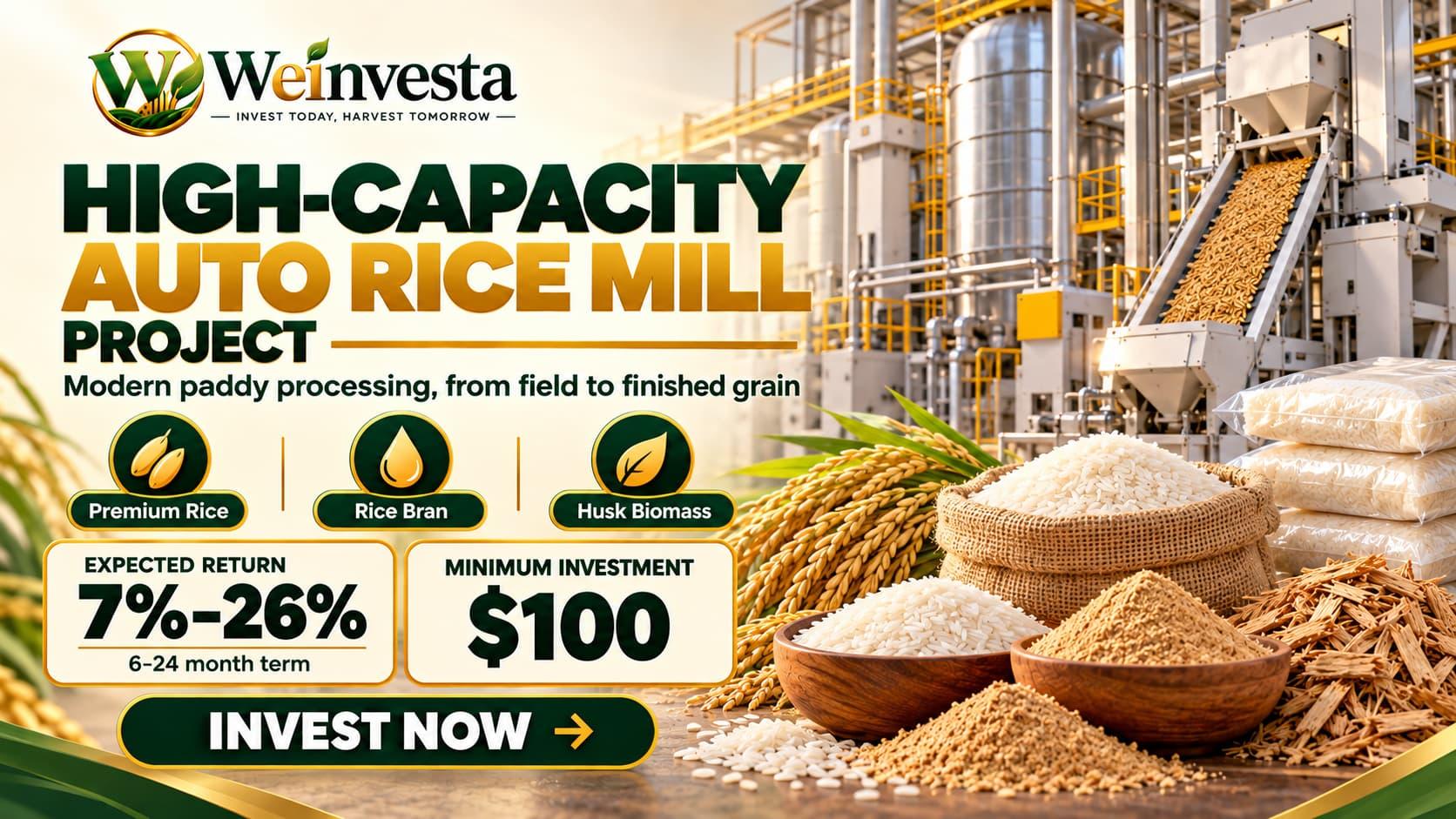
High-Capacity Auto Rice Mill Project: Investing in Modern Rice Processing
Rice is one of the world’s most important staple foods. However, freshly harvested paddy must pass through several processing stages before it becomes market-ready rice. Drying, parboiling, husking, polishing, grading, color sorting, packaging, and storage all play an essential role in producing consistent, high-quality grain.
The Weinvesta High-Capacity Auto Rice Mill Project is a modern agro-processing initiative designed to automate these operations at scale. The project aims to produce premium packaged rice while capturing additional value from important byproducts such as rice bran and husk.
Its planned operations cover Brazil, India, Thailand, Colombia, and Guatemala—countries with established agricultural production and significant rice-processing potential.
High-Capacity Auto Rice Mill Project Overview
Project: High-Capacity Auto Rice Mill Project
Category: Agro Processing
Status: Active
Target Amount: $136,953.20
Displayed Return Range: 7%–26%
Available Terms: 6, 12, or 24 months
Payout Schedule: On maturity
Displayed Investment Range: $100–$1,000,000
Planned Markets: Wholesale distributors, retailers, and supermarket chains
Countries: Brazil, India, Thailand, Colombia, and Guatemala
Funding progress and investment conditions may change. Always check the live project page before making a decision.
What Is the High-Capacity Auto Rice Mill Project?
The project proposes the development of a fully automated rice-processing hub where paddy intake, drying, parboiling, milling, polishing, grading, sorting, packaging, and storage can be managed within one integrated operation.
Its planned facilities include:
Paddy intake and initial quality inspection
Drying yards and moisture-control systems
Parboiling equipment
Automated husking and milling lines
Rice polishing and grading
Optical color sorting
Automated weighing and bagging
Packaging facilities
Warehouse storage
Wholesale and retail distribution systems
This integrated approach is designed to improve quality consistency, reduce processing losses, and generate value from rice, bran, and husk.
Integration With 5,000+ Hectares of Farmland
The project is designed to process paddy harvested from more than 5,000 hectares of integrated farmland. Additional feedstock may also be obtained from regional farmers through purchase agreements.
Combining internally produced paddy with third-party sourcing could help maintain a more consistent supply of raw material for the mill.
Learn more about Weinvesta’s wider agricultural operations through the Premium Agriculture Project.
How Does the Project Plan to Generate Revenue?
The Auto Rice Mill business model is not limited to selling processed rice. Different products and potential revenue streams can be created throughout the processing cycle.
1. Branded Packaged Rice
Rice can be graded, polished, quality-checked, and packaged for retail customers and supermarket chains. Branded packaging may allow the project to capture more value than selling unprocessed grain.
2. Wholesale Rice Distribution
The project plans to supply rice in bulk to wholesalers, food distributors, institutional buyers, and regional retailers.
3. Rice Bran Supply
Fresh rice bran is an important raw material for edible-oil production. The bran generated by the mill may support the related Rice Bran Oil Production Project.
4. Rice Husk and Biomass
Rice husk can potentially be sold or reused as boiler fuel, biomass energy feedstock, and raw material for selected industrial applications.
5. Storage and Distribution
Warehouse storage, branded packaging, and supermarket distribution could allow the project to participate in multiple stages of the rice value chain.
Why Is Automated Rice Processing Important?
Traditional milling systems may struggle to maintain consistent moisture levels, grain quality, output volume, and breakage rates. A fully automated rice mill can provide greater control over these factors.
Potential operational advantages include:
Faster paddy processing
More consistent grain quality
Better moisture control
Reduced rice breakage
Automated quality inspection
Accurate weighing and packaging
Production of multiple rice grades
Higher processing capacity
Better production-cost monitoring
More reliable supply for wholesale buyers
Actual performance will depend on equipment quality, electricity availability, maintenance, operator experience, and effective management.
Investment Terms and Displayed Return Options
The project page currently presents three term-based options.
6-Month Option
Displayed Total Profit: 7%
Lock Period: 6 months
Payout: On maturity
Displayed Investment Range: $100–$1,000,000
12-Month Option
Displayed Total Profit: 13%
Lock Period: 12 months
Payout: On maturity
Displayed Investment Range: $100–$1,000,000
24-Month Option
Displayed Total Profit: 26%
Lock Period: 24 months
Payout: On maturity
Displayed Investment Range: $100–$1,000,000
These figures describe the options displayed on the project page and should not be treated as a guarantee of future performance. Review the live project documents and applicable terms before participating.
You can also compare other opportunities on the Weinvesta Investment Plans page.
Commercial Strategy
The project’s commercial strategy focuses on three principal markets:
National wholesale distributors
Retailers and supermarket chains
Connected agricultural and food-processing businesses
In addition to producing packaged and wholesale rice, the mill is intended to supply rice bran to oil-processing operations and rice husk to biomass or industrial users.
This integrated model is designed to reduce waste and create commercial value from a greater proportion of each unit of paddy processed.
Visit the Agro Processing projects page to compare this opportunity with other agricultural processing initiatives.
The Role of the Project in the Agricultural Value Chain
A modern rice mill connects agricultural production with consumer markets. It receives harvested paddy, converts it into standardized products, manages storage, and prepares the final grain for distribution.
The project could contribute to the wider agricultural value chain through:
Processing paddy produced by farmers
Producing standardized, market-ready rice
Adding value to agricultural output
Supplying raw material for rice bran oil
Converting rice husk into biomass or fuel
Supporting storage and distribution infrastructure
Creating operational and technical employment
Improving access to wholesale and retail markets
The project’s success will ultimately depend on reliable feedstock, efficient operations, quality control, market demand, and disciplined financial management.
Key Risks to Consider
Every agriculture and agro-processing project involves operational, commercial, and market-related risks. Prospective investors should consider the following factors carefully.
Paddy Price Fluctuation
The price of paddy may change because of harvest volumes, seasonal supply, weather conditions, and market demand. Higher raw-material costs could affect operating margins.
Crop Seasonality
Rice production is seasonal. Poor harvests, weather disruptions, or supply shortages may reduce the amount of paddy available to the mill.
Moisture and Storage Losses
Incorrect moisture control can reduce grain quality and market value. Long-term storage can also create risks related to pests, humidity, spoilage, and weight loss.
Machinery Downtime
Failures involving milling, polishing, sorting, drying, or packaging equipment may interrupt production and increase maintenance expenses.
Electricity and Fuel Costs
A high-capacity rice mill requires significant energy. Changes in electricity or fuel costs could affect overall profitability.
Quality Rejection
Buyers may reject rice that does not meet their requirements for moisture, color, grain size, breakage rate, packaging, or food safety.
Working-Capital Pressure
The project may need to purchase paddy before processed rice is sold. This creates a timing gap between operating expenses and revenue collection.
Market Competition
The project will compete with established rice mills and consumer brands on price, quality, availability, and distribution.
Before participating, review the Weinvesta Risk Disclosure, Terms and Conditions, and all project-specific documents.
Project Documents to Review
Investors should review the available documentation before selecting an investment term. Relevant resources may include:
Weinvesta Whitepaper
Sector-by-Sector Projects Profile
Project Business Plan
Investment Prospectus
Risk Overview
Project-specific Risk Disclosure
Applicable investment terms
Maturity and payout conditions
These documents can help investors understand the intended use of funds, operational model, projected cash-flow sources, project timeline, and identified risks.
How to Participate
The general process for exploring the project through Weinvesta is:
Complete the required identity and KYC verification.
Visit the High-Capacity Auto Rice Mill Project.
Review its business model, documents, terms, and risks.
Compare the displayed 6-, 12-, and 24-month options.
Select an option that aligns with your budget and financial objectives.
Complete funding through one of the supported payment methods.
Monitor available project information and updates through your account.
Read the How Weinvesta Works guide for more information about registration, project selection, funding, and online tracking.
Frequently Asked Questions
What sector does the Auto Rice Mill Project belong to?
The project is classified under Agro Processing because it converts harvested paddy into processed, graded, and packaged rice products.
Where is the project planned to operate?
The project page identifies Brazil, India, Thailand, Colombia, and Guatemala as its planned operating regions.
What returns are displayed?
The current project options display total profit figures of 7%, 13%, and 26% for terms of 6, 12, and 24 months respectively.
What is the minimum investment?
The project’s current term cards display an investment range beginning at $100. However, certain project descriptions or documents may contain different minimum amounts. Review the live terms before participating.
When are payouts scheduled?
The listed options indicate that payouts are scheduled on maturity.
Can the principal be withdrawn before maturity?
Capital may remain locked for the selected term, and early withdrawal may not be available. Investors should review the applicable withdrawal and maturity conditions before funding.
Are the displayed returns guaranteed?
Displayed or projected returns should not be interpreted as a guarantee of future results. Actual performance may be affected by commodity prices, production volumes, operating costs, machinery, market demand, and other risks.
What should I review before investing?
Review the project profile, business plan, use of funds, lock period, payout structure, commercial strategy, project documents, and risk disclosure.
Explore the High-Capacity Auto Rice Mill Project
The High-Capacity Auto Rice Mill Project presents an integrated plan for transforming paddy into packaged rice and commercially valuable byproducts.
By connecting large-scale farming, automated processing, rice bran oil production, biomass utilization, storage, and distribution, the project aims to participate across multiple stages of the agricultural value chain.
🔎 View the High-Capacity Auto Rice Mill Project
More From the Blog
Ready to Grow Your Wealth?
Put your capital behind real-world projects with real assets behind them.