
Steel Manufacturing & Re-Rolling Mills Project | WeInvesta
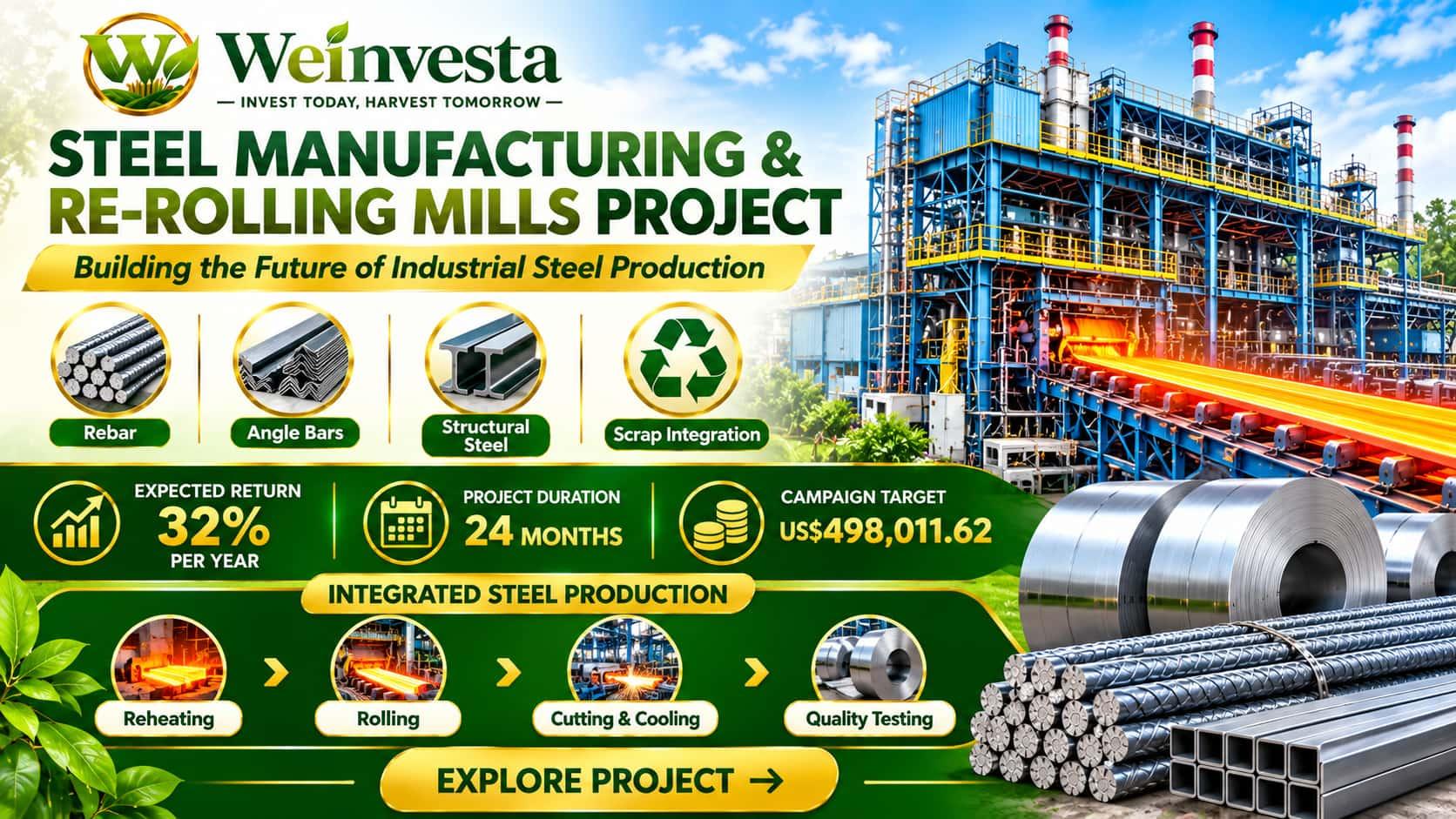
Steel is one of the essential materials used in modern construction, infrastructure development, commercial buildings, and industrial production. From reinforcing bars used in concrete structures to angle bars and structural steel sections, steel products support a wide range of development activities.
WeInvesta’s Steel Manufacturing & Re-Rolling Mills Project proposes developing a high-capacity, automated steel manufacturing and re-rolling operation designed to produce steel products for construction and industrial markets.
The planned product range includes:
Reinforcing bars (rebar)
Steel angle bars
Structural steel sections
Other basic steel products, with potential expansion into higher-margin products
The project aims to serve growing demand from contractors, property developers, infrastructure projects, construction material distributors, and industrial customers.
Its proposed business model includes backward integration with the scrap-processing and recycling operation within the wider project portfolio. This approach is intended to support raw-material sourcing, improve supply coordination, and strengthen control over production costs and margins.
The project identifies India, the United Arab Emirates, Saudi Arabia, Turkey, and Vietnam as target markets.
Interested in exploring this opportunity?
VIEW THE STEEL PROJECT & INVESTMENT PLANS →
Review the official project information, applicable investment terms, supporting documents, and risk disclosures before making an investment decision.
Why Steel Manufacturing and Re-Rolling Matter
Steel plays an important role in infrastructure, construction, transportation, manufacturing, and commercial development. Reinforcing bars are used in concrete structures, while angle bars and structural sections serve a range of structural and industrial applications.
A steel re-rolling operation can convert suitable raw materials, such as billets and processed scrap-derived inputs, into finished steel products through heating and rolling processes.
The proposed project aims to create value through several connected activities:
Construction material production: Manufacturing reinforcing bars and other steel products for construction-related demand.
Structural steel supply: Producing angle bars and basic structural sections for industrial and commercial applications.
Industrial integration: Connecting steel production with the proposed scrap-processing operation to support raw-material sourcing.
Automated production: Developing an industrial setup with planned reheating, rolling, cutting, cooling, and testing systems.
Product expansion: Starting with rebar and basic steel sections before potentially moving into higher-margin products.
Actual commercial performance will depend on production capacity, raw-material quality and availability, energy costs, product specifications, market prices, customer demand, and operational efficiency.
How the Steel Manufacturing Project Is Planned to Operate
The proposed business plan includes a series of production stages, from raw-material sourcing and heating to rolling, quality testing, packaging, and dispatch.
1. Raw-Material Sourcing and Furnace Capability
The project plans to develop furnace or billet procurement capability to support its steel production activities.
The proposed backward integration with the scrap-processing project may provide an additional source of suitable raw materials. The final sourcing strategy will depend on material quality, availability, pricing, production requirements, and operational agreements.
Reliable raw-material sourcing is important because variations in billet and scrap prices can directly affect production costs and profit margins.
2. Reheating Furnace
A reheating furnace is included in the proposed production setup. It is intended to prepare billets or other suitable steel inputs for the rolling process.
Heating conditions, energy consumption, temperature management, and equipment reliability will be important factors in maintaining consistent production quality.
3. Rolling Mill and Steel Forming
The rolling mill is expected to be a central part of the proposed facility.
Through controlled rolling operations, heated steel inputs can be shaped into products such as reinforcing bars, angle bars, and structural steel sections.
The project plans to begin with rebar and basic steel sections, then potentially expand into products with higher margins as production capabilities and market demand develop.
4. Cutting and Cooling
Cutting systems and a cooling bed are included in the proposed production process.
These systems are intended to help control product length, cooling, and handling after rolling. Their performance will influence production consistency, product dimensions, and the efficiency of downstream operations.
5. Testing and Quality Control
The business plan includes testing facilities and quality-control processes.
Steel products supplied to construction and industrial customers must meet relevant specifications and applicable standards. Testing and quality checks will therefore be important for product consistency, customer acceptance, and regulatory compliance.
6. Bundling, Storage, and Dispatch
After production and quality checks, finished steel products are planned to be bundled, stored, and prepared for dispatch.
Efficient inventory management and transportation arrangements will be important for delivering products to contractors, developers, infrastructure projects, distributors, and other customers.
Products and Commercial Applications
The project plans to focus initially on three principal product categories.
Reinforcing Bars (Rebar): Rebar is widely used to reinforce concrete in buildings, bridges, roads, foundations, and other infrastructure applications. The project plans to produce reinforcing bars for construction-related buyers.
Steel Angle Bars: Angle bars are used in different structural and fabrication applications. They may serve industrial customers, contractors, and manufacturers depending on product dimensions and specifications.
Structural Steel Sections: The project also plans to produce basic structural steel sections for construction and industrial applications. Additional product categories may be considered as production capacity and market requirements develop.
Product suitability and sales will depend on manufacturing specifications, quality certification, pricing, and buyer requirements.
Business Model and Revenue Opportunities
The project's commercial strategy focuses on manufacturing steel products and supplying them to customers involved in construction, infrastructure, property development, and industrial distribution.
Sales to construction contractors: Contractors may purchase reinforcing bars and structural steel products for building and infrastructure projects.
Supply to property developers: Real-estate and commercial development companies may represent potential customers requiring steel for construction activities.
Infrastructure projects: Road, bridge, commercial, and other infrastructure developments may create demand for suitable steel products, depending on project requirements and procurement arrangements.
Steel distributors: The project plans to work with distributors and construction-material suppliers to expand access to customers.
Backward integration with scrap processing: The proposed connection with the scrap recycling operation may support raw-material sourcing and provide additional supply coordination. Its actual benefits will depend on the availability, quality, and pricing of internally sourced materials.
The commercial model aims to combine steel production, internal supply coordination, and customer distribution. Its financial performance will depend on production costs, energy consumption, metal prices, capacity utilization, sales volumes, and payment cycles.
Target Markets
The project information identifies the following target markets:
India
United Arab Emirates (UAE)
Saudi Arabia
Turkey
Vietnam
These are the markets listed in the supplied project information. Actual sales and distribution will depend on local construction demand, product standards, regulatory approvals, commercial agreements, pricing, and logistics.
Project Snapshot
Project detailListed informationProject nameSteel Manufacturing & Re-Rolling Mills ProjectCategoryHeavy Industry & MetalsStatusActiveTarget marketsIndia, UAE, Saudi Arabia, Turkey, VietnamCampaign targetUS$498,011.62Raised so farUS$0Total investors0Funding progress0%Displayed expected return32%Displayed duration24 monthsDisplayed lock period2 yearsEstimated total project investment requirementUS$12 million–US$20 million
The campaign target of US$498,011.62 differs significantly from the estimated total project investment requirement of US$12 million–US$20 million. Prospective investors should review the official project documentation to understand how the campaign target relates to the wider project funding requirement.
Explore the Available Investment Plans
The detailed investment-plan cards list the following options:
Lock periodListed total profit ratePayout6 months8%At maturity12 months16%At maturity24 months32%At maturity
The detailed plan cards show an investment range of US$100–US$1,000,000, with a 0% instant bonus.
However, the general investment-terms section lists a US$1,000 minimum investment, a 24-month lock-in period, and a 20% target total profit.
These figures differ from the detailed investment-plan cards, which show 8%, 16%, and 32% for the respective investment periods. The project summary also displays an expected return of 32% over 24 months.
The US$100 minimum is the amount shown on the detailed investment-plan cards. The general investment-terms section lists US$1,000 instead. Prospective investors should confirm the applicable minimum and final terms through the official project page and platform before investing.
Invest Now — Starting from $100
Explore the available investment plans for the Steel Manufacturing & Re-Rolling Mills Project.
Investment shown on plan cards: US$100–US$1,000,000
INVEST NOW — STARTING FROM $100 →
Review the available lock periods, plan details, project documents, and applicable investment terms before proceeding.
Project Documents and Risk Information
Before making an investment decision, prospective investors should review the available supporting materials, including:
WeInvesta Whitepaper
Sector-by-Sector Projects Profile
Business Plan
Investment Prospectus & Risk Overview
Risk Disclosure
These materials should be reviewed to understand the proposed production model, project requirements, investment conditions, and associated risks.
Understand the Risks Before Investing
Steel manufacturing and re-rolling involve significant industrial, operational, environmental, financial, and market risks.
Key considerations include:
High power costs: Steel production requires significant energy. Electricity and fuel price increases may affect operating costs and margins.
Scrap price volatility: Changes in scrap and billet prices may affect raw-material costs and the profitability of finished products.
Environmental compliance: Steel manufacturing may require environmental permits, emissions controls, waste management, and compliance with local regulations.
Emissions control: Furnace and industrial processes may produce emissions that require appropriate monitoring and control systems.
Workplace safety incidents: High-temperature operations, heavy machinery, moving steel products, and material handling create workplace safety risks.
Machinery breakdown: Equipment failures may interrupt production, delay orders, and increase maintenance expenses.
Construction market slowdown: Reduced construction or infrastructure activity may affect demand for reinforcing bars and structural steel.
Working-capital requirements: Raw-material purchases, energy bills, production expenses, inventory, and customer payment cycles may require substantial working capital.
Regulatory approvals: Establishing and operating a steel facility may require permits, industrial approvals, and compliance with applicable product standards.
The project's performance will depend on reliable raw-material sourcing, efficient production, energy management, product quality, regulatory compliance, customer demand, and effective financial management.
Investment involves risk, and capital may be lost. Review the official project documents and risk disclosures carefully before proceeding.
Take the Next Step
The Steel Manufacturing & Re-Rolling Mills Project proposes to develop an industrial steel production operation focused on reinforcing bars, angle bars, and structural steel sections.
Its planned model combines furnace or billet sourcing capability, reheating, rolling, cutting, cooling, quality testing, bundling, and distribution. The proposed backward integration with the scrap-processing operation is intended to support raw-material supply and production coordination.
Explore the dedicated WeInvesta project page, review the available plans, and confirm the applicable investment terms before making a decision.
EXPLORE THE STEEL MANUFACTURING PROJECT →
Ready to explore the opportunity?
INVEST NOW — PLANS SHOWN FROM $100 →
Contact the WeInvesta team for clarification about the project, available investment plans, and supporting documents.

Ready to Grow Your Wealth?
Put your capital behind real-world projects with real assets behind them.