
Rice Bran Oil Production Project | WeInvesta
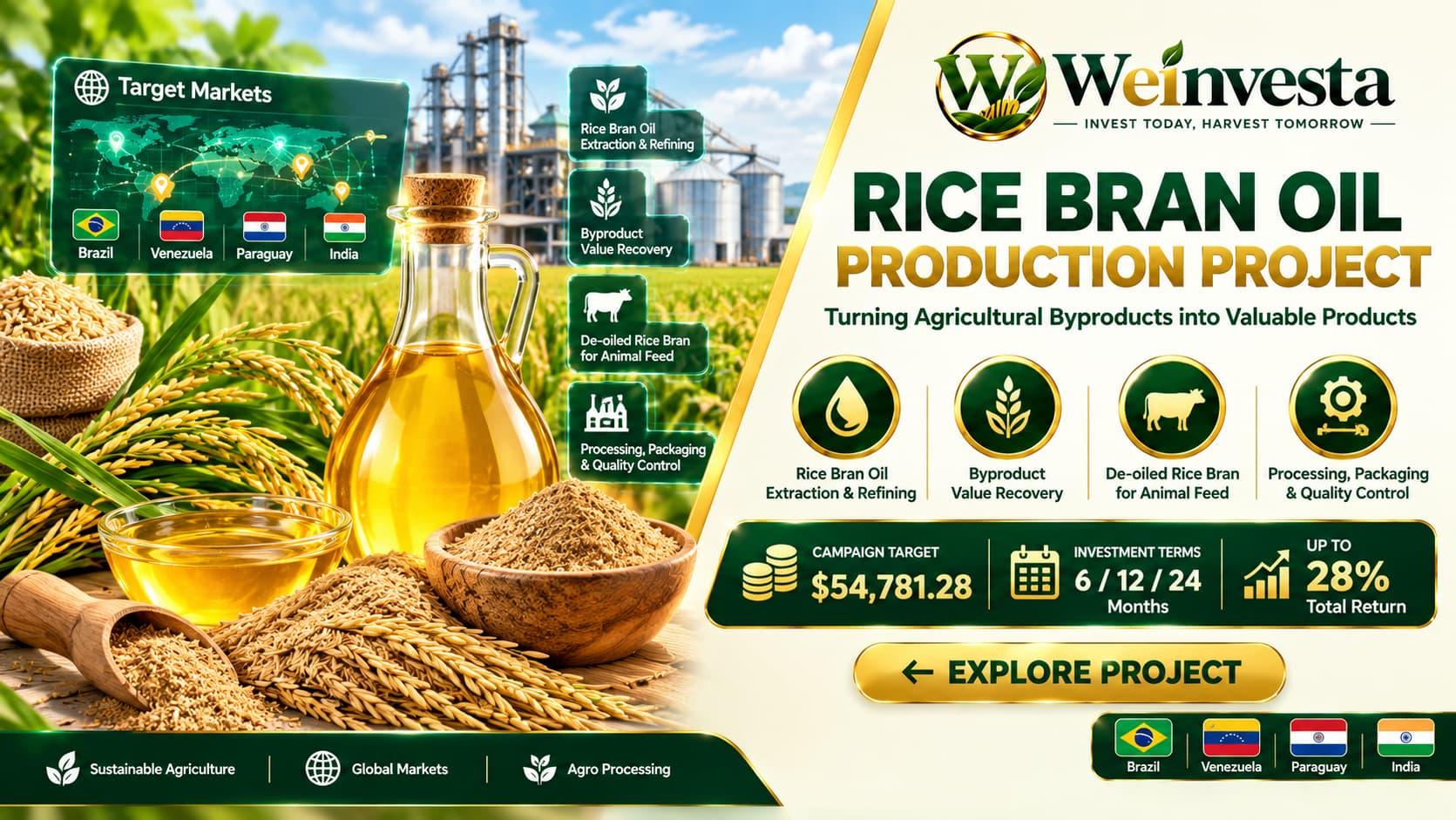
Rice Bran Oil Production: Creating Value from Agricultural Byproducts
Rice milling generates several byproducts that can be used as valuable raw materials for additional agricultural and industrial activities. One such material is rice bran, which can be processed to extract rice bran oil and produce de-oiled rice bran for suitable animal feed applications.
WeInvesta’s Rice Bran Oil Production Project aims to convert fresh rice bran into refined edible oil and de-oiled rice bran (DORB), creating two potential product streams from a single agricultural processing operation.
The project identifies Brazil, Venezuela, Paraguay, and India as its target markets. Its proposed business model connects rice production and milling activities with oil extraction, refining, packaging, and the sale of byproducts.
This integrated approach is intended to improve the utilization of agricultural resources and create additional value from rice milling. Actual commercial performance, however, will depend on raw material quality, oil extraction yields, operational efficiency, food safety, product pricing, market demand, and regulatory compliance.
Explore the Rice Bran Oil Production Project for the project overview and available details.
Project Overview
Project Name: Rice Bran Oil Production Project
Sector: Agro Processing
Status: Active
Target Markets: Brazil, Venezuela, Paraguay, and India
Displayed Expected Return: Up to 28%, depending on the selected plan
Displayed Investment Terms: 6 months, 12 months, or 24 months
Campaign Target: $54,781.28
Raised So Far: $0.00
Total Investors: 0
Funding Progress: 0%
Minimum Investment Stated in the Project Overview: $1,000
Estimated Facility Investment Requirement: US$1.50 million–US$2.20 million
The figures above reflect the information supplied for this article. Funding information and investment conditions may change. Review the live project page and official documents before making an investment decision.
About the Rice Bran Oil Production Project
The project proposes a commercial extraction and refining facility designed to process fresh rice bran into two primary outputs:
Refined rice bran oil for edible-oil markets.
De-oiled rice bran (DORB) for suitable animal feed markets.
Rice bran is a byproduct of rice milling. Instead of using it only as a low-value residual material, an extraction facility can recover oil from suitable bran and create an additional product for the food market. The remaining de-oiled bran can then be marketed as an ingredient for animal feed, subject to quality and safety requirements.
The project's strategy is to link rice bran sourcing with internal and regional automatic rice mills. This sourcing model is intended to support a more consistent supply of raw materials and reduce exposure to feedstock shortages.
The effectiveness of this arrangement will depend on the reliability of supply agreements, the freshness and quality of the bran, collection and transportation arrangements, and the operating capacity of the processing facility.
1. Rice Bran Oil Extraction and Refining
Rice bran oil is extracted from rice bran and may be refined for use as edible cooking oil. The project aims to establish a facility covering the essential stages of production, from raw material handling to finished-product packaging.
The proposed plant development plan includes:
Rice bran collection and stabilization.
Raw material storage and handling.
Oil extraction.
Filtration and refining.
Packaging and finished-product storage.
Utilities and production support systems.
Quality control and food safety procedures.
Freshness is particularly important because rice bran can deteriorate after milling if it is not handled and stabilized appropriately. The processing plan therefore needs effective raw material management, suitable equipment, consistent operating procedures, and appropriate quality testing.
The commercial results will depend on extraction yields, oil quality, processing capacity, equipment reliability, energy costs, packaging expenses, and the final selling price.
The existence of a proposed facility does not by itself establish that the plant is operational or that its production targets have been achieved.
2. De-Oiled Rice Bran for Animal Feed
After oil extraction, the remaining rice bran material is known as de-oiled rice bran (DORB). Subject to proper processing and applicable quality standards, it can be marketed for use in animal feed formulations.
This creates a second potential revenue stream alongside refined edible oil.
DORB may serve relevant livestock and feed markets, depending on nutritional specifications, moisture levels, product consistency, storage conditions, applicable feed regulations, and customer requirements.
The value of this byproduct depends on the quality of the output and the ability to establish reliable buyers. It should not be assumed that all processed bran will automatically meet feed requirements or secure a particular market price.
3. Integration with Rice Mills and Agricultural Supply Chains
The project identifies direct sourcing from internal and regional automatic rice mills as a key business advantage.
Integrating sourcing with rice milling can help coordinate raw material collection and processing schedules. It may also reduce some procurement uncertainties when the supply relationships are reliable and commercially sustainable.
The wider agricultural supply chain can benefit when rice milling byproducts are directed toward additional processing and productive uses.
This model is closely related to the broader idea of circular resource utilization, in which byproducts from one operation become inputs for another. You can also explore WeInvesta’s Agri-Waste & Bio-Energy Recycling Project to learn about another proposed initiative focused on agricultural byproduct recovery.
Business Plan and Commercial Strategy
The stated business plan is to develop a medium-sized rice bran oil extraction facility with the infrastructure needed for sourcing, processing, refining, packaging, utilities, and quality assurance.
The proposed commercial strategy begins with domestic sales of edible rice bran oil and animal feed byproducts. After the business demonstrates its production performance and commercial margins, the plan proposes reinvesting profits into expanded refining capacity and branded packaging.
This phased approach aims to establish a commercial operating base before pursuing broader market opportunities.
Important considerations include raw material supply contracts, plant construction costs, equipment selection, food safety systems, manufacturing efficiency, packaging design, distribution networks, and the ability to compete with established edible-oil products.
Projected profitability should be assessed against documented operating expenses, achievable production volumes, realistic sales prices, and sufficient working capital.
Target Markets
The project identifies four target markets:
Brazil
Venezuela
Paraguay
India
These countries represent the target markets stated in the supplied project information. Their inclusion does not establish that the project already has operating facilities, signed customer contracts, or active distribution in every country.
Market entry will depend on the availability of suitable customers, the competitiveness of the product, domestic edible-oil pricing, feed-market demand, logistics costs, import and export requirements, and any applicable regulatory approvals.
A thorough commercial assessment should identify the intended sales regions, distribution partners, product specifications, and the evidence supporting demand forecasts.
Investment Plans and Lock Periods
The project page displays three investment plans. According to the supplied terms, the stated total profit is scheduled for payment at maturity.
Six-Month Plan
Displayed Total Profit: 7%
Lock Period: 6 months
Investment Range: $100–$1,000,000
Payout: At maturity
Instant Bonus: 0%
Twelve-Month Plan
Displayed Total Profit: 14%
Lock Period: 12 months
Investment Range: $100–$1,000,000
Payout: At maturity
Instant Bonus: 0%
Twenty-Four-Month Plan
Displayed Total Profit: 28%
Lock Period: 24 months
Investment Range: $100–$1,000,000
Payout: At maturity
Instant Bonus: 0%
The general project description separately states a minimum investment of $1,000, a 24-month lock-in period, and a target total profit of 17%. These terms do not fully align with the three displayed plans and their $100 starting amount.
Before publication or investment, confirm the applicable minimum investment, plan eligibility, profit calculations, lock-in conditions, and contractual payout terms with WeInvesta.
The displayed rates are advertised plan terms and are not a guarantee of investment performance. Review the investment agreement to understand whether the stated percentages represent total profit over the full investment period, how profits are calculated, and whether fees or early-withdrawal restrictions apply.
For a broader overview of the platform's investment process, visit How It Works and compare the available investment plans.
Funding Status and Development Costs
According to the supplied project details, the current campaign figures are:
Target Amount: $54,781.28
Raised So Far: $0.00
Total Investors: 0
Funding Progress: 0%
The project description separately estimates the facility investment requirement at US$1.50 million–US$2.20 million.
The relationship between the campaign funding target and the estimated facility investment requirement should be explained in the official business plan and investment prospectus. Investors should understand what the campaign is intended to finance, how the remaining development costs will be funded, and which production milestones are expected.
These figures represent different stated amounts and should not be assumed to describe the same budget.
Project Documents and Due Diligence
Before committing funds, review the official documentation and understand the project's commercial, technical, legal, and financial structure.
WeInvesta Whitepaper: Read the Whitepaper
Investment Prospectus: Review the Investment Prospectus
Detailed Projects Profiles: Review the Project Profiles
Risk Disclosure: Read the Investment Risk Disclosure
Frequently Asked Questions: Visit the FAQ
Where applicable, verify the proposed facility location, ownership and operating arrangements, rice bran supply contracts, plant capacity, equipment budget, construction schedule, food safety approvals, product specifications, animal feed standards, customer contracts, insurance, operating expenses, and payout conditions.
You can also learn more about WeInvesta and explore its other projects.
Understanding the Risks
Rice bran oil production involves agricultural supply, manufacturing, food safety, commercial, and financial risks.
Important considerations include:
Deterioration of rice bran if freshness and stabilization are not managed appropriately.
Lower-than-expected oil extraction yields.
Rising electricity, fuel, packaging, and maintenance costs.
Food safety compliance and refinery quality issues.
Competition and changes in domestic edible-oil prices.
Changes in packaging costs and distribution expenses.
Regulatory approvals and operating permit requirements.
Equipment failure, production downtime, or maintenance delays.
Seasonal variation in the availability and quality of rice bran.
Uncertainty in demand or sales prices for refined oil and DORB.
Restricted access to invested funds during the lock-in period.
Integration with rice mills may help manage raw material sourcing, but it does not eliminate supply, production, pricing, or market risks. Investors may lose some or all of their capital.
Review the official Risk Disclosure and applicable investment agreement before making a decision.
Explore the Rice Bran Oil Production Project
WeInvesta’s Rice Bran Oil Production Project proposes turning fresh rice bran into refined edible oil and de-oiled bran for animal feed markets. Its business model focuses on integrating rice milling, oil extraction, refining, packaging, and byproduct sales.
Review the project's official information, assess the proposed facility and commercial strategy, and compare the investment conditions before deciding whether the opportunity matches your objectives and risk tolerance.
Explore the project: Rice Bran Oil Production Project
Learn about the investment process: How It Works
Compare plans: WeInvesta Investment Plans
Contact the team: Contact WeInvesta

Ready to Grow Your Wealth?
Put your capital behind real-world projects with real assets behind them.