
Retail & Supermarket Chain Expansion Project | WeInvesta
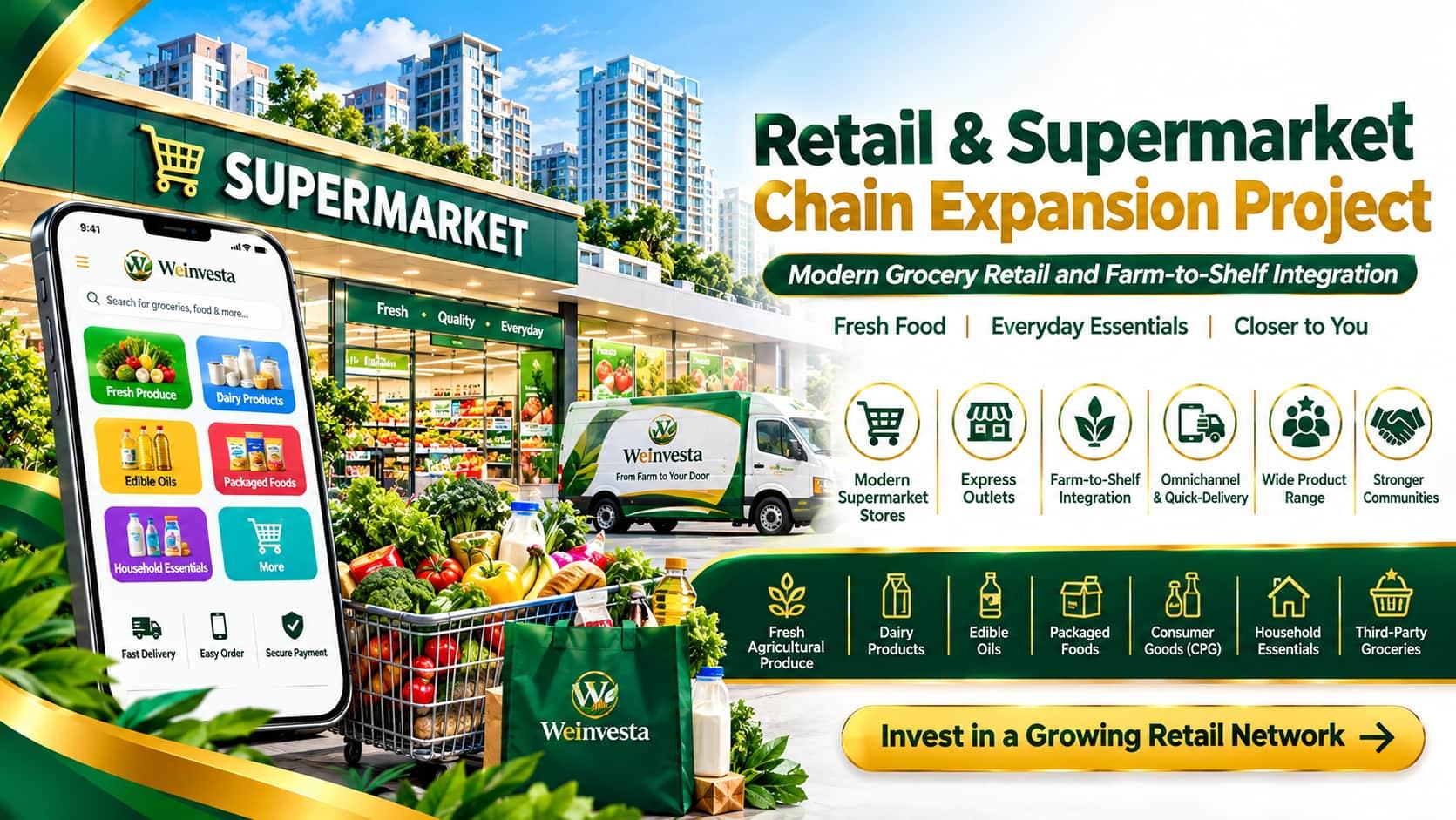
The retail and grocery industry plays an essential role in everyday life. From fresh agricultural produce and dairy products to edible oils, packaged foods, and household essentials, consumers depend on convenient access to reliable retail outlets.
As urban populations grow and shopping habits evolve, modern supermarkets, express grocery stores, and online delivery services are becoming increasingly important parts of the consumer economy.
WeInvesta's Retail & Supermarket Chain Expansion Project aims to expand modern retail grocery chains and express supermarket storefronts in high-density urban residential areas. The initiative focuses on connecting agricultural production, food distribution, and consumer retail through an integrated farm-to-shelf business model.
By combining supermarket storefronts, express outlets, and quick-commerce delivery channels, the project aims to create direct consumer access to food, dairy, edible oil, and consumer packaged goods (CPG) products.
This approach is designed to connect the wider WeInvesta food and consumer goods portfolio with everyday shopping demand.
Why Modern Supermarket Expansion Matters
Grocery shopping is a recurring necessity for households. Consumers regularly purchase fresh vegetables, fruits, dairy products, cooking essentials, packaged foods, and household goods.
Modern supermarkets help organize these products under one retail environment while providing convenient shopping experiences and consistent product availability.
High-density residential areas can offer attractive retail opportunities because of their concentrated household populations and potential for repeat customer visits.
The project's expansion strategy focuses on locations with strong household consumption, regular shopping activity, and convenient access for local communities.
By combining physical retail outlets with online ordering and delivery operations, the proposed business model aims to serve customers through multiple shopping channels.
Project Overview: Connecting Farms, Supermarkets, and Consumers
The Retail & Supermarket Chain Expansion Project focuses on capital expansion of modern grocery chains and express supermarket storefronts in high-density urban residential hubs.
Its central business concept is farm-to-shelf integration: connecting food and consumer goods production with procurement, retail distribution, and direct consumer sales.
The project aims to create direct consumer access to the portfolio's:
Fresh agricultural produce.
Dairy products.
Edible oils.
Packaged food products.
Consumer packaged goods (CPG).
Third-party groceries.
Household essentials.
By combining internally sourced portfolio products with third-party grocery products, the retail network aims to develop a broader product offering for everyday consumers.
Key Business Components
1. Modern Supermarket Storefront Expansion
The project plans to establish modern grocery stores in high-density urban residential locations.
These stores are intended to provide convenient access to fresh food, groceries, packaged products, and household essentials.
Location selection will prioritize areas with strong household consumption, regular customer traffic, and opportunities for repeat purchases.
2. Express Supermarket Outlets
Alongside larger retail storefronts, the project plans to develop express supermarket outlets.
These smaller-format retail locations are intended to serve nearby residential communities with convenient access to frequently purchased grocery items.
An express outlet model may help extend the retail network into densely populated neighborhoods while supporting convenient shopping.
3. Farm-to-Shelf Integration
One of the project's central business highlights is its planned farm-to-shelf approach.
The retail network aims to create direct consumer access to products from the wider portfolio, including agricultural produce, dairy, edible oils, and CPG brands.
Connecting production and retail distribution may create opportunities to coordinate procurement, product availability, and distribution activities.
This model aims to strengthen the connection between food production and final consumer demand.
4. Omnichannel Retail and Quick-Commerce Delivery
Modern consumers increasingly value shopping convenience and flexible purchasing options.
The project proposes an omnichannel retail model that combines:
Physical supermarket storefronts.
Express grocery outlets.
Online ordering.
Quick-commerce delivery operations.
Customer loyalty programs.
By connecting offline and online retail channels, the project aims to provide customers with multiple ways to access everyday products.
5. Procurement, Cold Display, and Inventory Management
Successful grocery retail operations require coordinated procurement and inventory management.
The business plan includes developing:
Procurement systems.
Cold-display infrastructure.
Point-of-sale (POS) systems.
Inventory control processes.
Delivery operations.
Supplier contracts.
These operational components are intended to support product availability, stock monitoring, and efficient retail activities.
Proper inventory management is particularly important for fresh produce, dairy, and other perishable products.
6. Private-Label Products and Customer Loyalty
The commercial strategy also includes private-label product opportunities and customer loyalty programs.
Private-label products may allow the retail network to offer selected goods under its own branding, while loyalty programs can encourage repeat shopping and strengthen customer relationships.
Combined with online ordering and convenient delivery, these services aim to support long-term customer engagement.
Business Model and Revenue Strategy
The project's commercial strategy focuses on selling internally sourced portfolio products alongside third-party groceries, fresh food, and household goods.
The planned business model includes several retail activities:
Retail Store Sales: Revenue opportunities from grocery products, fresh produce, dairy, edible oils, packaged foods, and household essentials sold through physical supermarkets.
Express Outlet Sales: Consumer sales through smaller-format supermarket outlets located in high-density residential communities.
Online Ordering and Delivery: Potential sales through online ordering and quick-commerce delivery channels.
Farm-to-Shelf Distribution: Connecting portfolio food and consumer goods products with direct retail distribution.
Private-Label Products: Developing branded product offerings that may support differentiation and retail margins.
Customer Loyalty Programs: Encouraging repeat purchases through customer-focused rewards and engagement initiatives.
The strategy aims to capture value across procurement, distribution, and retail sales. Actual commercial results will depend on operational execution, customer demand, competition, and cost management.
Key Investment Highlights
The project presents several proposed business and investment highlights:
Expansion of modern grocery chains in high-density urban areas.
Development of express supermarket storefronts.
Farm-to-shelf integration connecting food production with retail sales.
Direct consumer access to agricultural, dairy, edible oil, and CPG products.
An omnichannel model combining supermarkets and quick-commerce delivery.
Planned procurement and supplier management systems.
Cold-display infrastructure for fresh and perishable products.
POS systems and inventory control.
Private-label product opportunities.
Customer loyalty programs and online ordering.
Exposure to recurring consumer grocery demand.
The project aims to establish a retail distribution network that connects the wider food and consumer goods portfolio with everyday household shopping requirements.
Target Markets and Retail Locations
The project focuses on high-density urban residential centers where household consumption and repeat shopping activity may support supermarket operations.
Its intended customer groups include:
Urban Households: Consumers purchasing groceries, fresh food, dairy, cooking essentials, and household products.
Working Professionals: Customers seeking convenient grocery shopping and delivery options.
Families: Households requiring regular access to food, packaged products, and everyday essentials.
Online Grocery Customers: Consumers interested in ordering products digitally and receiving deliveries.
Local Communities: Residents who may benefit from nearby supermarket and express retail outlets.
The project prioritizes locations with strong household consumption and repeat customer traffic. Specific store addresses, confirmed opening schedules, and launch locations have not been provided in the available project information.
Project Snapshot
The following figures reflect the project's displayed information when reviewed.
Project Name: Retail & Supermarket Chain Expansion Project
Category: Retail & Consumer Goods
Project Location: High-Density Urban Centers
Project Status: Active
Displayed Expected Return: 28%
Displayed Duration: 24 Months
Target Amount: $149,403.49
Raised So Far: $0.00
Total Investors: 0
Funding Progress: 0%
Displayed Main Lock Period: 2 Years
Project figures and funding progress may change. Please check the live project page for updated information.
Displayed Investment Plans
The project page currently displays three investment options with different lock periods.
Plan 1: 6-Month Investment Plan
Lock Period: 6 Months
Displayed Fixed Rate: 7%
Total Profit: 7%
Investment Range: $100–$1,000,000
Instant Bonus: 0%
Payout Schedule: On Maturity
Plan 2: 12-Month Investment Plan
Lock Period: 12 Months
Displayed Fixed Rate: 14%
Total Profit: 14%
Investment Range: $100–$1,000,000
Instant Bonus: 0%
Payout Schedule: On Maturity
Plan 3: 24-Month Investment Plan
Lock Period: 24 Months
Displayed Fixed Rate: 28%
Total Profit: 28%
Investment Range: $100–$1,000,000
Instant Bonus: 0%
Payout Schedule: On Maturity
Important Investment Terms Notice: The project's About This Project section separately states a minimum investment of $1,000, a 24-month lock-in period, and a 17% target total profit. These terms differ from the displayed investment-plan cards, which show a $100 minimum and rates of 7%, 14%, and 28%.
Prospective investors should confirm the applicable minimum investment, lock period, and return structure directly with WeInvesta before proceeding.
Displayed rates are not guaranteed returns. Capital is at risk.
Project Documents and Transparency
Before considering an investment, prospective investors should review the available project documents to understand the proposed business model, operational strategy, investment structure, and associated risks.
Available documents include:
WeInvesta Whitepaper: General information about the WeInvesta platform and its investment approach.
Sector-by-Sector Projects Profile: An overview of the projects and their business activities.
Business Plan: Information about the proposed retail expansion and operational strategy.
Investment Prospectus & Risk Overview: Investment-related information and risk considerations.
Risk Disclosure: Important information about potential financial and operational risks.
Carefully reviewing these documents can help investors make more informed decisions.
Risks and Important Considerations
Retail and supermarket operations involve commercial, financial, and operational risks.
Important considerations include:
Rent Escalation: Increasing rental expenses may affect store operating costs and profitability.
Inventory Shrinkage: Stock loss, theft, damage, or inaccurate inventory records may reduce available inventory value.
Product Spoilage: Fresh produce, dairy, and other perishable products require effective storage and inventory management.
Location Selection: Choosing locations with insufficient customer traffic or weak household demand may affect store performance.
Cash Leakage: Inadequate cash controls, accounting procedures, or transaction monitoring may create financial losses.
Supplier Price Increases: Changes in procurement costs may affect product pricing and retail margins.
Market Competition: Existing supermarkets, grocery retailers, convenience stores, and online delivery services may create competitive pressure.
Labor Costs: Staffing expenses and workforce management may affect operating performance.
Consumer Spending Volatility: Changes in household spending and purchasing behavior may affect retail sales.
Operational Execution: Procurement, cold-display management, POS systems, inventory control, and delivery operations require effective coordination.
Investors should carefully assess these risks and review the project's risk disclosure before making an investment decision.
Building a Connected Retail Network for Everyday Consumers
Grocery retail is closely connected to everyday household consumption. Consumers regularly need access to fresh food, dairy products, edible oils, packaged groceries, and household essentials.
WeInvesta's Retail & Supermarket Chain Expansion Project aims to connect these recurring consumer needs with a modern retail distribution strategy.
Through supermarket storefronts, express outlets, farm-to-shelf integration, and quick-commerce delivery, the initiative seeks to create direct retail access to the wider portfolio of food and consumer goods products.
The proposed model combines physical retail infrastructure with digital ordering, procurement systems, inventory management, supplier relationships, and customer loyalty initiatives.
Its long-term success will depend on suitable store locations, efficient operations, competitive pricing, effective inventory management, and sustained consumer demand.
Explore the Investment Opportunity
Interested in learning more about modern supermarket expansion and integrated grocery retail?
Explore WeInvesta's Retail & Supermarket Chain Expansion Project to review its business model, investment plans, supporting documents, and risk disclosures.
Displayed Investment Range: $100–$1,000,000 on the investment-plan cards.
Displayed Return Options: 7%, 14%, and 28%, depending on the selected lock period.
Lock Period Options: 6 Months, 12 Months, and 24 Months.
Explore the Project & Invest Now
You can also contact the WeInvesta team through the project page to ask questions about the project and its investment terms.
Please confirm all applicable investment conditions directly with WeInvesta before proceeding, as the general investment terms and displayed investment plans currently show different figures.
Review all project documents and risk disclosures carefully.
WeInvesta — Invest Today, Harvest Tomorrow.
More From the Blog
Nov 17, 2026
Agri-Waste & Bio-Energy Recycling Investment | Sustainable Green Energy Project – WeInvesta
Read MoreNov 17, 2026
الاستثمار في إعادة تدوير المخلفات الزراعية والطاقة الحيوية | مشروع الاقتصاد الدائري المستدام – WeInvesta
Read MoreNov 17, 2026
কৃষি বর্জ্য রিসাইক্লিং ইনভেস্টমেন্ট | Bio-Energy ও Circular Economy Project – WeInvesta
Read More
Ready to Grow Your Wealth?
Put your capital behind real-world projects with real assets behind them.