
Organic Banana Fiber & Musa Silk Extraction Project | WeInvesta
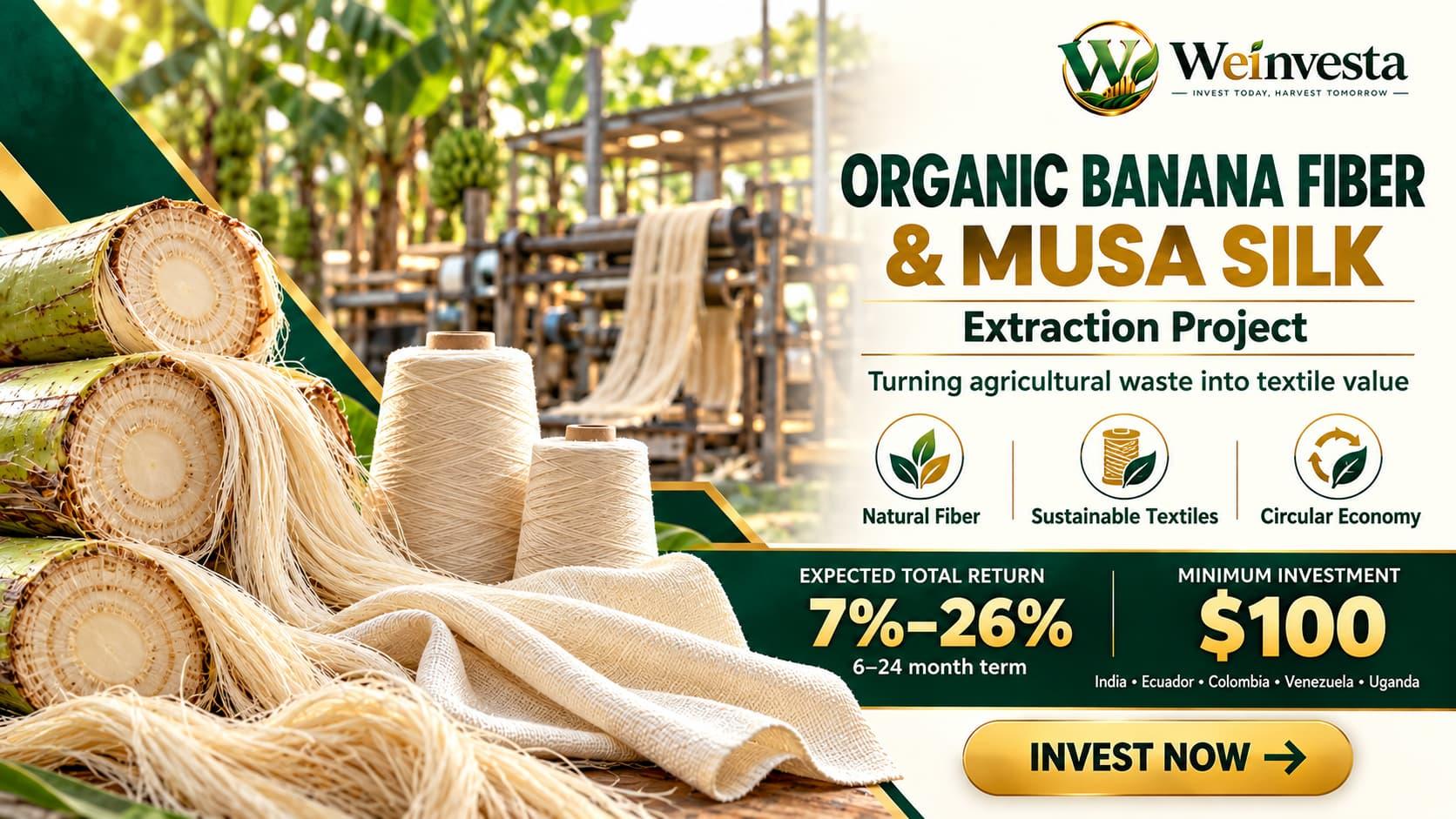
As industries increasingly explore plant-based materials and circular production models, agricultural byproducts offer an opportunity to create value beyond traditional farming. Banana pseudostems, which remain after harvesting, can serve as a source of natural fiber when collected and processed using suitable equipment.
The Organic Banana Fiber & Musa Silk Extraction Project aims to recover this underutilized agricultural resource and convert it into natural textile fibers and specialty Musa silk for potential use in sustainable fashion, handicrafts, eco-paper, and packaging applications.
The project targets India, Ecuador, Colombia, Venezuela, and Uganda, with a business model focused on agricultural waste recovery, fiber extraction, processing, and sales to domestic and international buyers.
What Is Banana Fiber Extraction?
Banana plants produce substantial biomass during cultivation. After harvesting the fruit, their pseudostems can become an agricultural residue that requires collection and handling.
Through mechanical extraction and subsequent processing, suitable banana pseudostems can be converted into natural fibers. Depending on fiber quality and processing standards, these materials may be suitable for textile applications, craft products, blended yarn inputs, paper production, and sustainable packaging.
The project’s Musa silk offering is intended to serve higher-value natural-fiber applications, subject to product quality, technical specifications, and buyer requirements.
How the Project Works
The proposed facility is designed around a series of collection and processing operations:
1. Raw material collection
Discarded banana pseudostems are collected from farms and agricultural sources. Consistent sourcing and timely transportation are important for maintaining material quality.
2. Fiber extraction
Decorticator machines separate usable fibers from the collected plant material. Machine selection, operating efficiency, and maintenance will influence production output.
3. Washing and degumming
Extracted fibers undergo washing and, where required, degumming to remove unwanted plant residues and prepare them for subsequent processing.
4. Drying and quality control
Controlled drying helps manage moisture levels and supports fiber consistency. This stage is especially important during wet seasons, when drying conditions may become more difficult.
5. Baling, packing, and distribution
Processed fibers are graded, packed, and prepared for transport to buyers. Initial sales are planned around raw and semi-processed fiber, with opportunities to develop more refined products over time.
Business Model and Revenue Opportunities
The project’s commercial strategy is designed to develop in stages.
Initially, the facility plans to sell raw and semi-processed banana fibers to suitable industrial and commercial buyers. As processing capacity and buyer relationships develop, the business intends to explore refined fiber, blended-yarn inputs, and eco-packaging materials.
Potential customer segments include:
Sustainable fashion and textile manufacturers
Handicraft and specialty-product producers
Eco-paper manufacturers
Biodegradable and environmentally conscious packaging businesses
Domestic distributors and export buyers
The commercial opportunity depends on achieving consistent fiber quality, controlling moisture and processing costs, maintaining reliable raw material supplies, and meeting buyer specifications.
Why Circular Economy Matters
A circular-economy approach seeks to recover useful materials and extend their value instead of treating them solely as waste.
By collecting discarded banana pseudostems and processing them into marketable fibers, the project aims to create a productive use for agricultural residues. The model may also support additional activity in collection, transportation, machinery operation, sorting, packaging, and distribution.
Its environmental and commercial benefits will depend on actual operating practices, resource efficiency, waste handling, and the availability of suitable buyers.
Project Snapshot
Project detailListed informationProject nameOrganic Banana Fiber & Musa Silk Extraction ProjectCategoryRecycling & Circular EconomyStatusActiveTarget marketsIndia, Ecuador, Colombia, Venezuela, UgandaCampaign targetUS$50,000Raised so farUS$0Funding progress0%Expected return shownUp to 26%Listed investment terms6, 12, or 24 months
Investment Plans
The detailed investment-plan section lists the following options:
Lock periodListed total profit ratePayout6 months7%At maturity12 months13%At maturity24 months26%At maturity
The detailed plan cards list an investment range of US$100–US$1,000,000, with no instant bonus.
These are the rates displayed in the supplied project information, not a guarantee of investment performance. Prospective investors should review the current official terms, project documentation, and associated risks before committing funds.
Key Risks to Consider
The project may face a number of operational and commercial challenges, including inconsistent banana pseudostem supply, variation in fiber quality, difficulties drying materials during wet seasons, machinery maintenance, labor requirements, export certification, transportation expenses, and competition from other natural fibers.
Buyer qualification and approval timelines may also affect the pace of sales and revenue development. Effective sourcing arrangements, quality control, cost management, and customer diversification will be important to the project’s execution.
Explore the Project
WeInvesta encourages interested readers to review its available project information and investment documentation before making a decision.
Final Thoughts
The Organic Banana Fiber & Musa Silk Extraction Project proposes a way to transform discarded banana pseudostems into useful natural-fiber products. By combining agricultural residue collection, mechanical fiber extraction, processing, and sales to textile and eco-product buyers, the project seeks to participate in the growing interest in circular materials.
Its long-term prospects will depend on reliable raw material sourcing, consistent product quality, efficient processing, cost control, and access to qualified buyers.
Ready to Grow Your Wealth?
Put your capital behind real-world projects with real assets behind them.