
Next-Gen AI & Enterprise Automation | WeInvesta
Next-Gen AI & Enterprise Automation: Connecting Artificial Intelligence with Digital Business
Artificial intelligence and automation are changing the way businesses manage operations, connect with customers, process information, and deliver digital services. From intelligent fleet management to automated business workflows, technology platforms can help organizations improve coordination and develop new digital services.
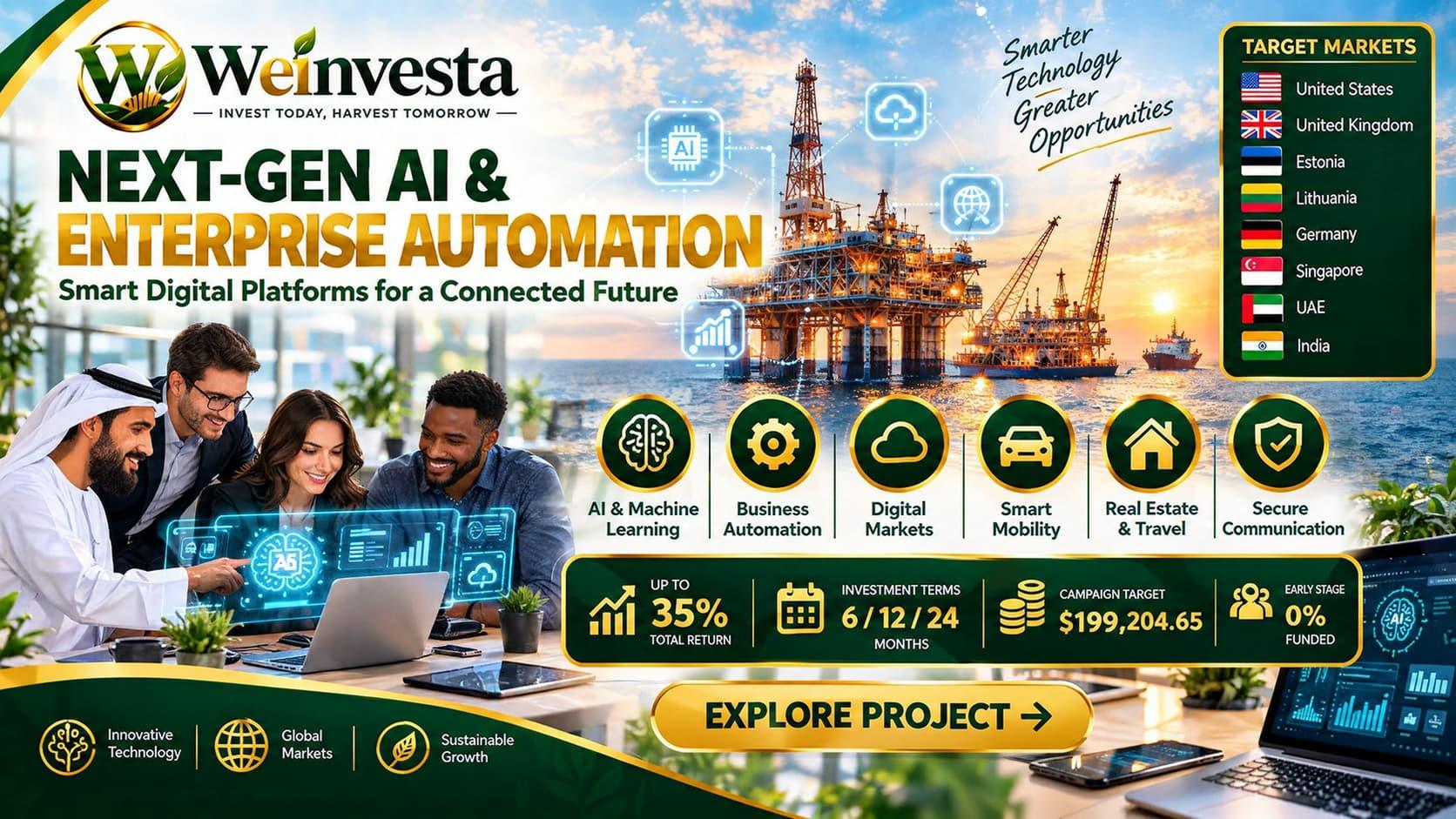
WeInvesta’s Next-Gen AI & Enterprise Automation project is described as a technology venture focused on enterprise artificial intelligence platforms, machine-learning automation tools, proprietary software, and digital infrastructure.
The project outlines a portfolio of digital services covering mobility, real estate rentals, travel booking, facility management, B2B and B2C marketplaces, business communications, video streaming, and social networking. Its target markets include the United States, the United Kingdom, Estonia, Lithuania, Germany, Singapore, the United Arab Emirates, and India.
The project’s stated approach combines software development, recurring software-as-a-service (SaaS) revenue opportunities, digital transaction activity, and scalable online services. However, actual commercial results depend on product development, user adoption, operating costs, competition, security, regulatory compliance, and execution.
Project Overview
Project Name: Next-Gen AI & Enterprise Automation
Sector: AI & Technology
Status: Active
Target Markets: United States, United Kingdom, Estonia, Lithuania, Germany, Singapore, United Arab Emirates, and India
Displayed Expected Return: Up to 35%, depending on the selected plan
Displayed Investment Terms: 6 months, 12 months, or 24 months
Campaign Target: $199,204.65
Raised So Far: $0.00
Total Investors: 0
Funding Progress: 0%
Estimated Build-Phase CAPEX: US$6 million–US$8 million over the first three years
These figures reflect the information supplied for this article and may change. Review the current project page and official documentation before making an investment decision.
About the Project
The project describes a technology portfolio designed to combine AI-enabled digital services, enterprise automation tools, online marketplaces, and secure communication infrastructure.
Its proposed platform ecosystem spans several business applications, with an emphasis on software-based services that can be delivered to individual users, businesses, and institutional customers.
1. AI-Driven Mobility and Fleet Management
The portfolio includes on-demand mobile platforms for ride-hailing and intelligent fleet management.
Potential applications include coordinating vehicle requests, supporting fleet operations, improving dispatch workflows, and helping businesses manage transportation-related activities. AI and automation tools may support decision-making and operational efficiency when appropriately designed and implemented.
Commercial performance would depend on platform reliability, user adoption, driver and fleet participation, local licensing requirements, competitive pricing, customer service, and ongoing technology development.
2. Real Estate Rental Platforms
The project identifies short-term and commercial real estate rental platforms as part of its proposed digital portfolio.
Such platforms can connect property owners, tenants, business customers, and service providers through digital search, listing, booking, and transaction processes.
The long-term performance of a rental platform depends on the quality and availability of listings, market demand, customer trust, payment systems, applicable property regulations, and the cost of attracting and retaining users.
3. Travel Booking and Smart Tour Ecosystems
The proposed portfolio includes integrated tour planning and travel booking services.
Digital travel platforms may bring together itinerary planning, accommodation discovery, booking management, and other travel-related services. Automation can support workflow coordination, customer communications, and service management.
Actual demand and revenue would depend on partnerships, the availability of bookable services, customer experience, seasonal travel patterns, competition, and relevant consumer-protection and travel regulations.
4. Domestic and Commercial Facility Management
The project also describes on-demand facility management applications serving households and commercial customers.
These services may include requesting, scheduling, and coordinating maintenance or other facility-related tasks. Automated workflows can help organize service requests, dispatch providers, and manage communications.
The business case depends on the availability of qualified service providers, service quality, operational coverage, pricing, customer retention, and the ability to manage requests consistently.
5. B2B and B2C E-Commerce Marketplaces
The portfolio includes specialized business-to-business (B2B) and business-to-consumer (B2C) marketplaces.
B2B marketplaces can connect businesses with suppliers and professional buyers, while B2C platforms serve individual consumers. Depending on their design, these platforms may generate revenue through transactions, subscriptions, service fees, or advertising.
Their performance depends on product selection, seller participation, transaction security, customer experience, fulfillment arrangements, competition, and marketplace liquidity.
6. Secure Digital Communications and Social Platforms
The project identifies a communications ecosystem that includes:
Encrypted messaging.
Video streaming.
Business email systems designed for reliable delivery.
Social networking spaces.
Privacy-focused digital infrastructure.
These services require dependable infrastructure, user-friendly design, effective cybersecurity, privacy safeguards, and ongoing maintenance. Messaging security, email deliverability, and privacy claims should be supported by technical architecture, testing, policies, and appropriate independent assessments.
The existence of a planned communications portfolio does not, by itself, establish that every service has been launched or independently validated.
Artificial Intelligence, Machine Learning, and Enterprise Automation
AI and machine-learning tools can support tasks such as data analysis, workflow coordination, information retrieval, forecasting, and routine process automation.
In enterprise settings, automation may help reduce repetitive manual work, improve consistency, and connect different business systems. The extent of these benefits depends on data quality, appropriate model selection, integration with existing processes, human oversight, and performance monitoring.
The project description highlights proprietary software intellectual property and experienced technology development teams. Investors should review the actual ownership of software assets, intellectual-property registrations where applicable, development milestones, technical documentation, staffing arrangements, and maintenance plans.
AI capabilities should be assessed based on demonstrated functionality and measurable performance rather than the technology label alone.
Business Model and Potential Revenue Sources
The project identifies several possible revenue channels associated with digital technology platforms:
Software-as-a-Service (SaaS): Recurring fees for access to business software and digital tools.
Transaction fees: Charges associated with bookings, marketplace transactions, or other platform activity.
Digital advertising: Advertising revenue where suitable for the service and user experience.
Platform services: Fees for additional functions, integrations, or specialized business solutions.
Recurring revenue can support business planning, but it is not automatic. Revenue depends on customer acquisition, retention, pricing, platform usage, service costs, competition, and customers’ willingness to pay.
The project also describes scalability as a key investment consideration. Digital platforms can sometimes serve additional users without increasing costs at the same rate, but infrastructure, customer support, cybersecurity, compliance, and development expenses may still rise substantially as the business grows.
Target Markets
The project identifies eight target markets:
United States
United Kingdom
Estonia
Lithuania
Germany
Singapore
United Arab Emirates
India
These countries represent the geographical scope stated in the project description. Their inclusion does not confirm that products, teams, customers, partnerships, or operating entities are already active in every market.
Before investing, review the planned launch sequence, local operating entities, licensing and data-protection requirements, market-entry strategy, partnership arrangements, and product availability in each jurisdiction.
Investment Plans and Lock Periods
The project page displays three investment plans. According to the displayed terms, the listed total profit is scheduled for payment at maturity.
Six-Month Plan
Displayed Total Profit Rate: 9%
Lock Period: 6 months
Investment Range: $100–$1,000,000
Payout: At maturity
Instant Bonus: 0%
Twelve-Month Plan
Displayed Total Profit Rate: 18%
Lock Period: 12 months
Investment Range: $100–$1,000,000
Payout: At maturity
Instant Bonus: 0%
Twenty-Four-Month Plan
Displayed Total Profit Rate: 35%
Lock Period: 24 months
Investment Range: $100–$1,000,000
Payout: At maturity
Instant Bonus: 0%
The general project description separately states a minimum investment of $1,000, a 24-month lock period, and an estimated growth target of 22%, with a plan band of 22%–30%. These figures differ from the three advertised total-profit rates and the $100 minimum shown in the detailed plans.
Before publishing or investing, confirm the current minimum investment, eligible plans, applicable profit rates, lock-period conditions, and contractual payout terms with WeInvesta.
The displayed rates are advertised plan terms, not a guarantee of actual performance. Review how profits are calculated, whether the figures represent total returns over each complete term, and whether any fees, withdrawal restrictions, or other conditions apply.
Funding Status and Development Costs
The supplied project information reports the following campaign figures:
Target Amount: $199,204.65
Raised So Far: $0.00
Total Investors: 0
Funding Progress: 0%
The project separately estimates US$6 million–US$8 million in build-phase capital expenditure over the first three years.
The relationship between the campaign target and the estimated development budget should be explained in the official business plan and investment prospectus. Investors should understand what the campaign funds, how the wider development program will be financed, and what milestones are expected during the build phase.
Project Documents and Due Diligence
Before committing funds, review the official project documentation and understand the commercial, legal, technical, and financial structure of the opportunity.
WeInvesta Whitepaper: Read the Whitepaper
Sector-by-Sector Projects Profile: Explore Projects
Investment Prospectus and Risk Overview: Review Risk Disclosure
Company Information: About WeInvesta
Investment Process: How It Works
Where applicable, review software ownership and licensing, intellectual-property rights, product roadmaps, operating-company details, development budgets, technical architecture, cybersecurity practices, privacy policies, commercial partnerships, revenue assumptions, operating costs, fees, and payout conditions.
Understanding the Risks
AI and enterprise technology ventures face product, market, technical, cybersecurity, regulatory, and financial risks.
Important considerations include:
Delays in software development and product launches.
Difficulty attracting users, business customers, or marketplace participants.
Strong competition and rapidly changing technology.
Cybersecurity incidents, data breaches, service outages, or privacy failures.
Legal requirements relating to AI, consumer protection, data processing, and cross-border operations.
Dependence on cloud infrastructure, third-party providers, or software vendors.
Higher-than-expected development, staffing, compliance, and customer-acquisition costs.
Uncertain monetization, revenue concentration, and financing constraints.
Restricted access to invested capital during the lock period.
AI and digital platforms may offer opportunities for scalable services, but neither growth nor profitability is guaranteed. Investors may lose some or all of their capital.
Explore Next-Gen AI & Enterprise Automation
Discover WeInvesta’s Next-Gen AI & Enterprise Automation project, review the official documentation, and assess the proposed technology portfolio and investment terms before deciding whether the opportunity aligns with your financial objectives and risk tolerance.
Explore the project: Next-Gen AI & Enterprise Automation
Learn how investing works: How It Works
Contact the team: Contact WeInvesta

Ready to Grow Your Wealth?
Put your capital behind real-world projects with real assets behind them.