
Meat Production Investment | Livestock, Dairy & Global Export Project – WeInvesta
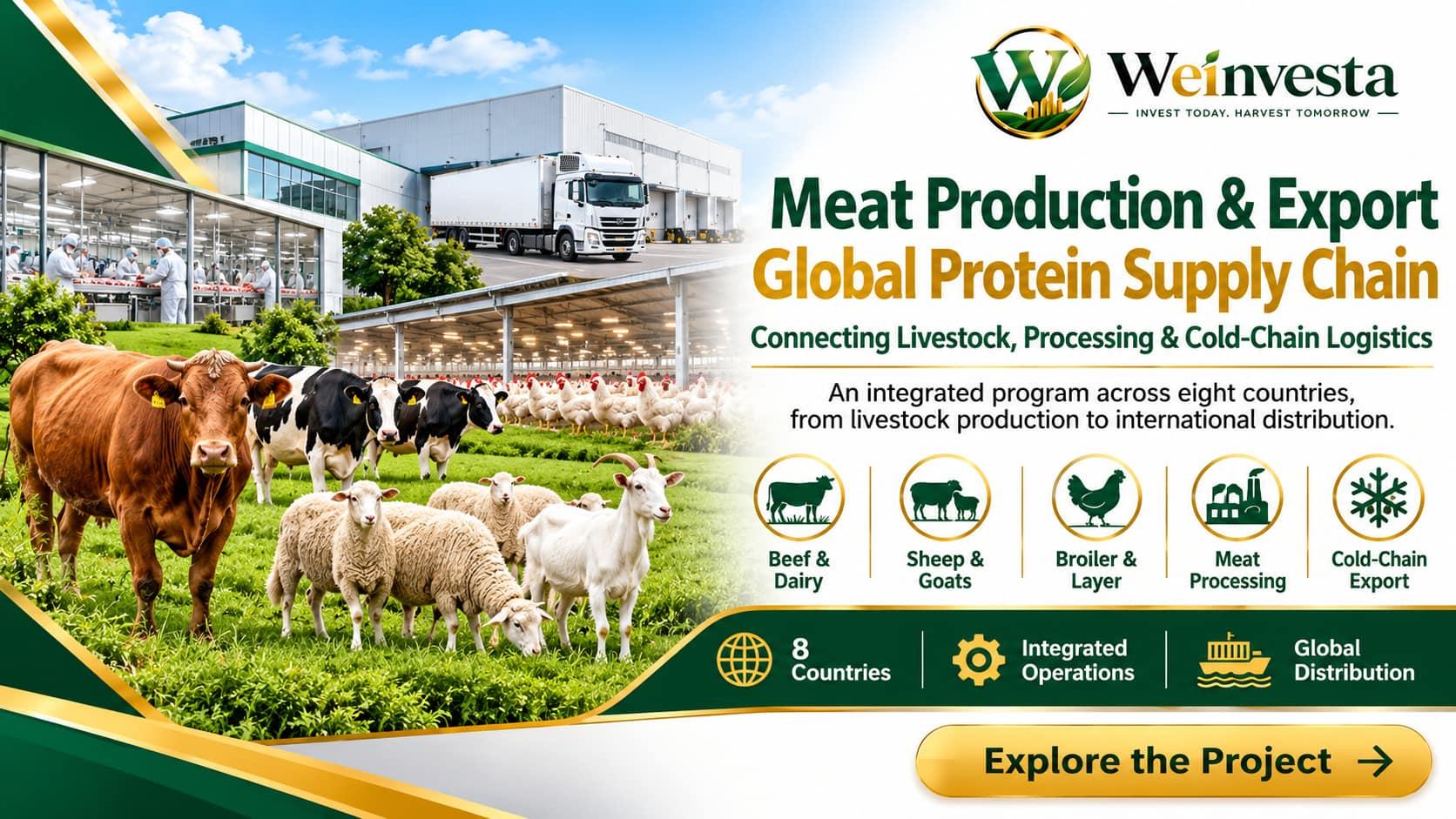
Meat, dairy products, and eggs are important components of food supply chains around the world. From household consumption and supermarkets to restaurants, food manufacturers, and international distributors, these products support a wide range of everyday commercial activities.
However, supplying these markets requires more than livestock production alone. A coordinated food-production business must also consider animal health, feed management, processing facilities, product quality, refrigerated storage, transportation, and access to reliable buyers.
This creates an opportunity for integrated livestock and food-processing operations that connect multiple stages of the supply chain.
WeInvesta’s Meat Production & Export Program focuses on a vertically integrated business model combining livestock farming, beef production, dairy processing, sheep and goat operations, poultry production, cold-chain logistics, and international export distribution.
The project identifies Poland, Romania, Brazil, Venezuela, Uruguay, Paraguay, Zambia, and Uganda as its target markets.
Its proposed approach aims to connect primary agricultural production with processing and distribution activities, creating a coordinated platform for meat, dairy, and poultry products.
Explore the official project:
https://weinvesta.com/projects/meat-production-program
Project Overview: Building an Integrated Livestock Platform
The central concept behind the project is vertical integration.
Instead of treating livestock farming, processing, storage, and distribution as completely separate activities, the project aims to coordinate them within a connected operating model.
The proposed platform includes:
Beef cattle fattening and processing.
Dairy farming and milk processing.
Sheep and goat breeding and fattening.
Broiler chicken production.
Layer-hen operations for egg production.
Cold-chain storage and refrigerated logistics.
Domestic distribution and international export channels.
Integration with crop production, silage fodder, and agricultural waste conversion.
By coordinating these activities, the project aims to develop multiple product categories and distribution opportunities across the livestock and food sectors.
The actual performance of this model will depend on operational readiness, infrastructure, management, market access, regulatory compliance, and commercial execution.
Why Meat Production and Livestock Processing Matter
The livestock and food-processing sectors play an important role in supplying essential food products.
Consumers and businesses purchase beef, poultry, milk, cheese, butter, yogurt, and eggs through supermarkets, wholesalers, restaurants, food-service companies, and other distribution channels.
A coordinated production system must manage several connected requirements:
Livestock Management: Responsible animal sourcing, breeding, feeding, veterinary care, and health monitoring.
Feed Security: Reliable access to suitable feed and fodder to support livestock operations.
Processing Infrastructure: Facilities for handling, slaughtering, processing, packaging, and quality control.
Dairy Production: Hygienic milk collection, processing, refrigeration, and distribution.
Poultry Operations: Biosecurity, feeding, vaccination, housing, and production-cycle management.
Cold-Chain Logistics: Temperature-controlled storage and transportation for perishable products.
Market Access: Distribution agreements, buyer relationships, export approvals, and compliance with destination-market requirements.
The project aims to bring these activities together under an integrated livestock and food-production strategy.
Key Business Components
1. Beef Cattle Production and Processing
The project description includes a dedicated feedlot designed for approximately 2,500 head of cattle, supported by a beef fattening operation and Halal-certified processing.
Beef production involves several stages, including livestock sourcing, feeding, animal-health management, processing, packaging, storage, and distribution.
The proposed model aims to coordinate cattle production with processing and refrigerated logistics, helping connect livestock operations with domestic and international meat markets.
Halal processing may also be relevant to markets where consumers and buyers require products that meet applicable Halal standards. Prospective investors should verify the relevant certification, facility status, and export eligibility through official documentation.
2. Dairy Farming and Milk Processing
The proposed platform includes approximately 500–1,000 dairy cows connected to a modern dairy-processing operation.
The planned product categories include:
Pasteurized milk.
Artisanal cheese.
Butter.
Yogurt.
Dairy production requires consistent animal care, hygienic milking procedures, veterinary management, suitable feed, refrigeration, and reliable distribution.
Processing milk into different consumer products can create additional commercial channels beyond the sale of raw milk. However, actual production volumes and financial results will depend on herd performance, processing capacity, product quality, operating costs, and market demand.
3. Sheep and Goat Breeding and Fattening
The project also describes an intensive breeding and fattening program involving approximately 5,000–10,000 lambs, sheep, and goats.
These livestock categories can serve different consumer markets and provide additional product options within a diversified livestock operation.
Effective management requires appropriate breeding practices, animal-health monitoring, feed planning, housing, and access to suitable buyers.
Production outcomes may be affected by disease, mortality, feed costs, breeding performance, market prices, and operational conditions. The stated capacity should therefore be assessed alongside the project's detailed business plan and supporting records.
4. Commercial Poultry and Egg Production
The poultry component is designed around two production streams:
Approximately 10,000–30,000 broiler chickens for meat production.
Approximately 50,000 layer hens for table egg production.
Broiler operations focus on raising chickens for meat, while layer operations are designed to supply eggs through regular production cycles.
Both require appropriate housing, feed management, veterinary supervision, vaccination programs, biosecurity procedures, and reliable routes to market.
Poultry production can provide a complementary product category within the wider livestock platform. Nevertheless, disease outbreaks, feed-price fluctuations, mortality, energy costs, and market-price changes can materially affect results.
5. Meat and Dairy Processing Infrastructure
Processing infrastructure is an important part of the proposed business model.
The project describes facilities intended to support meat handling, dairy processing, product preparation, packaging, storage, and distribution.
The related processing and cold-chain capital expenditure identified in the project description is approximately US$4.3 million.
Processing operations require suitable equipment, trained personnel, hygiene procedures, quality-control systems, maintenance, utilities, and compliance with applicable food-safety regulations.
The exact scope, development status, ownership, and operational capacity of the facilities should be reviewed through the project's official documents.
6. Cold-Chain Storage and Refrigerated Logistics
Meat, dairy, and poultry products are perishable and require appropriate handling throughout the supply chain.
Cold-chain logistics use temperature-controlled storage and transportation to help maintain product quality and meet relevant food-safety requirements.
The project's proposed logistics model highlights:
Refrigerated storage.
Temperature-controlled transportation.
Coordinated product handling.
Inventory and distribution planning.
Support for domestic and export delivery channels.
Effective cold-chain management can be important for reducing spoilage and maintaining product condition. However, equipment failure, power interruptions, transportation delays, and inadequate temperature monitoring can create operational and financial risks.
7. International Export and Distribution Channels
The project identifies the following countries as its target markets:
Poland.
Romania.
Brazil.
Venezuela.
Uruguay.
Paraguay.
Zambia.
Uganda.
The project aims to develop access to domestic and international distribution channels for meat, dairy, and poultry products.
Potential commercial channels may include wholesalers, supermarkets, food-service businesses, institutional buyers, processors, and export distributors.
International trade in animal products requires compliance with destination-country import rules, veterinary and sanitary requirements, customs procedures, product standards, and relevant certifications.
Market access should not be assumed solely from the identification of a country as a target market. Investors should confirm existing buyer relationships, export approvals, and operational arrangements through the official project documents.
Integrated Production Strategy: Connecting Crops, Feed, Livestock, and Processing
One of the project's stated strategic concepts is to connect crop production, silage fodder, livestock operations, food processing, and waste conversion.
An integrated model may help coordinate feed requirements with agricultural production and improve the use of suitable by-products.
The intended business logic includes:
Planning feed availability for livestock operations.
Using silage and suitable fodder to support animal nutrition.
Coordinating livestock production with processing capacity.
Managing agricultural and livestock by-products.
Connecting finished products with distribution channels.
Such integration may create operational efficiencies when properly implemented. However, it does not eliminate exposure to feed-price inflation, crop-production variability, animal disease, equipment failure, or market disruptions.
The actual level of integration and its measurable benefits should be assessed through project records and operational reporting.
Commercial Strategy: Serving Multiple Food Markets
The project’s commercial approach is based on developing multiple product categories and distribution routes.
Meat Distribution: Supplying beef, sheep, goat, and poultry products through suitable domestic and wholesale channels.
Dairy Product Sales: Developing distribution opportunities for pasteurized milk, cheese, butter, and yogurt.
Egg Supply: Connecting layer-hen production with retailers, wholesalers, restaurants, and other buyers.
Cold-Chain Distribution: Using suitable refrigerated storage and transportation to support the handling of perishable products.
Export Markets: Exploring international distribution opportunities subject to the necessary approvals, buyer agreements, and regulatory requirements.
Integrated Supply Chain: Coordinating livestock, feed, processing, storage, and distribution activities to support the wider business model.
The project's commercial performance will depend on production costs, selling prices, buyer demand, competition, logistics expenses, and the successful execution of its operating strategy.
Key Investment Highlights
The project presents several proposed business components:
Integrated livestock and food-production strategy.
Beef cattle feedlot capacity described at approximately 2,500 head.
Proposed dairy operation involving 500–1,000 cows.
Sheep and goat breeding and fattening program involving 5,000–10,000 animals.
Broiler production capacity described at approximately 10,000–30,000 chickens.
Layer-hen operation involving approximately 50,000 hens.
Meat and dairy processing activities.
Halal-certified processing identified in the project description.
Cold-chain storage and refrigerated logistics.
Domestic and international distribution strategy.
Target markets across Europe, Latin America, and Africa.
Integration with crop production, silage fodder, and waste conversion.
Related processing and cold-chain CAPEX identified at approximately US$4.3 million.
These highlights describe the project's stated business model and proposed operating scope. They should not be interpreted as independent confirmation that every facility, capacity, certification, or export arrangement is already operational.
Project Snapshot
Project Name: Meat Production & Export Program
Category: Meat Production
Project Status: Active
Target Markets: Poland, Romania, Brazil, Venezuela, Uruguay, Paraguay, Zambia, and Uganda
Displayed Expected Return: Up to 26%
Displayed Maximum Duration: 24 Months
Target Amount: $107,072.50
Raised So Far: $68,775.86
Total Investors: 92
Funding Progress: Approximately 64%
Displayed Investment Range: $100–$1,000,000 on the plan cards
Related Processing and Cold-Chain CAPEX: Approximately US$4.3 million
Project figures, funding progress, plan availability, and displayed terms may change. Refer to the live project page for the latest information.
Displayed Investment Plans
The project page displays three investment options. The listed profit rates are total displayed profit for each selected term, with payout shown as payable at maturity.
6-Month Investment Plan
Lock Period: 6 Months
Displayed Fixed Rate: 7%
Total Displayed Profit: 7%
Investment Range: $100–$1,000,000
Instant Bonus: 0%
Payout Schedule: On Maturity
12-Month Investment Plan
Lock Period: 12 Months
Displayed Fixed Rate: 13%
Total Displayed Profit: 13%
Investment Range: $100–$1,000,000
Instant Bonus: 0%
Payout Schedule: On Maturity
24-Month Investment Plan
Lock Period: 24 Months
Displayed Fixed Rate: 26%
Total Displayed Profit: 26%
Investment Range: $100–$1,000,000
Instant Bonus: 0%
Payout Schedule: On Maturity
Important Investment Terms to Review
The project's general Investment Terms section and its displayed investment-plan cards contain different figures.
The general terms in the project description state:
Minimum Investment: $1,000 USD.
Lock Period: 18 Months.
Target Total Profit: 16%.
Plan Band: 16%–25%.
However, the displayed plan cards list:
Minimum Investment Range: $100–$1,000,000.
6-Month Plan: 7% total displayed profit.
12-Month Plan: 13% total displayed profit.
24-Month Plan: 26% total displayed profit.
These differences should be clarified before publication or investment. Prospective investors should confirm the currently applicable minimum investment, selected lock period, profit calculation, contractual terms, and payout conditions directly with WeInvesta.
The displayed rates are plan figures and must not be treated as guaranteed investment outcomes. Capital is at risk.
Project Documents and Transparency
Before making an investment decision, prospective investors should review the official project documentation.
The project page lists the following documents:
WeInvesta Whitepaper: General information about the platform and its investment approach.
Sector-by-Sector Projects Profile: An overview of the platform's sectors and project activities.
Investment Prospectus & Risk Overview: Information about the investment structure and relevant risks.
Investors should also request clarification on the project's operating facilities, asset ownership, processing capacity, certifications, export arrangements, financial assumptions, and applicable investment agreement.
Reviewing the documents and asking questions before committing capital can help investors understand the project's proposed business model and associated risks.
Risks and Important Considerations
Livestock farming, meat processing, dairy production, poultry operations, and international food distribution involve significant commercial and operational risks.
Important considerations include:
Animal Disease: Disease outbreaks can affect livestock health, production volumes, and operating costs.
Feed-Price Inflation: Increases in grain, fodder, and feed prices may reduce operating margins.
Animal Mortality: Mortality and breeding-performance issues can affect production plans.
Food Safety and Contamination: Inadequate hygiene or contamination incidents may lead to recalls, penalties, and reputational damage.
Processing Facility Risk: Equipment breakdown, maintenance costs, and operational interruptions may affect production.
Cold-Chain Failure: Temperature-control problems can cause spoilage and product losses.
Regulatory Compliance: Livestock, slaughtering, food processing, Halal certification, and exports are subject to applicable legal requirements.
Export and Trade Restrictions: Import rules, sanitary approvals, customs procedures, and trade-policy changes may affect market access.
Market-Price Volatility: Changes in meat, dairy, poultry, and feed prices can influence revenue and profitability.
Buyer and Distributor Dependency: Delayed payments, contract changes, or loss of buyers may affect cash flow.
Currency and Cross-Border Risk: International operations may be exposed to foreign-exchange movements and cross-border payment challenges.
Investors should carefully evaluate these risks, review the official Risk Disclosure, and confirm all contractual terms before making a decision.
Building a Connected Livestock and Food-Production Business
The global food supply chain depends on coordinated production, processing, storage, and distribution.
Livestock businesses that combine meat, dairy, poultry, and related processing activities may have opportunities to serve different consumer and commercial markets. However, successful execution requires effective animal management, reliable infrastructure, food-safety controls, disciplined cost management, and dependable market access.
WeInvesta’s Meat Production & Export Program aims to bring these activities together through an integrated livestock platform connecting farming, processing, cold-chain logistics, and international distribution.
Its proposed business model focuses on multiple food categories and target markets, while its long-term performance will depend on operational execution, market demand, regulatory compliance, and financial management.
Explore the Meat Production & Export Program
Interested in learning more about an investment project focused on livestock production, meat and dairy processing, poultry operations, and international distribution?
Visit the official project page to review the latest project information, displayed investment plans, available documents, and risk disclosures.
Displayed Investment Range: $100–$1,000,000 on the investment-plan cards.
Displayed Profit Options: 7%, 13%, and 26%, depending on the selected plan.
Displayed Lock Period Options: 6 Months, 12 Months, and 24 Months.
Explore the Meat Production & Export Program
You can also contact the WeInvesta team through the project page to clarify the applicable investment terms and ask questions before proceeding.
WeInvesta — Invest Today, Harvest Tomorrow.
More From the Blog
Nov 17, 2026
Agri-Waste & Bio-Energy Recycling Investment | Sustainable Green Energy Project – WeInvesta
Read MoreNov 17, 2026
الاستثمار في إعادة تدوير المخلفات الزراعية والطاقة الحيوية | مشروع الاقتصاد الدائري المستدام – WeInvesta
Read MoreNov 17, 2026
কৃষি বর্জ্য রিসাইক্লিং ইনভেস্টমেন্ট | Bio-Energy ও Circular Economy Project – WeInvesta
Read More
Ready to Grow Your Wealth?
Put your capital behind real-world projects with real assets behind them.