
High-Capacity Auto Rice Mill Project | WeInvesta
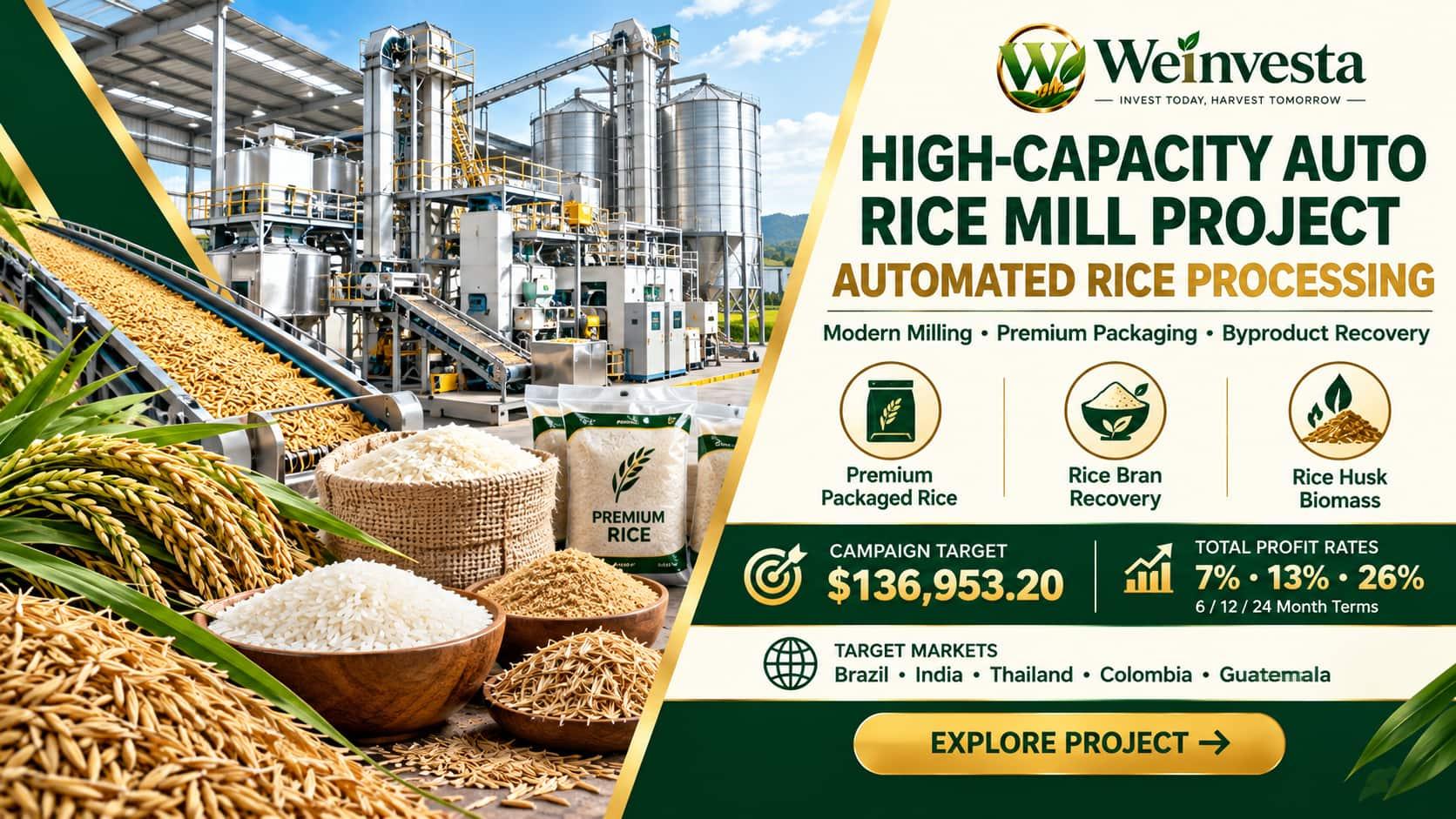
Rice is a staple food for billions of people, making efficient rice processing an important part of agricultural supply chains. Modern milling facilities can support consistent product quality through integrated operations such as paddy drying, parboiling, husking, polishing, grading, and packaging.
The High-Capacity Auto Rice Mill Project aims to establish a modern, fully automated rice-processing facility that converts harvested paddy into packaged rice products while capturing additional value from rice bran and husk.
The project targets Brazil, India, Thailand, Colombia, and Guatemala. Its proposed sourcing model combines paddy from integrated farmland with supplies purchased from regional farmers under purchase agreements.
By bringing several processing stages together, the project aims to improve operational coordination, support consistent product quality, and develop multiple commercial outlets for rice and its byproducts.
What Is an Automated Rice Mill?
An automated rice mill processes paddy through a coordinated series of mechanical and quality-control operations. Depending on the production setup, the process may include cleaning, drying, parboiling, husking, polishing, grading, color sorting, weighing, and packaging.
Automation can help standardize processing steps and monitor product quality. Actual performance, however, depends on equipment selection, operating procedures, raw material quality, maintenance, energy availability, and workforce training.
The proposed facility is intended to combine these functions in a modern agro-processing hub, with storage and distribution infrastructure to support commercial operations.
How the Project Is Planned to Operate
1. Paddy Procurement and Intake
The project plans to source paddy from integrated farmland and regional farmers through purchase agreements. The supplied project information refers to paddy harvested from more than 5,000 hectares of integrated farmland.
Incoming paddy will need appropriate inspection and handling to assess quality, moisture levels, and suitability for processing. Reliable procurement arrangements will be important for maintaining consistent mill utilization throughout the year.
2. Drying and Parboiling
The facility is planned to include drying areas and parboiling equipment. Drying helps manage moisture before storage and processing, while parboiling involves controlled treatment of paddy before milling.
These stages require effective temperature and moisture management to support grain quality and reduce avoidable losses. Seasonal conditions and electricity costs may influence operating performance.
3. Husking and Milling
During husking and milling, the outer husk is separated and the grain is processed to produce milled rice. Appropriate machine settings and routine maintenance are important for efficient processing and limiting unnecessary broken-grain losses.
4. Polishing, Grading, and Color Sorting
The project proposes polishing, grading, and color-sorting equipment to help produce rice that meets the specifications of different customers.
Quality consistency, grain appearance, cleanliness, and product specifications can influence buyer acceptance and the ability to serve premium retail and wholesale markets.
5. Packaging and Warehouse Storage
Processed rice is planned to be weighed, bagged, labeled, and stored before distribution. Branded packaging and effective warehouse management may support retail sales, wholesale distribution, and supply to supermarket chains.
Storage controls will be important for managing moisture, pests, product handling, and inventory turnover.
Creating Additional Value from Rice Bran and Husk
The project's business model extends beyond selling milled rice. It also aims to recover commercial value from two important byproducts: rice bran and rice husk.
Rice bran can serve as a raw material for suitable downstream applications, including rice bran oil production, subject to quality requirements and the receiving facility's processing capabilities.
Rice husk may be used in suitable fuel or biomass applications, depending on technical feasibility, equipment requirements, and environmental considerations.
These byproduct streams may provide additional sales opportunities while helping make productive use of materials generated during rice milling.
The project also describes a potential connection with WeInvesta’s rice bran oil initiative and consumer packaged goods distribution. The commercial value of these connections will depend on actual operating arrangements, product quality, transfer prices, and buyer demand.
Business Model and Commercial Strategy
The project plans to generate revenue through several channels:
Branded packaged rice: Supply packaged products to retailers and supermarket chains.
Wholesale rice: Sell processed rice to distributors and other commercial buyers.
Rice bran sales: Supply suitable bran to the rice bran oil processing operation or other qualified buyers.
Husk utilization: Explore sales or internal use for appropriate fuel and biomass applications.
The commercial strategy prioritizes consistent product quality, branded retail packaging, wholesale distribution, and relationships with regional farmers and agricultural suppliers.
Potential buyers include wholesale distributors, supermarkets, retailers, food businesses, and industrial customers interested in suitable rice-processing byproducts.
Successful execution will depend on procurement costs, milling yield, packaging expenses, storage capacity, distribution efficiency, market pricing, and competition from established rice mills.
Project Snapshot
Project detailSupplied informationProject nameHigh-Capacity Auto Rice Mill ProjectCategoryAgro ProcessingStatusActiveTarget marketsBrazil, India, Thailand, Colombia, GuatemalaCampaign targetUS$136,953.20Raised so farUS$0Total investors0Funding progress0%Displayed expected return26%Displayed project duration24 monthsDisplayed lock period2 yearsEstimated total project investment requirementUS$3.50 million–US$5.50 million
The campaign target and estimated total project investment requirement represent different figures in the supplied information. Their relationship should be clarified in the official project documentation.
Investment Plans
The detailed investment-plan cards list three options:
Lock periodListed total profit ratePayout timing6 months7%At maturity12 months13%At maturity24 months26%At maturity
The detailed plan cards specify an investment range of US$100 to US$1,000,000, with a 0% instant bonus.
However, the general investment-terms section separately states a minimum investment of US$1,000 and a target total profit of 16%. These figures conflict with the detailed plan cards and the project summary, which shows a 26% expected return and a two-year duration.
The final terms should be confirmed and made consistent across the project page, investment plans, and published articles before promotion. The rates listed above should not be interpreted as guaranteed investment outcomes.
Prospective investors should review the current official investment terms, project documentation, payout conditions, and applicable risk disclosures before investing.
Key Risks and Considerations
The project may face operational, commercial, agricultural, and financial risks, including:
Paddy price fluctuations: Changes in procurement costs may affect processing margins.
Seasonality: Harvest cycles and local supply conditions may influence raw material availability.
Moisture and storage losses: Improper drying or storage may reduce grain quality and increase spoilage.
Equipment downtime: Repairs and maintenance can interrupt production.
Electricity costs: Energy expenses may affect manufacturing costs.
Pest and warehouse risks: Storage conditions require effective monitoring and management.
Quality rejection: Finished rice may fail to meet buyer specifications.
Working capital pressure: Procurement, inventory, packaging, and distribution require funding.
Competition: Established mills and branded rice suppliers may create pricing pressure.
Procurement planning, preventive maintenance, quality-control procedures, careful inventory management, and diversified customer relationships will be important to operating performance.
Explore WeInvesta
Learn more about WeInvesta’s project information and available documentation:

Ready to Grow Your Wealth?
Put your capital behind real-world projects with real assets behind them.