
Building the Future of Urban Grocery Retail | WeInvesta Supermarket Expansion
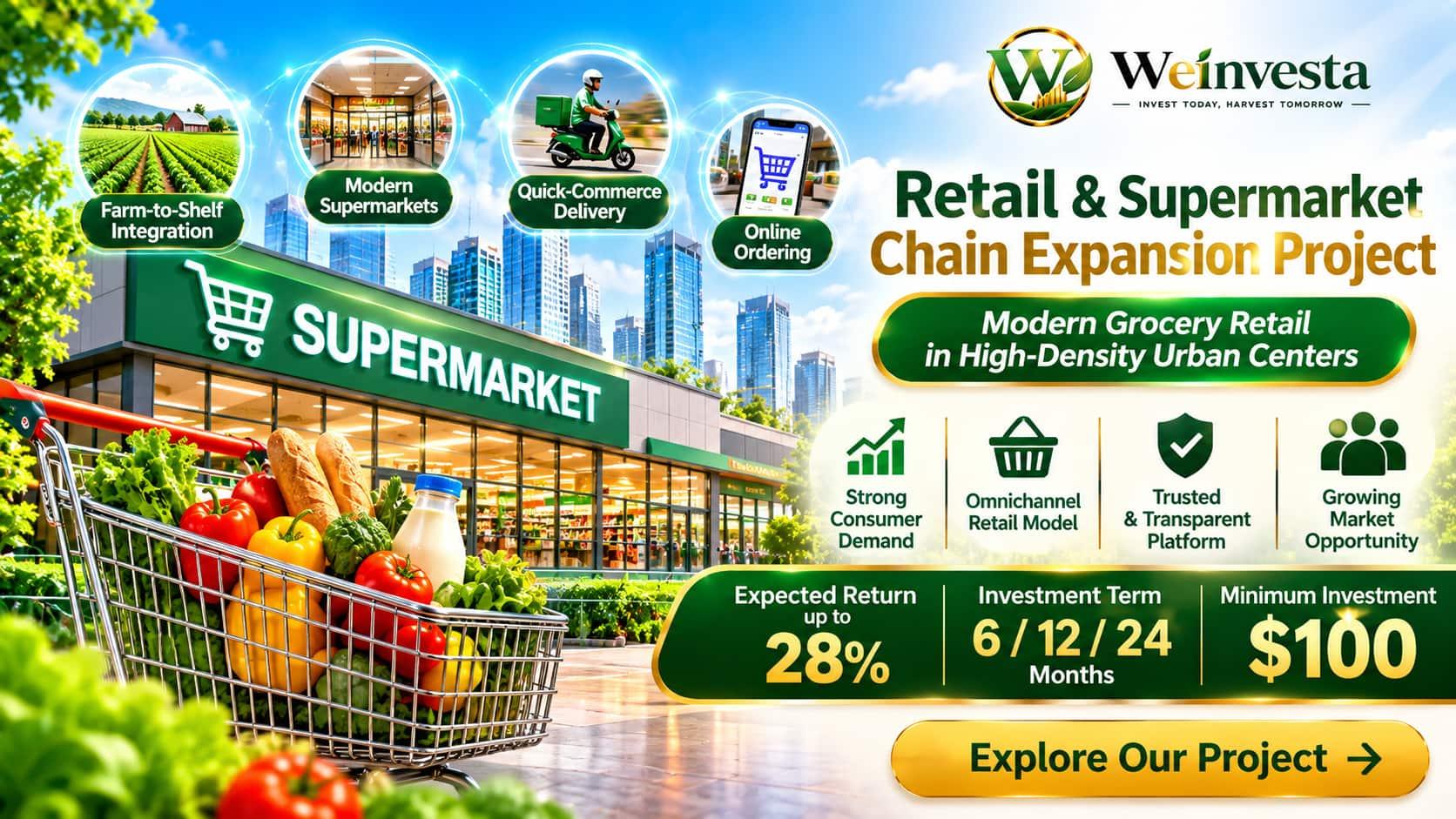
Grocery shopping is an essential part of everyday life. As urban communities grow and consumer expectations evolve, modern retail businesses must adapt to changing shopping habits, product availability, and delivery preferences.
Traditional grocery stores are increasingly competing with organized supermarkets, express retail outlets, and online ordering platforms. Consumers want convenient access to fresh produce, household essentials, dairy products, packaged foods, and everyday necessities in one accessible shopping experience.
Recognizing this evolving retail landscape, WeInvesta presents its Retail & Supermarket Chain Expansion Project, an initiative focused on expanding modern grocery stores and express supermarket storefronts in high-density urban residential areas.
The project's business concept combines physical retail locations, agricultural product sourcing, inventory management, and digital ordering to create an integrated consumer-facing retail operation.
Explore the project:
https://weinvesta.com/projects/retail-supermarket-expansion
Project Overview: Developing an Integrated Retail Network
The project focuses on establishing and expanding grocery retail operations in locations where household consumption and repeat customer traffic are important commercial considerations.
Rather than concentrating exclusively on traditional supermarket operations, the proposed model combines several business activities:
Modern grocery and supermarket storefronts.
Express retail outlets serving nearby residential communities.
Direct access to fresh agricultural products.
Procurement and supplier management systems.
Refrigerated product displays and inventory control.
Online ordering and quick-commerce delivery.
Customer loyalty programs and private-label product opportunities.
This integrated approach is designed to connect product sourcing with retail distribution and direct consumer sales.
Farm-to-Consumer: Connecting Supply with Everyday Demand
One of the project's central business concepts is its farm-to-shelf integration strategy.
Agricultural products and fresh food can move through a connected supply chain before reaching consumers through retail storefronts and delivery channels.
The proposed model aims to create a closer connection between food production, procurement, storage, distribution, and final retail sales.
Its potential operational benefits include:
Improving coordination between suppliers and retail locations.
Creating direct consumer access to fresh agricultural products.
Supporting the distribution of food and dairy products.
Integrating selected portfolio products into retail channels.
Developing additional sales opportunities through physical and digital platforms.
The project also aims to provide direct consumer access to products from food, dairy, edible oil, and consumer packaged goods businesses within the broader portfolio.
Modern Store Infrastructure and Operational Development
Expanding a supermarket network requires more than securing commercial property and opening storefronts. Each location needs reliable operational systems that support daily retail activities.
The project's planned business development includes several important infrastructure components.
1. Strategic Store Locations
The expansion strategy prioritizes high-density urban residential areas with strong household consumption and repeat shopping activity.
2. Procurement and Supplier Networks
Supplier contracts and procurement systems are intended to support product availability and coordinate the flow of groceries and fresh produce.
3. Cold Display and Product Handling
Cold display infrastructure is relevant to maintaining appropriate storage and presentation conditions for selected fresh and dairy products.
4. Point-of-Sale and Inventory Management
POS systems and inventory controls are planned to support sales tracking, stock monitoring, and retail operations.
5. Delivery and Online Ordering
Digital ordering and delivery operations are part of the proposed omnichannel retail strategy, connecting physical stores with customers who prefer convenient shopping options.
An Omnichannel Retail Strategy
Modern consumers do not always follow a single shopping method. Some prefer visiting physical stores, while others value online ordering and home delivery.
The project proposes combining these channels through an omnichannel retail model.
Its commercial strategy includes:
In-store grocery and household product sales.
Online ordering for selected products.
Quick-commerce delivery operations.
Customer loyalty programs.
Private-label product opportunities.
Sales of internal portfolio products and third-party groceries.
Combining these channels may create multiple ways for customers to interact with the retail business. However, actual performance will depend on execution, operating costs, consumer demand, and competitive conditions.
Revenue Opportunities and Commercial Considerations
The project identifies several potential commercial activities within the grocery and consumer goods sector.
These include selling fresh produce, dairy products, packaged groceries, edible oils, and household essentials through physical and digital retail channels.
The business model also considers private-label products and the distribution of selected internal portfolio products.
Important commercial considerations include:
Product sourcing and supplier pricing.
Store rental and operating expenses.
Inventory turnover and stock management.
Product spoilage and inventory shrinkage.
Delivery and logistics costs.
Customer retention and repeat purchases.
Competition from established retailers and local grocery businesses.
These factors will influence the project's ability to operate efficiently and develop sustainable commercial activity.
Project Snapshot
Project Name: Retail & Supermarket Chain Expansion Project
Category: Retail & Consumer Goods
Location: High-Density Urban Centers
Project Status: Active
Displayed Expected Return: 28%
Displayed Duration: 24 Months
Campaign Target Amount: $149,403.49
Raised So Far: $0.00
Total Investors: 0
Funding Progress: 0%
Displayed Headline Lock Period: 2 Years
Estimated Project Requirement: US$3M–US$6M
Displayed Investment Plans
The project page displays three investment-plan options:
6-Month Plan
Fixed Rate: 7%
Investment Range: $100–$1,000,000
Total Displayed Profit: 7%
Bonus: 0%
Payout: At maturity
12-Month Plan
Fixed Rate: 14%
Investment Range: $100–$1,000,000
Total Displayed Profit: 14%
Bonus: 0%
Payout: At maturity
24-Month Plan
Fixed Rate: 28%
Investment Range: $100–$1,000,000
Total Displayed Profit: 28%
Bonus: 0%
Payout: At maturity
Important Investment Terms to Review
The project's information page contains different investment-term figures in separate sections.
The investment-plan cards display a minimum investment of $100, while the Investment Terms section mentions a minimum of $1,000. The plan cards display returns of 7%, 14%, and 28%, while another section mentions a 17% total profit target.
The page also identifies a 24-month investment duration and a two-year lock period.
Investors should review the latest official project documents and confirm the applicable minimum investment, return terms, lock period, and payout conditions directly with WeInvesta before committing funds.
Understanding the Project Risks
Retail and supermarket operations involve commercial and operational risks. Potential challenges identified for this project include:
Increasing commercial rent and property expenses.
Inventory shrinkage and product spoilage.
Poor location selection.
Cash management and operational leakage.
Supplier price increases.
Competition from other retail businesses.
Labor and logistics costs.
Changes in consumer spending.
The project's commercial success will depend on effective management, suitable locations, supplier relationships, inventory controls, and the ability to respond to changing market conditions.
Review the Project Documents Before Investing
Making an informed investment decision requires reviewing the available project information.
WeInvesta lists the following supporting documents:
WeInvesta Whitepaper.
Sector-by-Sector Projects Profile.
Business Plan.
Investment Prospectus & Risk Overview.
Risk Disclosure.
Prospective investors should carefully examine these documents to understand the business model, investment structure, applicable terms, and associated risks.
Explore the Retail & Supermarket Expansion Project
The Retail & Supermarket Chain Expansion Project represents a business concept focused on connecting agricultural supply, organized grocery retail, and modern consumer shopping channels.
By combining physical storefronts with procurement systems, inventory management, and digital delivery operations, the project aims to develop an integrated retail network serving urban communities.
If you are interested in exploring opportunities within the retail and consumer goods sector, review the project's details and available investment plans before making a decision.
Explore the Project and Investment Plans:
https://weinvesta.com/projects/retail-supermarket-expansion
Invest Today, Harvest Tomorrow.
Frequently Asked Questions
1. What is the Retail & Supermarket Chain Expansion Project?
It is a WeInvesta project focused on expanding modern grocery stores and express supermarket outlets in high-density urban communities.
2. What makes this retail business model different?
The proposed model combines supermarket storefronts, farm-to-shelf sourcing, supplier networks, inventory systems, online ordering, and quick-commerce delivery.
3. What is the displayed minimum investment?
The investment-plan cards display a minimum of $100. However, another section mentions $1,000. Confirm the applicable minimum directly with WeInvesta.
4. What investment plans are displayed?
The project page displays three plans: 6 months at 7%, 12 months at 14%, and 24 months at 28%.
5. Are the displayed returns guaranteed?
No. Displayed rates should not be interpreted as guaranteed returns. Investment outcomes are subject to the applicable terms, project performance, and investment risks.
More From the Blog
Nov 17, 2026
Agri-Waste & Bio-Energy Recycling Investment | Sustainable Green Energy Project – WeInvesta
Read MoreNov 17, 2026
الاستثمار في إعادة تدوير المخلفات الزراعية والطاقة الحيوية | مشروع الاقتصاد الدائري المستدام – WeInvesta
Read MoreNov 17, 2026
কৃষি বর্জ্য রিসাইক্লিং ইনভেস্টমেন্ট | Bio-Energy ও Circular Economy Project – WeInvesta
Read More
Ready to Grow Your Wealth?
Put your capital behind real-world projects with real assets behind them.