
Digital Money Exchange & Neo-Banking | WeInvesta
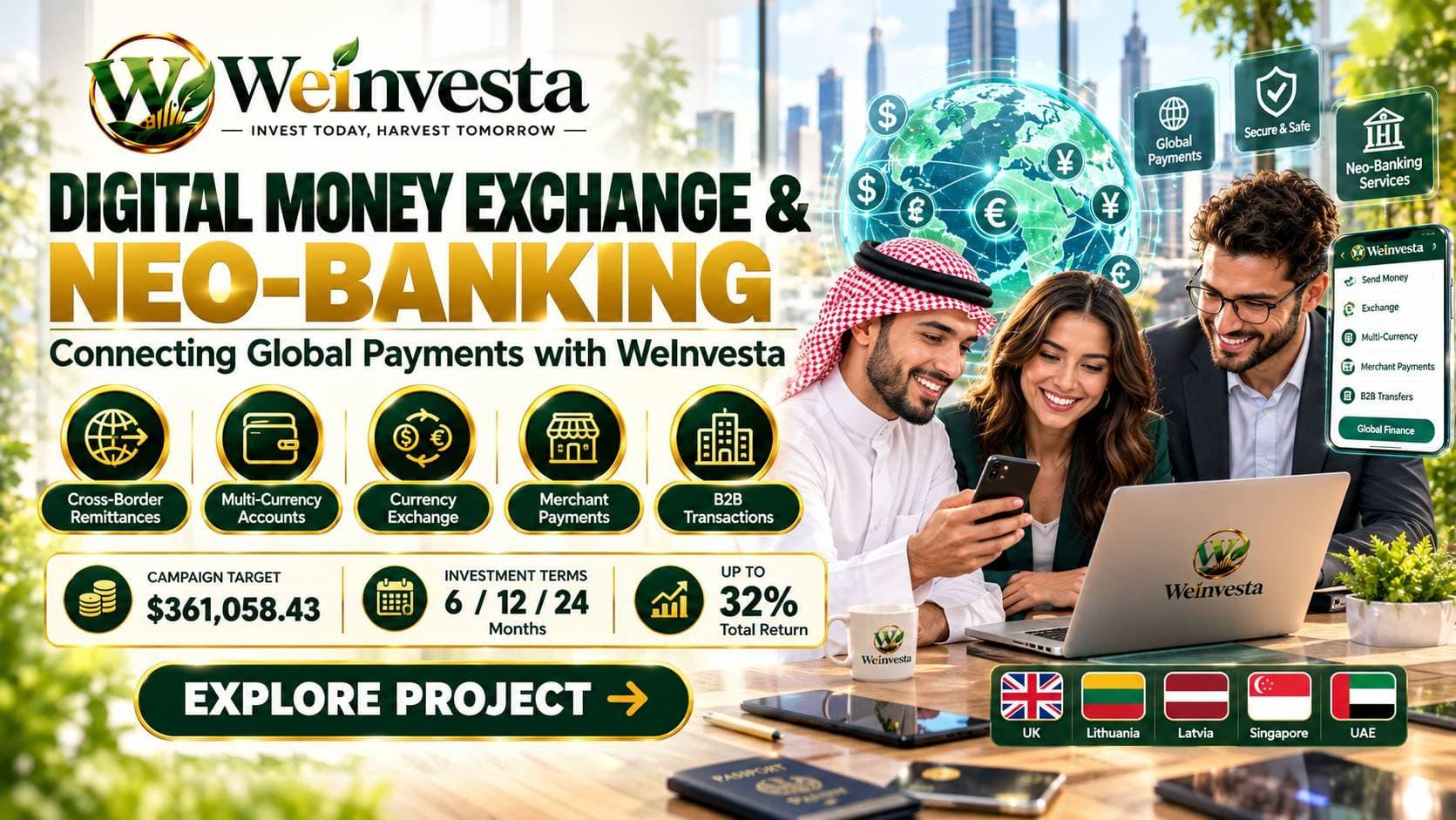
Digital Money Exchange & Neo-Banking: The Future of Digital Financial Services
International trade, global employment, online businesses, and cross-border commerce depend on reliable systems for moving money between countries. Individuals and businesses often need to exchange currencies, send international payments, settle commercial transactions, and manage funds across multiple markets.
Digital financial technology can help connect these activities through online payment infrastructure, multi-currency services, and integrated financial tools.
WeInvesta’s Digital Money Exchange & Neo-Banking project is described as a fintech initiative focused on cross-border money exchange, digital remittance infrastructure, merchant payment services, and business-to-business (B2B) transactional networks.
The proposed platform aims to serve retail users and businesses through multi-currency accounts, international transfers, currency conversion, merchant payments, and B2B trade settlements.
The project identifies the United Kingdom, Lithuania, Latvia, Singapore, and the United Arab Emirates as its target markets.
Explore the proposed opportunity on the Digital Money Exchange & Neo-Banking project page. Before evaluating the investment, you can also review How WeInvesta Works to understand the platform’s general investment process.
Project Overview
Project Name: Digital Money Exchange & Neo-Banking
Sector: Fintech & Payments
Status: Active
Target Markets: United Kingdom, Lithuania, Latvia, Singapore, and United Arab Emirates
Displayed Expected Return: Up to 32%, depending on the selected plan
Displayed Investment Terms: 6 months, 12 months, or 24 months
Campaign Target: $361,058.43
Raised So Far: $0.00
Total Investors: 0
Funding Progress: 0%
Estimated Development CAPEX: US$10.5 million–US$14.5 million across both phases
These figures reflect the project information provided for this article. Funding figures, investment terms, and project availability may change. Refer to the live project page and official documentation for the latest applicable information.
About the Project
The project describes a digital financial ecosystem intended to connect money exchange, international remittances, merchant payments, multi-currency accounts, and commercial transaction services.
Neo-banking generally refers to digital-first financial services provided primarily through online platforms rather than traditional branch-based banking. However, offering banking, payment, card, or money-transfer services may require specific regulatory permissions or arrangements with appropriately licensed financial institutions.
The actual services available to customers will depend on the platform’s legal structure, its banking and payment partners, applicable licences, and the jurisdictions in which it operates.
The proposed rollout has two phases: an initial launch through a Banking-as-a-Service partner, followed by a potential expansion toward direct regulatory licensing and additional financial services.
1. Cross-Border Remittances and Digital Money Transfers
Cross-border remittances allow people and businesses to send money between countries. They are important for international employment, family support, global commerce, and business payments.
The project proposes digital infrastructure intended to support international money transfers with a convenient online user experience and competitive fees.
Potential platform functions may include:
Initiating international transfers digitally.
Tracking transaction status.
Converting supported currencies.
Providing payment notifications.
Supporting eligible personal and business transfers.
The availability, speed, and price of these services will depend on the countries served, payment corridors, financial partners, settlement arrangements, transaction limits, and compliance requirements.
International transfers may require identity verification, sanctions screening, transaction monitoring, fraud controls, and other checks under relevant financial regulations.
2. Multi-Currency Accounts and Currency Exchange
The proposed ecosystem includes multi-currency accounts and digital foreign-exchange services.
Multi-currency functionality may allow customers to view or manage balances in more than one currency, depending on the supported currencies and account structure. Currency exchange functionality may enable eligible users to convert money between available currencies.
Important service conditions include:
Supported currencies and account eligibility.
Exchange rates and conversion spreads.
Transaction and conversion fees.
Settlement times and transfer limits.
Account restrictions and withdrawal conditions.
Exchange rates fluctuate, and the value received from a transaction may change with market conditions. Currency liquidity, payment-provider charges, and operational costs may also affect the rates offered to customers.
The project identifies currency liquidity spreads as a potential revenue source. Actual revenue would depend on transaction volume, competitive pricing, liquidity costs, customer demand, and market movements.
3. Merchant Payments and B2B Trade Settlements
Merchant payment services can help businesses accept and process customer payments. Business-to-business payment infrastructure can support transactions between suppliers, distributors, buyers, and commercial partners.
The proposed platform aims to connect merchant payments with business transaction networks and international settlement corridors.
Possible capabilities may include merchant payment processing, transaction records, payment-status reporting, and business settlement workflows. Faster settlement can help businesses manage working capital, although the actual settlement time depends on the payment rails, participating institutions, currencies, and contractual arrangements.
The commercial success of these services would depend on merchant adoption, transaction volumes, integration with payment providers, fraud prevention, service reliability, and the willingness of businesses to pay the applicable fees.
4. The Proposed Two-Phase Rollout
The project outlines a phased strategy for developing its digital financial ecosystem.
Phase 1: Launch Through a Banking-as-a-Service Partner
The first phase proposes launching through a licensed Banking-as-a-Service (BaaS) partner. The described infrastructure may include:
White-label core banking technology.
Card-issuing services.
Know Your Customer (KYC) identity verification.
Anti-Money Laundering (AML) controls.
Remittance and payment rails.
A BaaS arrangement can allow a technology company to access certain financial capabilities through an authorized partner. The precise services, permissions, responsibilities, and customer protections depend on the partner’s licences, the contractual structure, and applicable law.
Before investing, review the identity and regulatory status of the proposed partner, the services it will provide, the legal entity serving customers, and the division of compliance responsibilities.
Phase 2: Potential Direct Licensing and Expanded Financial Services
The second phase proposes pursuing direct banking or Electronic Money Institution (EMI) licensing after customer adoption and compliance capabilities have developed.
The description also identifies regulatory capital, treasury management, and potential microfinance expansion as elements of this phase.
Banking and EMI permissions are different regulatory authorizations. The requirements and approval process depend on the relevant jurisdiction and business model. A plan to apply for a licence must not be interpreted as confirmation that approval has already been granted.
This phase could require additional capital, governance arrangements, technology controls, regulatory engagement, and operational resources.
Target Markets
The project identifies five target markets:
United Kingdom
Lithuania
Latvia
Singapore
United Arab Emirates
These countries reflect the proposed geographical scope in the supplied project description. Their inclusion does not confirm that the platform’s services are already licensed, available, or operational in every market.
Investors should review the proposed launch schedule, legal entities, financial partners, licensing requirements, customer eligibility, data-protection obligations, cross-border transfer restrictions, and local compliance arrangements in each jurisdiction.
Business Model and Potential Revenue Sources
The project identifies several potential revenue channels.
Micro-transaction fees: Small charges associated with eligible transfers and payment activity.
Currency exchange spreads: Margins associated with converting between supported currencies.
Merchant payment services: Fees or commercial arrangements connected with processing merchant transactions.
B2B transaction services: Revenue associated with business payment and settlement activity.
These revenue sources depend on actual usage and transaction volumes. A high number of transactions does not automatically produce high profits. Payment-network charges, fraud losses, liquidity costs, compliance expenses, customer support, and technology maintenance must also be considered.
The proposed business model should be evaluated through documented fee schedules, partner agreements, transaction-level economics, customer acquisition assumptions, and realistic financial projections.
Investment Plans and Lock Periods
The project page displays three investment plans. According to the supplied terms, the listed total profit is scheduled to be paid at maturity.
Six-Month Plan
Displayed Total Profit: 8%
Lock Period: 6 months
Investment Range: $100–$1,000,000
Payout: At maturity
Instant Bonus: 0%
Twelve-Month Plan
Displayed Total Profit: 16%
Lock Period: 12 months
Investment Range: $100–$1,000,000
Payout: At maturity
Instant Bonus: 0%
Twenty-Four-Month Plan
Displayed Total Profit: 32%
Lock Period: 24 months
Investment Range: $100–$1,000,000
Payout: At maturity
Instant Bonus: 0%
The general project description separately states a minimum investment of $1,000, a 24-month lock period, and a target total profit of 20%, with a plan range of 20%–27%. These figures differ from the displayed plans and the $100 minimum shown in the detailed investment options.
Before investing, confirm the currently applicable minimum investment, available plans, total-profit calculations, eligibility requirements, and contractual payout terms with WeInvesta.
The displayed rates are advertised plan terms, not a guarantee of actual performance. Review the investment agreement to understand how returns are calculated, whether the rates represent total profit over the entire investment term, and whether fees, early-withdrawal restrictions, or other conditions apply.
To compare the available options, visit WeInvesta Investment Plans.
Funding Status and Development Costs
The supplied project information reports the following campaign figures:
Target Amount: $361,058.43
Raised So Far: $0.00
Total Investors: 0
Funding Progress: 0%
The project separately estimates US$10.5 million–US$14.5 million in capital expenditure across its two proposed phases.
The relationship between the campaign target and the broader development budget should be explained in the official business plan and investment prospectus. Investors should understand what the campaign is intended to finance, how the remainder of the project will be funded, and which milestones are expected in each phase.
Project Documents and Due Diligence
Before committing funds, review the official documents and understand the legal, commercial, technical, and financial structure of the project.
WeInvesta Whitepaper: Read the Whitepaper
Investment Prospectus: Read the Investment Prospectus
Detailed Projects Profiles: Review Project Profiles
Risk Disclosure: Review Investment Risks
Frequently Asked Questions: Visit the FAQ
Where applicable, verify the identities and licences of financial partners, the legal entities involved, payment and remittance permissions, safeguarding arrangements for customer funds, KYC/AML procedures, card-issuing arrangements, cybersecurity controls, data-protection policies, fee schedules, settlement terms, and withdrawal conditions.
You can also learn more about WeInvesta and the platform’s general investment process.
Understanding the Risks
Fintech and payment businesses face regulatory, operational, technical, financial, and counterparty risks.
Important considerations include:
Delays or failure in obtaining required licences or partner approvals.
Changes in financial regulations, international transfer rules, or compliance requirements.
Fraud, account takeover, cybersecurity incidents, or payment disputes.
Dependence on banks, card networks, payment processors, and other third parties.
Currency volatility, liquidity pressures, and settlement delays.
High customer acquisition costs and difficulty building customer trust.
Competition from established banks, remittance providers, and fintech platforms.
Higher-than-expected development, compliance, capital, and operational costs.
Restrictions on access to invested funds during the lock period.
A digital-first financial model does not eliminate financial or regulatory risks. Projected transaction growth does not guarantee profitability, and investors may lose some or all of their capital.
For further clarification, review the official risk disclosure and the applicable investment terms.
Explore Digital Money Exchange & Neo-Banking
Discover WeInvesta’s Digital Money Exchange & Neo-Banking project, review the official documentation, and assess the proposed rollout, financial assumptions, and investment terms before deciding whether the opportunity aligns with your financial objectives and risk tolerance.
Explore the project: Digital Money Exchange & Neo-Banking
Compare investment options: Investment Plans
Learn how the platform works: How It Works
Contact the team: Contact WeInvesta

Ready to Grow Your Wealth?
Put your capital behind real-world projects with real assets behind them.