
Consumer Brand Development & Retail Distribution Investment | WeInvesta CPG Project
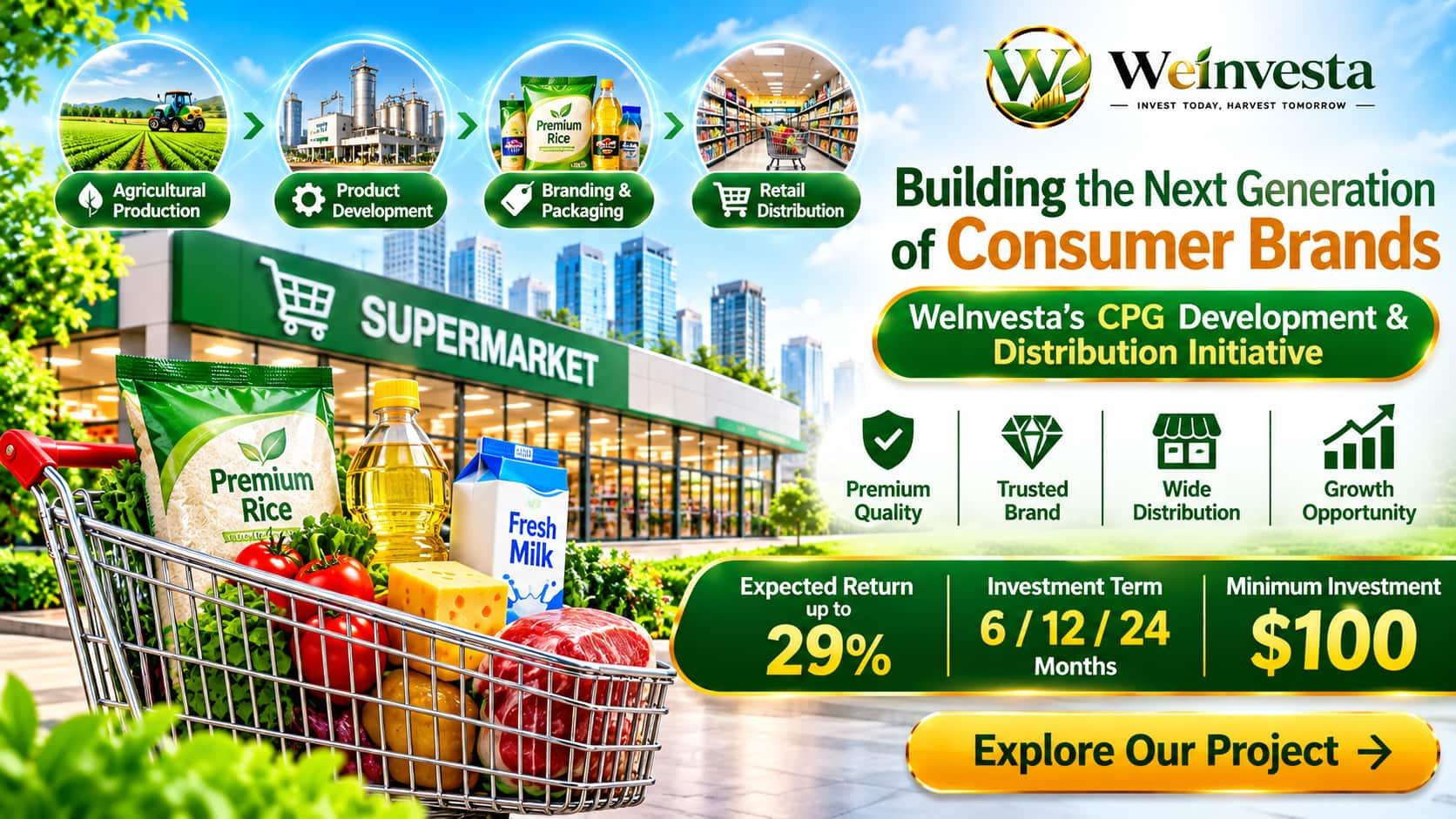
Everyday consumer products are an essential part of modern life. From rice and edible oils to dairy products, cheese, packaged staples, frozen meat, and household goods, consumers regularly purchase products that meet their daily needs.
However, producing a quality product is only one part of building a successful consumer business. Product identity, packaging, food safety, marketing, retail availability, and distribution also play important roles in connecting products with customers.
This creates an opportunity to develop recognizable consumer brands from existing agricultural and processing activities.
WeInvesta’s Consumer Packaged Goods (CPG) Branding & Distribution Project focuses on developing, packaging, marketing, and commercially distributing proprietary consumer food brands and processed products.
The initiative aims to transform agricultural and processing output into branded consumer products, creating a connection between production, product development, retail placement, and customer demand.
Explore the project:
https://weinvesta.com/projects/cpg-branding-distribution
Project Overview: Building Value Beyond Commodity Production
The project's central business concept is to move beyond selling agricultural and processed products only as commodities.
Instead, the proposed strategy focuses on developing recognizable brands, creating suitable packaging, establishing distribution agreements, and placing products in consumer retail channels.
The project aims to build branded products using output from the wider portfolio, including:
Rice and packaged staple foods.
Edible oils.
Processed dairy products.
Cheese and other dairy-based products.
Frozen meat.
Agricultural and food-processing products.
Eco-friendly consumer goods.
By developing branded products from existing agricultural and processing output, the project aims to create additional commercial opportunities across the consumer goods value chain.
Why CPG Branding and Distribution Matter
Consumer packaged goods are products that people purchase regularly for household and everyday use.
In competitive consumer markets, product quality alone may not be enough to establish a strong market position. Customers also consider brand recognition, packaging, price, availability, and trust.
A structured CPG business strategy therefore needs to connect several activities:
Product Development: Identifying suitable products and preparing them for consumer markets.
Brand Identity: Developing recognizable product names, visual identity, and brand positioning.
Packaging: Creating packaging that supports product presentation, protection, and market requirements.
Food Safety Systems: Establishing appropriate processes for product quality, handling, and compliance.
Marketing: Building awareness through digital marketing and other promotional channels.
Distribution: Connecting products with supermarkets, wholesalers, retailers, and online platforms.
The project aims to coordinate these activities to develop a more organized route from production to the final consumer.
Key Business Components
1. Brand Identity and Product Positioning
A recognizable brand helps consumers identify products and understand what they represent.
The project's business plan includes developing brand identities for selected consumer packaged products. This involves product naming, visual presentation, packaging design, and marketing positioning.
The goal is to create a consistent identity across product categories while communicating product information clearly to customers.
2. Packaging Development
Packaging is an important part of the consumer goods business.
It can influence product presentation, storage, transportation, and customer purchasing decisions.
The project plans to develop packaging for its selected food and consumer product categories, with attention to product requirements and applicable food safety standards.
3. Food Safety and Product Quality Systems
Consumer trust depends on consistent product quality and responsible handling.
The proposed business plan includes food safety systems intended to support product preparation, packaging, quality control, and distribution.
Food safety procedures, appropriate labeling, and compliance with applicable requirements are important considerations for packaged food products.
4. Multi-Region Distribution Network
A consumer brand needs access to customers through reliable distribution channels.
The project aims to develop distribution relationships across multiple regions, using both modern and traditional retail networks.
Its proposed distribution channels include:
Supermarkets and modern retail stores.
Traditional retail outlets.
Wholesalers and distributors.
E-commerce platforms.
Diaspora-focused markets.
Export distribution partners.
Expanding across multiple channels may provide different routes to market, although actual market access will depend on distribution agreements, product demand, competition, and regulatory requirements.
5. Digital Marketing and Sales Development
Building brand awareness requires consistent communication with consumers.
The project plans to develop digital marketing activities and sales teams to support product launches, brand awareness, and customer engagement.
Marketing activities may include online promotions, product campaigns, brand storytelling, and digital customer outreach.
The effectiveness of these activities will depend on campaign execution, marketing costs, customer response, and the competitiveness of the products.
6. Private-Label and House-Brand Strategy
Private-label and house-brand products are another part of the proposed commercial strategy.
These products can allow a retail or distribution business to offer goods under its own brand identity.
The project aims to explore this approach alongside the development of proprietary consumer brands. If successfully implemented, private-label products may provide opportunities for product differentiation and customer loyalty.
Product Launch Strategy: Start with Everyday Essentials
The business plan proposes launching with high-velocity staple products before expanding into premium and export-oriented product categories.
This approach focuses first on products that are part of regular household purchasing patterns.
Potential product categories include:
Rice and packaged staples.
Edible oils.
Dairy products and cheese.
Frozen meat.
Other processed food products.
Eco-friendly consumer goods.
After developing the initial product range, the strategy aims to expand into additional premium products and export markets.
The timing and success of product launches will depend on production readiness, packaging development, food safety requirements, market research, and distribution arrangements.
Commercial Strategy: Connecting Brands with Customers
The project proposes using a combination of physical retail, wholesale, and digital distribution channels.
Its commercial strategy includes:
Modern Retail: Placing branded products in supermarkets and organized retail stores.
Traditional Retail: Working with wholesalers, distributors, and traditional retail outlets to reach local consumers.
E-commerce: Making selected products available through online shopping channels.
Diaspora Markets: Exploring opportunities to reach international consumer communities through suitable distribution partners.
Export Distribution: Developing relationships with distributors in potential export markets, subject to applicable market and regulatory requirements.
Private-Label Products: Exploring house-brand products to support differentiation and customer relationships.
The objective is to create multiple commercial routes for branded products rather than depending on a single sales channel.
Key Investment Highlights
The project presents several proposed business highlights:
Development of proprietary consumer packaged food brands.
Branding and packaging of agricultural and processing output.
Product categories including rice, edible oils, dairy, cheese, and frozen meat.
Integration with existing agricultural and processing assets.
Multi-region distribution through modern and traditional retail.
Development of food safety and quality systems.
Digital marketing and sales team development.
E-commerce and wholesale distribution opportunities.
Private-label and house-brand product strategy.
Potential access to diaspora and export distribution channels.
The project's intended approach is to create additional brand and distribution value from products connected to the wider portfolio.
Project Snapshot
Project Name: Consumer Packaged Goods (CPG) Branding & Distribution
Category: Retail & Consumer Goods
Project Location: Multi-Region
Project Status: Active
Displayed Expected Return: 29%
Displayed Duration: 24 Months
Target Amount: $74,701.74
Raised So Far: $0.00
Total Investors: 0
Funding Progress: 0%
Displayed Main Lock Period: 2 Years
Estimated Investment Requirement: US$1.50M–US$3.00M
Project figures and funding progress may change. Please refer to the live project page for the latest information.
Displayed Investment Plans
The project page displays three investment options:
6-Month Investment Plan
Lock Period: 6 Months
Displayed Fixed Rate: 7%
Total Displayed Profit: 7%
Investment Range: $100–$1,000,000
Instant Bonus: 0%
Payout Schedule: On Maturity
12-Month Investment Plan
Lock Period: 12 Months
Displayed Fixed Rate: 15%
Total Displayed Profit: 15%
Investment Range: $100–$1,000,000
Instant Bonus: 0%
Payout Schedule: On Maturity
24-Month Investment Plan
Lock Period: 24 Months
Displayed Fixed Rate: 29%
Total Displayed Profit: 29%
Investment Range: $100–$1,000,000
Instant Bonus: 0%
Payout Schedule: On Maturity
Important Investment Terms to Review
The project's general investment terms and displayed investment-plan cards currently show different figures.
The general Investment Terms section mentions:
Minimum Investment: $1,000 USD.
Lock-in Period: 24 Months.
Target Total Profit: 18%.
However, the displayed investment-plan cards show:
Minimum Investment: $100.
6-Month Plan: 7%.
12-Month Plan: 15%.
24-Month Plan: 29%.
Prospective investors should confirm the applicable minimum investment, lock period, and return structure directly with WeInvesta before proceeding.
The displayed plan rates should not be interpreted as guaranteed returns. Capital is at risk.
Project Documents and Transparency
Before making an investment decision, prospective investors should review the available project documents.
The project page lists:
WeInvesta Whitepaper: General information about the platform and its investment approach.
Sector-by-Sector Projects Profile: An overview of the platform's business sectors and projects.
Business Plan: Details about the proposed CPG branding and distribution strategy.
Investment Prospectus & Risk Overview: Investment structure and relevant risk information.
Risk Disclosure: Important information about potential risks.
Reviewing these documents can help prospective investors better understand the project's proposed business activities and investment conditions.
Risks and Important Considerations
Developing and distributing consumer packaged goods involves commercial, operational, and market risks.
Important risks identified for this project include:
Brand Adoption Failure: Customers may not adopt new products or brands as expected.
Packaging Cost Increases: Rising packaging material and production costs may affect margins.
Food Safety Claims: Product quality or food safety issues may create legal, financial, and reputational consequences.
Product Recalls: Defective or non-compliant products may require withdrawal from the market.
Distributor Dependency: Reliance on distribution partners may affect market access and sales performance.
Shelf-Space Competition: Established brands may create challenges in securing retail placement.
Counterfeit Risk: Unauthorized imitation products may damage brand trust.
Marketing Overspend: Promotional expenses may exceed budgets without producing the expected commercial results.
Investors should assess these risks carefully and review the official risk disclosure before committing capital.
Building Consumer Brands from Real-World Production
The CPG sector connects production with the products people purchase every day.
For businesses involved in agriculture and food processing, developing branded products can create opportunities to participate in additional stages of the value chain.
WeInvesta's Consumer Packaged Goods (CPG) Branding & Distribution Project aims to connect agricultural and processing output with brand development, packaging, marketing, retail placement, and multi-region distribution.
By focusing on everyday consumer categories and multiple distribution channels, the initiative seeks to build a structured route from product development to consumer markets.
Its commercial progress will depend on brand acceptance, product quality, food safety, distribution relationships, pricing, marketing efficiency, and market demand.
Explore the CPG Branding & Distribution Project
Interested in exploring a project focused on consumer brands, packaged food products, and commercial distribution?
Visit the official WeInvesta project page to review the business model, displayed investment plans, supporting documents, and risk disclosures.
Displayed Investment Range: $100–$1,000,000 on the investment-plan cards.
Displayed Return Options: 7%, 15%, and 29%, depending on the selected lock period.
Lock Period Options: 6 Months, 12 Months, and 24 Months.
More From the Blog
Nov 17, 2026
Agri-Waste & Bio-Energy Recycling Investment | Sustainable Green Energy Project – WeInvesta
Read MoreNov 17, 2026
الاستثمار في إعادة تدوير المخلفات الزراعية والطاقة الحيوية | مشروع الاقتصاد الدائري المستدام – WeInvesta
Read MoreNov 17, 2026
কৃষি বর্জ্য রিসাইক্লিং ইনভেস্টমেন্ট | Bio-Energy ও Circular Economy Project – WeInvesta
Read More
Ready to Grow Your Wealth?
Put your capital behind real-world projects with real assets behind them.