
Agri-Waste Recycling Investment | Bio-Energy & Green Manufacturing Project – WeInvesta
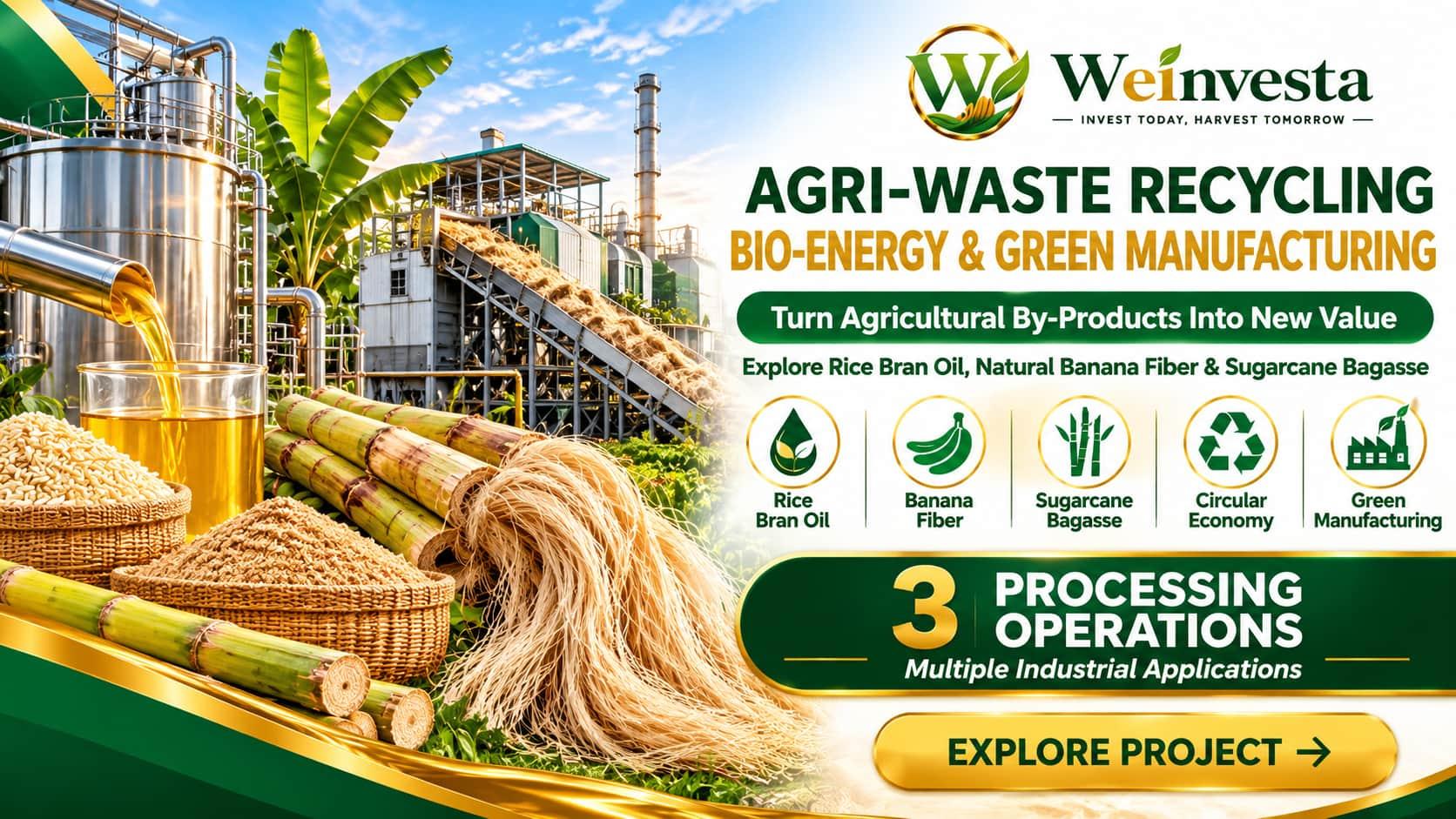
Agriculture produces more than food. It also generates large quantities of by-products that are often underused, discarded, or sold at relatively low prices.
Rice milling produces bran. Banana harvesting leaves behind large quantities of plant stems and trunks. Sugarcane processing generates fibrous bagasse. Although these materials may be treated as waste in conventional production systems, they can also serve as raw materials for other industries.
With appropriate processing methods, agricultural by-products can be transformed into edible oils, natural textile fibers, paper pulp, biodegradable products, and bio-energy resources.
This is the idea behind the circular economy: instead of treating every production by-product as something to discard, businesses look for ways to reuse materials and create additional economic value.
WeInvesta’s Agri-Waste & Bio-Energy Recycling Project is designed around this concept. The project brings together three proposed processing operations:
Rice bran oil production.
Natural banana fiber extraction.
Sugarcane bagasse recycling.
The broader objective is to connect agricultural waste recovery with industrial manufacturing and sustainable resource utilization.
For investors interested in understanding how recycling and green manufacturing can create commercial opportunities, this project offers a business model worth exploring.
Explore the official project:
https://weinvesta.com/projects/agri-waste-bio-energy-recycling
1. Understanding the Business Opportunity: Turning By-Products into Marketable Materials
Agricultural waste is not always without value. Its commercial potential depends on the availability of suitable processing technology, consistent raw material supplies, production costs, and demand from manufacturers.
For example, rice bran can be processed into rice bran oil. Banana plant trunks can provide natural fibers for textile and paper applications. Sugarcane bagasse can be used as a raw material for paper pulp, bio-energy, and biodegradable products.
These opportunities connect different industries:
Agriculture and farming.
Food processing.
Natural textile manufacturing.
Paper and packaging production.
Renewable and bio-energy.
Recycling and industrial materials.
Instead of depending on a single finished product, an integrated recycling business can explore several product categories using different agricultural feedstocks.
WeInvesta’s project is structured around three such operations, each with its own proposed production focus.
2. Three Processing Operations Behind the Project
A. Rice Bran Oil: Creating Value from Rice Milling By-Products
Rice is one of the world's most widely consumed staple crops. During rice milling, bran is separated from the grain. This by-product can be used as a raw material for producing rice bran oil.
Rice bran oil is an edible vegetable oil used in food preparation and cooking. Its commercial production requires appropriate extraction, refining, quality control, storage, and packaging facilities.
The WeInvesta project description outlines a proposed rice bran oil processing capacity of approximately 15,000–20,000 liters per day.
The planned operation focuses on:
Collecting rice bran from suitable milling sources.
Processing the bran through oil extraction systems.
Refining and preparing edible oil.
Maintaining product quality and food safety standards.
Packaging and distributing finished products.
Why this operation matters
Rice bran oil production creates an opportunity to use an agricultural milling by-product as an input for the food-processing industry.
Its commercial performance would depend on reliable rice bran supplies, extraction efficiency, energy costs, refining expenses, product quality, and access to buyers.
B. Organic Banana Fiber: Developing Natural Materials for Sustainable Manufacturing
Banana plants produce more than fruit. Their trunks and stems contain natural fibers that can be extracted and processed for different industrial applications.
After harvesting bananas, the remaining plant material is often underutilized. Banana fiber extraction offers a way to recover some of this material and prepare it for further manufacturing.
The project proposes using banana trunks to produce high-tensile natural fibers for applications such as:
Eco-textiles and natural fabrics.
Paper manufacturing.
Industrial packaging.
Other fiber-based materials.
This processing concept is particularly relevant to businesses exploring alternatives to conventional synthetic or resource-intensive materials.
Why banana fiber has commercial potential
Natural fibers can serve different manufacturing needs, depending on their strength, quality, consistency, and processing characteristics.
For a banana fiber operation to become commercially viable, it needs reliable access to banana plant material, efficient extraction equipment, proper drying and treatment processes, quality control, and buyers who can use the finished fiber.
The project refers to this activity as an organic banana fiber extraction operation. Its actual production readiness, output specifications, and customer demand should be reviewed through the official project documents.
C. Sugarcane Bagasse: Exploring Bio-Energy and Alternative Industrial Materials
Sugarcane processing generates bagasse, the fibrous material remaining after juice extraction.
Rather than allowing this material to remain unused, it can be processed for several applications.
The WeInvesta project identifies three intended uses:
Green bio-energy.
Paper pulp.
Biodegradable tableware.
These applications connect agricultural waste recovery with energy production and sustainable manufacturing.
Bio-energy applications
Suitable biomass materials can be used as feedstock for energy generation through appropriate processing systems. The feasibility of a specific operation depends on the technology selected, moisture levels, energy requirements, conversion efficiency, and local regulations.
Paper pulp production
Bagasse fibers can be processed into pulp for paper-related manufacturing. This creates a potential industrial use for a by-product of sugarcane processing.
Biodegradable products
Processed sugarcane fibers can also be used to manufacture certain disposable food-service products, including biodegradable tableware.
The commercial opportunity depends on production quality, manufacturing costs, buyer demand, and the ability to compete with alternative materials.
3. Why Combine Three Different Recycling Operations?
One of the main characteristics of this project is its multi-operation structure.
Rice bran oil, banana fiber, and sugarcane bagasse processing are different activities, but they share a common principle: recovering value from agricultural by-products.
This approach can create exposure to multiple industrial product categories rather than relying entirely on one processing line.
The proposed operations serve different markets:
Food Processing
Rice bran oil.
Edible oil distribution.
Food manufacturing supply chains.
Textile and Packaging Materials
Natural banana fibers.
Eco-textile applications.
Paper and industrial packaging materials.
Energy and Sustainable Manufacturing
Bagasse-based bio-energy.
Paper pulp.
Biodegradable tableware.
The project’s combined business model aims to connect agricultural supply sources with industrial buyers through processing, product development, and distribution.
However, having multiple product categories does not automatically eliminate business risk. Each operation requires its own equipment, management, raw material supply, quality standards, and commercial customers.
4. The Circular Economy: A Different Way to Think About Industrial Production
Traditional production models often focus on converting primary raw materials into finished products. A circular-economy model also considers what happens to the materials left behind.
For example:
Rice milling produces bran that can be processed into oil.
Banana harvesting leaves plant trunks that can provide natural fibers.
Sugarcane processing generates bagasse that can be used in other industrial applications.
By identifying suitable uses for these materials, businesses can explore additional production opportunities while reducing the amount of agricultural by-products treated as waste.
This model is relevant to several sustainability goals:
More efficient use of agricultural resources.
Development of alternative industrial raw materials.
Greater utilization of biomass.
Opportunities for waste recovery and recycling.
Support for resource-efficient manufacturing.
The environmental benefits depend on the complete production process. Energy consumption, water use, transportation, processing chemicals, emissions, and waste disposal must all be considered when evaluating the actual sustainability impact.
5. International Project Markets and Agricultural Supply Chains
The WeInvesta project identifies the following countries as part of its target geographical coverage:
Brazil
Colombia
India
Indonesia
Venezuela
Kenya
South Africa
Nigeria
These markets have agricultural and industrial activities that may provide opportunities for sourcing agricultural by-products or distributing processed materials.
However, each country has different agricultural conditions, infrastructure, regulations, transportation costs, and commercial requirements.
For a recycling operation to function effectively, it needs more than access to raw materials. It also requires:
Reliable agricultural suppliers.
Suitable processing locations.
Qualified equipment and technical operators.
Efficient transportation and storage.
Product quality standards.
Commercial relationships with manufacturers and distributors.
Compliance with environmental and industrial regulations.
The project's geographical coverage should therefore be understood as its stated target-market scope, not as confirmation that operational facilities or established supply contracts already exist in every listed country.
6. Processing Infrastructure and Capital Requirements
Industrial recycling requires suitable machinery and supporting infrastructure.
The project description identifies a combined estimated capital expenditure of approximately US$5.8 million across the following operations:
Rice bran oil processing plant.
Banana fiber extraction plant.
Sugarcane bagasse processing facilities.
The infrastructure requirements may include raw material handling, extraction machinery, processing equipment, storage, utilities, packaging systems, and quality-control facilities.
Each processing operation has different technical requirements.
For example, edible oil production needs extraction and refining equipment, while banana fiber processing requires fiber separation and preparation systems. Bagasse recycling requires equipment appropriate to the intended energy, pulp, or biodegradable product applications.
The scale, ownership, construction status, equipment specifications, and financing arrangements should be verified through the project's official documents and supporting evidence.
7. How Could the Business Generate Revenue?
The project description highlights two potential revenue sources:
1. Waste Processing Fees
Businesses or agricultural suppliers may pay for the collection, handling, or processing of certain agricultural by-products, depending on the commercial arrangement.
2. Sales of Processed Materials
Recovered materials can be processed into products intended for sale to food manufacturers, textile producers, paper manufacturers, packaging businesses, and other industrial customers.
Potential product categories include:
Rice bran oil.
Natural banana fibers.
Paper pulp.
Biomass-based energy products.
Biodegradable tableware.
The combination of processing services and finished-product sales is the project's stated commercial concept.
Actual revenue will depend on supplier agreements, processing costs, production volumes, product quality, customer demand, selling prices, and the ability to operate the facilities efficiently.
These are potential business revenue channels, not a guarantee of profitability or investor returns.
8. Why Explore the WeInvesta Agri-Waste & Bio-Energy Recycling Project?
The project brings together several areas of commercial interest:
Multiple Processing Activities
Three proposed operations focus on rice bran oil, banana fiber, and sugarcane bagasse.
Agricultural Resource Recovery
The business model focuses on using agricultural by-products as industrial raw materials.
Different Product Markets
The proposed outputs connect food processing, textiles, paper, packaging, and bio-energy.
Circular-Economy Approach
The project aims to create additional value from materials that may otherwise be underutilized.
International Scope
The project identifies target markets across South America, Asia, and Africa.
Defined Investment Plans
The official project page displays investment options with different lock periods and stated total profit rates.
These features make the project relevant to readers who want to learn more about recycling, sustainable manufacturing, and agricultural resource utilization.
9. Project Snapshot
Project Name: Agri-Waste & Bio-Energy Recycling
Category: Recycling & Circular Economy
Project Status: Active
Target Countries: Brazil, Colombia, India, Indonesia, Venezuela, Kenya, South Africa, Nigeria
Displayed Expected Return: 25%
Displayed Maximum Duration: 24 Months
Target Amount: $144,423.37
Raised So Far: $0.00
Total Investors: 0
Funding Progress: 0%
Displayed Investment Range: $100–$1,000,000 (according to the investment plan cards)
Combined Processing CAPEX: Approximately US$5.8 Million
Project figures and investment-plan availability may change. Always check the live project page for the latest information.
10. Explore the Displayed Investment Plans
The official project page currently displays three investment options. Each option has a different lock period and stated total profit.
6-Month Plan
Displayed Fixed Rate: 6%
Total Displayed Profit: 6%
Investment Range: $100–$1,000,000
Instant Bonus: 0%
Lock Period: 6 Months
Payout: On Maturity
12-Month Plan
Displayed Fixed Rate: 13%
Total Displayed Profit: 13%
Investment Range: $100–$1,000,000
Instant Bonus: 0%
Lock Period: 12 Months
Payout: On Maturity
24-Month Plan
Displayed Fixed Rate: 25%
Total Displayed Profit: 25%
Investment Range: $100–$1,000,000
Instant Bonus: 0%
Lock Period: 24 Months
Payout: On Maturity
The displayed rates are plan information, not guaranteed investment outcomes. Review the applicable agreement, profit calculation, payout conditions, and risk disclosures before committing funds.
Important: Confirm the Minimum Investment and Applicable Terms
The project's general Investment Terms section states:
Minimum Investment: $1,000 USD
Lock Period: 18 Months
Target Total Profit: 15%
Plan Band: 15%–23%
However, the displayed investment cards show a minimum investment of $100, with 6-month, 12-month, and 24-month options offering displayed total profit rates of 6%, 13%, and 25%.
These details do not fully match.
For this reason, although the plan cards display a $100 minimum, prospective investors should confirm the currently applicable minimum investment, lock period, selected plan, profit calculation, and contractual payout terms directly with WeInvesta before investing.
11. Project Documents: Review Before You Invest
A well-informed investment decision starts with understanding the project and its associated risks.
The project page lists the following documents:
WeInvesta Whitepaper: General information about the platform and its approach.
Sector-by-Sector Projects Profile: An overview of the platform's project sectors.
Business Plan: Information about the proposed business model and operations.
Investment Prospectus & Risk Overview: Investment-related information and risk considerations.
Risk Disclosure: Important details about potential investment risks.
Before investing, consider asking for further information about:
Processing facility ownership and development status.
Machinery specifications and installation plans.
Raw material sourcing arrangements.
Production capacity assumptions.
Customer and distribution agreements.
Project funding and capital allocation.
Revenue and operating cost projections.
Applicable legal agreements and withdrawal or payout conditions.
Reviewing these details can help you understand what the project intends to do, what has already been implemented, and what remains dependent on future execution.
12. Important Risks to Understand
Agri-waste recycling and bio-energy projects involve industrial, environmental, operational, and commercial risks.
Some important considerations include:
Raw Material Availability
Rice bran, banana trunks, and sugarcane bagasse depend on agricultural production. Seasonal changes and supplier availability can affect production.
Processing Technology
Equipment performance, maintenance, extraction efficiency, and production quality can influence operating costs and output.
Market Demand
The demand and selling prices for rice bran oil, natural fibers, pulp, bio-energy, and biodegradable products may change.
Capital Expenditure
Industrial plants require substantial investment. Construction delays, equipment costs, and unexpected expenses may affect implementation.
Energy and Operating Costs
Electricity, fuel, labor, transportation, and maintenance expenses can influence profitability.
Environmental and Regulatory Compliance
Processing facilities must comply with applicable environmental, industrial, waste-management, and product-safety requirements.
Competition
The project may compete with established oil producers, textile material suppliers, paper manufacturers, energy producers, and alternative packaging businesses.
Currency and International Trade
Cross-border operations can be affected by exchange-rate movements, shipping costs, customs procedures, and changes in trade regulations.
Investment and Liquidity Risk
Funds allocated to a project may be locked for the selected period. Early access, repayment, and payout conditions depend on the applicable agreement.
No investment return should be considered guaranteed. Investors should evaluate whether they can accept the possibility of losing some or all of their invested capital.
13. Is This Project Worth Exploring?
If you are interested in businesses that connect agriculture with industrial manufacturing, the Agri-Waste & Bio-Energy Recycling Project presents a model worth examining.
Its three proposed operations address different uses for agricultural by-products:
Rice bran for edible oil production.
Banana trunks for natural fiber extraction.
Sugarcane bagasse for bio-energy, paper pulp, and biodegradable products.
The common business idea is straightforward: identify underused agricultural materials, process them into products with potential commercial demand, and connect production with suitable buyers.
The opportunity is not based on the environmental concept alone. Its commercial success will depend on whether the project can secure raw materials, establish efficient processing facilities, control costs, meet product standards, and build sustainable customer relationships.
That is why reviewing the business plan, project documents, investment terms, and risks is an essential part of deciding whether this project matches your investment objectives.
14. Explore the Project and Review Your Investment Options
Interested in learning more about agricultural waste recycling, natural fiber manufacturing, and bio-energy opportunities?
Visit the official WeInvesta project page to explore the business model, review the displayed investment plans, and access the available project documents.
Project: Agri-Waste & Bio-Energy Recycling
Displayed Investment Options:
6 Months — 6% Total Displayed Profit
12 Months — 13% Total Displayed Profit
24 Months — 25% Total Displayed Profit
Displayed Minimum Investment: $100 (according to the investment plan cards; confirm the applicable terms before investing).
Explore the official project and investment plans:
https://weinvesta.com/projects/agri-waste-bio-energy-recycling
Have questions about the project, investment terms, or documentation? Contact the WeInvesta team through the official project page before making your decision.
WeInvesta — Invest Today, Harvest Tomorrow.
More From the Blog
Nov 17, 2026
Agri-Waste & Bio-Energy Recycling Investment | Sustainable Green Energy Project – WeInvesta
Read MoreNov 17, 2026
الاستثمار في إعادة تدوير المخلفات الزراعية والطاقة الحيوية | مشروع الاقتصاد الدائري المستدام – WeInvesta
Read MoreNov 17, 2026
কৃষি বর্জ্য রিসাইক্লিং ইনভেস্টমেন্ট | Bio-Energy ও Circular Economy Project – WeInvesta
Read More
Ready to Grow Your Wealth?
Put your capital behind real-world projects with real assets behind them.