
Agri-Waste & Bio-Energy Recycling | WeInvesta
Agri-Waste & Bio-Energy Recycling: Creating Value from Agricultural Byproducts
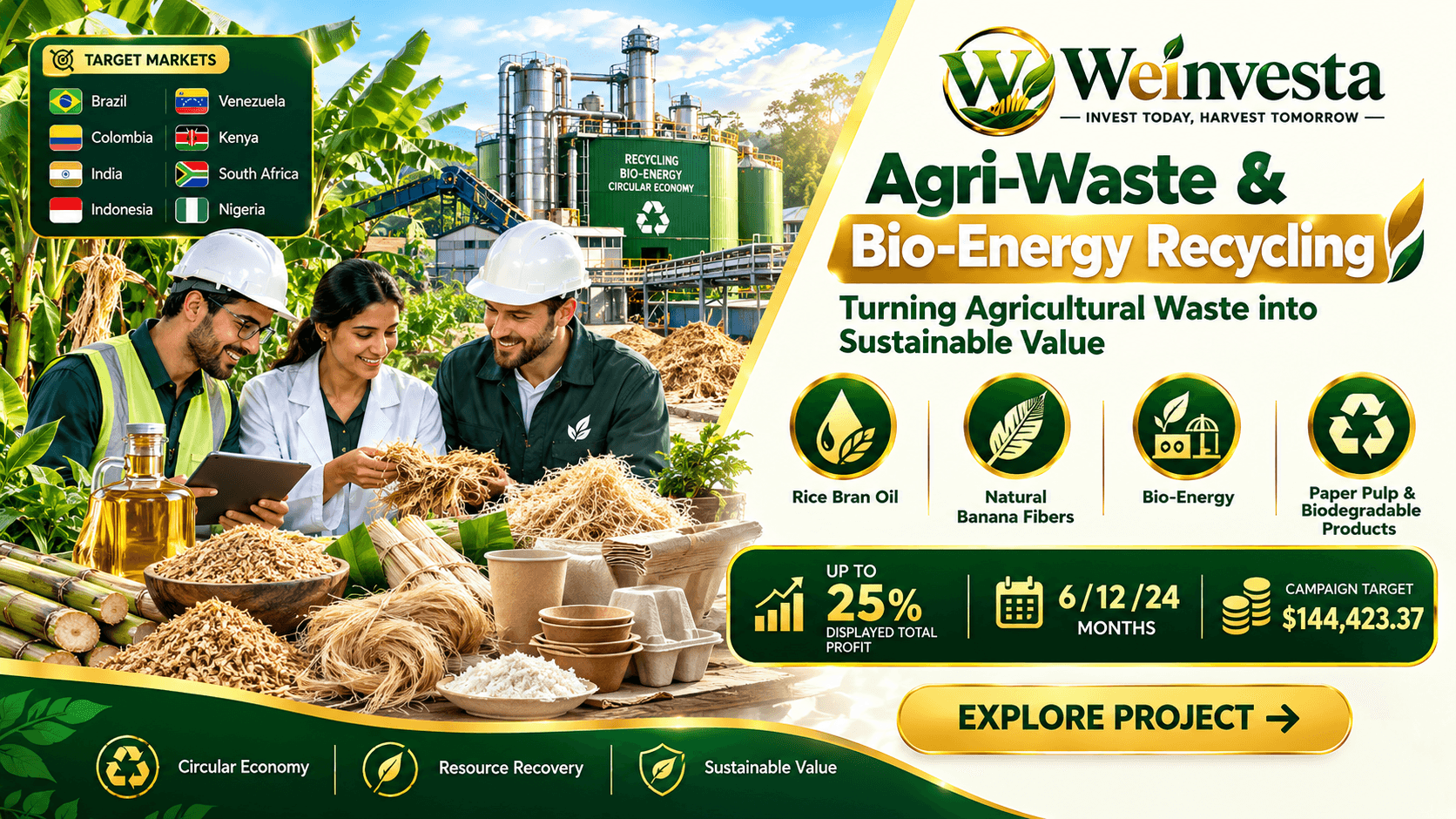
Agricultural production generates substantial quantities of byproducts, including rice milling residues, banana plant stems, and sugarcane bagasse. When managed effectively, these materials can become useful inputs for food processing, renewable energy, paper manufacturing, textiles, and other industrial applications.
WeInvesta’s Agri-Waste & Bio-Energy Recycling project focuses on converting agricultural waste into higher-value products through integrated processing and recycling operations. The initiative identifies Brazil, Colombia, India, Indonesia, Venezuela, Kenya, South Africa, and Nigeria as its target markets.
The project follows a circular-economy approach: instead of treating agricultural byproducts solely as waste, it aims to recover their usable materials and redirect them into productive supply chains.
Its proposed activities cover three principal areas: rice bran oil production, natural banana fiber extraction, and sugarcane bagasse recycling.
The actual commercial and environmental results will depend on plant operations, feedstock availability, processing efficiency, energy requirements, product quality, market demand, and regulatory compliance.
Project Overview
Project Name: Agri-Waste & Bio-Energy Recycling
Sector: Recycling & Circular Economy
Status: Active
Target Markets: Brazil, Colombia, India, Indonesia, Venezuela, Kenya, South Africa, and Nigeria
Displayed Expected Return: Up to 25%, depending on the selected plan
Displayed Investment Terms: 6 months, 12 months, or 24 months
Campaign Target: $144,423.37
Raised So Far: $0.00
Total Investors: 0
Funding Progress: 0%
Combined Estimated Plant CAPEX: US$5.8 million
These figures reflect the project information supplied for this article. Funding figures, investment terms, and project availability may change. Consult the live project page and official documents before making an investment decision.
About the Project
The project describes a sustainable processing program designed to recover valuable materials from agricultural byproducts and convert them into commercial products.
Its proposed operating model has three main components.
1. Rice Bran Oil Production
Rice milling produces bran, a byproduct that can be processed to extract rice bran oil. Rather than allowing this material to go unused, a dedicated processing facility can convert it into an edible oil product for relevant food markets.
The project specifies a proposed processing capacity of 15,000–20,000 liters per day of rice bran oil extracted from rice milling byproducts.
The commercial performance of this operation would depend on the availability and quality of rice bran, processing yields, plant utilization, energy costs, food-safety standards, packaging, distribution, and market prices.
The stated processing capacity is a project specification and should not be interpreted as proof of current production or guaranteed sales.
2. Organic Banana Fiber Extraction
Banana plant stems and trunks can contain natural fibers that may be recovered for further processing. The project proposes upcycling banana plant material into higher-value fiber products for applications such as:
Eco-textiles and natural-fiber materials
Paper production
Industrial packaging
This approach is intended to make productive use of agricultural residues that might otherwise be discarded or underutilized.
Actual results would depend on the availability of suitable banana plant material, fiber extraction technology, processing costs, fiber quality, manufacturing specifications, and buyer demand.
3. Sugarcane Bagasse Recycling
Bagasse is the fibrous material left after sugarcane is crushed to extract its juice. The project proposes converting this byproduct into several types of useful materials and products.
The planned applications include:
Bio-energy
Paper pulp
Biodegradable tableware
Reusing bagasse may offer opportunities to recover value from sugar-processing residues and supply materials for energy and manufacturing markets.
The commercial feasibility of these operations depends on the consistency of feedstock supply, conversion technology, energy requirements, production costs, environmental permits, and the availability of buyers.
A Circular-Economy Approach
The central idea behind the project is to connect agricultural production with downstream processing and materials recovery.
A circular-economy model aims to keep usable resources in productive circulation for as long as practicable, reducing unnecessary waste and improving the use of available raw materials.
For agricultural recycling, this can involve collecting processing residues, separating useful components, converting them into marketable products, and returning recovered materials to industrial supply chains.
The project identifies potential benefits from recovering materials that farmers or processors might otherwise discard. However, access to low-cost agricultural residues does not automatically translate into high margins or predictable profits. Collection, transport, storage, processing, energy, quality control, and distribution all create costs that must be managed.
Environmental and Industrial Applications
The project’s proposed operations connect waste recovery with several industrial sectors:
Food processing: Rice bran oil production.
Textiles: Natural banana fibers for suitable textile applications.
Paper and packaging: Recovered fibers and sugarcane bagasse.
Renewable energy: Bio-energy produced from agricultural residues.
Biodegradable products: Tableware manufactured from bagasse-based materials.
These applications may support resource efficiency and offer alternatives to certain conventional raw materials. Their actual environmental benefits depend on the full production process, energy sources, water use, transportation, waste management, and the life cycle of the resulting products.
Environmental, social, and governance (ESG) considerations may also be relevant to institutional investors and businesses assessing circular-economy projects. Any claims about certifications, environmental performance, or regulatory compliance should be supported by appropriate project documentation.
Target Markets
The project identifies eight countries as target markets:
Brazil
Colombia
India
Indonesia
Venezuela
Kenya
South Africa
Nigeria
These markets represent the geographical scope stated in the project description. Their inclusion does not establish that facilities, contracts, partners, or operations are already active in every country.
Investors should verify the location of each proposed plant, the availability of agricultural feedstocks, the identity of operating companies, local permits, distribution arrangements, and the demand for intended products.
Investment Plans and Lock Periods
The project page displays three investment plans. According to the displayed terms, the stated total profit is scheduled to be paid at maturity.
Six-Month Plan
Displayed Total Profit Rate: 6%
Lock Period: 6 months
Investment Range: $100–$1,000,000
Payout: At maturity
Instant Bonus: 0%
Twelve-Month Plan
Displayed Total Profit Rate: 13%
Lock Period: 12 months
Investment Range: $100–$1,000,000
Payout: At maturity
Instant Bonus: 0%
Twenty-Four-Month Plan
Displayed Total Profit Rate: 25%
Lock Period: 24 months
Investment Range: $100–$1,000,000
Payout: At maturity
Instant Bonus: 0%
The wider project description separately states a minimum investment of $1,000, an 18-month lock period, and a target total profit of 15%, with a plan band of 15%–23%. These details do not fully match the three plans displayed above.
Before publishing or investing, confirm the currently applicable minimum investment, lock period, profit rate, eligibility requirements, and payout terms with WeInvesta.
The displayed rates are advertised plan figures and are not a guarantee of actual investment performance. Investors should review how profit is calculated, whether it is simple or compounded, what happens at maturity, and whether any fees or restrictions apply.
Funding Status and Development Costs
According to the supplied project information, the current campaign figures are:
Target Amount: $144,423.37
Raised So Far: $0.00
Total Investors: 0
Funding Progress: 0%
The project description separately states a combined estimated capital expenditure (CAPEX) of US$5.8 million for the rice bran oil, banana fiber, and bagasse processing plants.
The relationship between the larger plant-development requirement and the campaign target should be explained in the official business plan and investment prospectus. Investors should understand whether the campaign is intended to fund a component of the wider development program and how the overall project is financed.
Project Documents and Due Diligence
Before committing funds, review the official project documents and understand the commercial, technical, legal, and financial structure of the opportunity.
WeInvesta Whitepaper: Read the Whitepaper
Sector-by-Sector Projects Profile: Explore Projects
Investment Prospectus and Risk Overview: Review Risk Disclosure
Company Information: About WeInvesta
Investment Process: How It Works
Where applicable, verify facility ownership, operating-company details, feedstock supply agreements, processing capacity, plant budgets, technology providers, permits, environmental approvals, product certifications, customer contracts, insurance, operating costs, fees, and payout conditions.
Understanding the Risks
Agricultural waste processing and bio-energy projects face operational, commercial, technical, environmental, and financial risks.
Important considerations include:
Inconsistent or insufficient agricultural feedstock supply.
Seasonal availability and changing prices of raw materials.
Equipment failures, processing inefficiencies, and plant downtime.
Higher-than-expected energy, transport, storage, and maintenance costs.
Changes in demand or prices for rice bran oil, natural fibers, pulp, bio-energy, and biodegradable products.
Environmental permitting, waste handling, and regulatory compliance.
Product quality, certification, and competition from alternative materials.
Financing constraints and restricted access to invested funds during the lock period.
A circular-economy approach does not eliminate investment risk or guarantee profitability. Investors may lose some or all of their capital.
Explore the Agri-Waste & Bio-Energy Recycling Project
Discover WeInvesta’s Agri-Waste & Bio-Energy Recycling project, review the available documents, and assess the proposed operations and investment conditions before deciding whether the opportunity aligns with your financial objectives and risk tolerance.
Explore the project: Agri-Waste & Bio-Energy Recycling
Learn how investing works: How It Works
Contact the team: Contact WeInvesta
Ready to Grow Your Wealth?
Put your capital behind real-world projects with real assets behind them.